
For years, the most common question from companies buying carbon credits was a nervous one: will any of this still count? The SBTi Corporate Net-Zero Standard V2.0 finally answers it, and the answer is genuinely good news. Carbon credits and carbon removals now have a defined, planned place on the path to net-zero, with a timeline companies can actually build a strategy around.
The Science Based Targets initiative (SBTi) is the body most large companies use to validate that their climate targets are credible and aligned with keeping warming in check. Its standard is, in effect, the rulebook for what counts as a serious net-zero commitment. V2.0 is the new version of that rulebook, and for the first time it sets out a clear sequence for how credits and removals support a target rather than leaving buyers to guess.
The short version: what V2.0 says about offsetting
Under the SBTi Corporate Net-Zero Standard V2.0, companies still reach their targets primarily by cutting their own emissions, and carbon credits do not substitute for those cuts. What is new is a structured framework called Ongoing Emissions Responsibility (successor to BVCM), which gives credits a clear role in three stages: an optional recognition program companies can join now, a requirement from 2035 for the largest companies to fund carbon removals, and a requirement to neutralize all remaining emissions with removals once a company reaches net-zero. For the carbon market, this is the clarity that has been missing: a defined, growing, and eventually mandatory demand for high-quality credits and removals.
That is the perspective buyers have wanted. There is now a reason to act, a sense of what to buy, and a timeline for when it matters.
The road ahead, in three stages
The heart of V2.0 for anyone in the carbon market is the Ongoing Emissions Responsibility (OER) framework. The idea behind it is simple and fair: companies keep emitting while they work toward net-zero, so they should take responsibility for those ongoing emissions by funding real climate action beyond their own operations. The framework lays this out as three stages that arrive in sequence.
Stage 1: get recognized now
From the moment V2.0 takes effect, companies can earn public recognition on the SBTi Dashboard for funding climate action, scaled to how much of their ongoing emissions they choose to cover. There are three levels:
Engaged: cover at least 1% of total ongoing emissions, by funding verified mitigation equal to that volume or by committing a contribution budget. SBTi recommends a budget of at least $20 per tonne of CO₂ equivalent.
Advanced: cover all scope 1 and 2 emissions plus enough scope 3 to reach at least 10% of total emissions, at a benchmark of $20 per tonne.
Leadership: cover 100% of total ongoing emissions at $80 per tonne, which SBTi describes as fully accounting for the cost of a company's climate impact.
The encouraging part is that this stage is open immediately and rewards companies for acting early. A buyer does not have to wait for a future deadline to be credited for doing the right thing today.
Companies that benefit most from V2.0 are the ones that treat the optional stage as a head start, not a footnote. Recognition is available now, high-integrity supply is still accessible, and the buyers building relationships with strong projects this year will be in a far stronger position when the requirements tighten. Early movers get both the recognition and the better supply.
Boris Bekkering - Commercial Director
One thing worth understanding clearly
For newcomers, the most important point to grasp is the difference between two words SBTi uses carefully: contribution and neutralization. A climate contribution funds emission cuts or removals somewhere beyond your own operations, and it is reported alongside your emissions rather than cancelling them out. Neutralization is the specific act of balancing out the emissions you cannot eliminate, and it can only be done with carbon removals.
This matters because it tells you what to buy and when. In the early, recognition stage, both verified reductions and removals count. As a company approaches net-zero, the focus shifts firmly to removals. Knowing that now lets a buyer plan a portfolio that ages well instead of buying for today and re-buying later.
Stage 2: removals become required from 2035
From 2035, the largest companies move from optional to mandatory. SBTi calls these Category A companies, and the label captures large businesses in any country, broadly those with annual turnover of at least €450 million or at least 1,000 employees. Mid-sized companies headquartered in high-income countries can also fall into Category A, by meeting at least two of three thresholds (a €25 million balance sheet, €50 million turnover, or 250 employees) or by emitting more than 10,000 tonnes of CO₂ equivalent across scopes 1 and 2. Smaller companies, and mid-sized companies based in lower-income countries, sit in Category B and are not bound by the 2035 requirement.
These Category A companies will need to fund eligible carbon removals equal to at least 1% of their ongoing emissions in 2035, rising steadily to 100% by their net-zero year and no later than 2050.
Durability rises alongside volume. From 2035, a growing share of those removals must be long-lived, meaning they keep carbon stored for centuries to millennia, climbing to a full share by the net-zero year. SBTi has signalled it will refine these figures in a future revision, but the direction is set and dependable: durable removals are moving from a niche choice to a core requirement.
Stage 3: full neutralization at net-zero
When a company reaches its net-zero target year, and every year after, it must reduce emissions as far as possible and then neutralize everything that remains using eligible carbon removals. Emissions from long-lasting greenhouse gases must be balanced with long-lived removals; the rest can use a mix. This is the destination the whole standard points toward, and removals are the only tool that gets a company there.
What "counts" as a quality credit
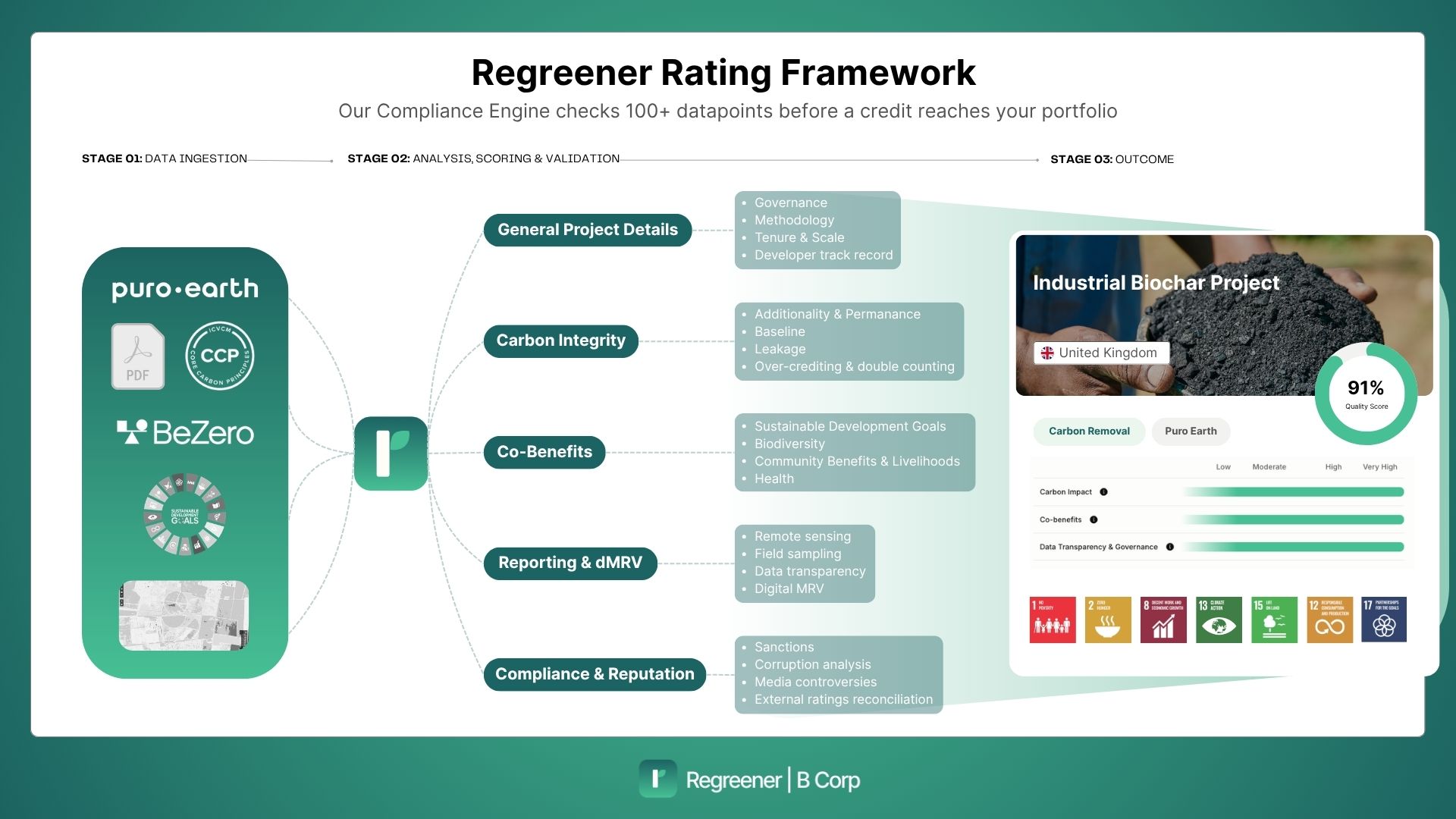
The reassuring news for buyers who already care about quality is that V2.0 rewards exactly the diligence good buyers were already doing. To support recognition or to neutralize emissions, a credit has to clear SBTi's integrity bar plus recognized third-party criteria. In practice that means proven additionality (the climate benefit would not have happened anyway), conservative measurement and verification, accounting for leakage so the net result is real, and serialized, registry-tracked units that prevent the same tonne being counted twice. Verified outcomes also have to be measured after the fact and independently assured.
These are the same fundamentals Regreener applies through its own project rating work, so V2.0 effectively confirms that high-quality procurement and a credible SBTi position are the same thing.
What else is new in V2.0 (beyond credits)
V2.0 is a full update to the standard, and several changes outside the offsetting rules make it more practical to commit to. The ones most worth knowing if you are coming to this fresh:
Two company categories. Companies are split into Category A (large companies everywhere, plus medium companies in high-income countries) and Category B (smaller companies, and medium companies in lower-income countries). Category B gets lighter requirements, for example scope 3 targets, transition plan disclosure, and base-year assurance are optional, which lowers the barrier for smaller firms to take part.
A living base year. Rather than measuring progress against a fixed historical year, V2.0 sets targets from a current "target base year" using the latest data, so commitments stay aligned with net-zero as time passes. Category A companies need at least limited assurance of that base-year data.
Transition plans and senior sign-off. Every company needs a transition plan that shows how it will hit its targets and its high-level path to net-zero, and the highest level of governance has to sign off on the targets. Category A companies disclose the plan when targets are validated, with up to 15 months of flexibility.
More realistic scope 1 options. Companies can pick an absolute reduction, a sector-specific emissions-intensity pathway (useful for steel, cement, or chemicals), or an "asset transition" route for businesses whose equipment turns over slowly. All routes still aim for net-zero by 2050 or sooner.
A broader, clearer scope 2. Low-carbon electricity now explicitly includes renewables, nuclear, and generation fitted with carbon capture. Companies can use power purchase agreements and certificates within defined conditions, and large electricity users now report how much of their consumption is matched to low-carbon power on an hourly basis, with recognition available for leaders.
Flexible scope 3. Companies can make limited, justified exclusions to focus on their most material emissions, and choose between overarching reduction targets, supplier and customer alignment targets, or category-specific targets. For smaller companies, scope 3 targets are optional.
A best-efforts progress model. Targets are pursued on a best-efforts basis. A company that falls short in one cycle faces steeper reductions in the next rather than being pushed out of the framework, so companies acting in good faith stay in the system. This is one of the most reassuring shifts in the whole standard.
Taken together, these changes make V2.0 easier to commit to and easier to stay aligned with, which is a large part of why the market finally has a sense of direction.
What this means for your strategy
The opportunity in V2.0 is that it turns a foggy obligation into a clear plan. There are two distinct demand signals, and they call for slightly different buying. The recognition stage rewards a broad mix of high-integrity credits, where reductions and removals both qualify and early action earns public credit. The 2035 and net-zero stages point firmly and predictably toward durable removals.
A company that understands this can build a portfolio in the right order: secure recognition now with strong, verified projects, while building a relationship with durable removal supply before demand intensifies across the market. Regreener structures client portfolios around exactly this sequence, matching each credit to the stage it is meant to serve, so a buyer's spending today still works for them in 2035 and at net-zero.