
have us call you right now.
Fruit tree planting with farmers in India
Fruit tree planting with farmers in India
" width="512px"><path d="M 0 512 L 0 0 L 512 0 L 512 512 Z" fill="transparent" height="512px" id="SxNlF9mo4" width="512px"/><path d="M 256 512 C 397.385 512 512 397.385 512 256 C 512 114.615 397.385 0 256 0 C 114.615 0 0 114.615 0 256 C 0 397.385 114.615 512 256 512 Z" fill="rgb(240, 240, 240)" height="512px" id="WAKAWwm5J" width="512px"/><path d="M 230.6 0 C 129.1 0 41.4 59.1 0 144.7 L 461.2 144.7 C 419.8 59.1 332.1 0 230.6 0 Z" fill="rgb(255, 152, 17)" height="144.7px" id="vZ_yWx0g1" transform="translate(25.4 0)" width="461.2001px"/><path d="M 230.6 144.7 C 332.1 144.7 419.8 85.6 461.2 0 L 0 0 C 41.4 85.6 129.1 144.7 230.6 144.7 Z" fill="rgb(109, 165, 68)" height="144.7px" id="AQaNyeYLw" transform="translate(25.4 367.3)" width="461.2001px"/><g d="M 60 120 C 26.915 120 0 93.085 0 60 C 0 26.915 26.915 0 60 0 C 93.085 0 120 26.915 120 60 C 120 93.085 93.085 120 60 120 Z M 60 11.162 C 33.068 11.162 11.162 33.068 11.162 60 C 11.162 86.932 33.068 108.838 60 108.838 C 86.932 108.838 108.838 86.932 108.838 60 C 108.838 33.068 86.932 11.162 60 11.162 Z M 53.198 60 C 53.198 56.243 56.243 53.198 60 53.198 C 63.757 53.198 66.802 56.243 66.802 60 C 66.802 63.757 63.757 66.802 60 66.802 C 56.243 66.802 53.198 63.757 53.198 60 Z M 60 61.02 L 42.714 62.766 L 5.582 61.02 L 5.582 58.98 L 42.714 57.234 L 60 58.98 Z M 60 61.02 L 77.286 62.766 L 114.418 61.02 L 114.418 58.98 L 77.286 57.234 L 60 58.98 Z M 58.98 60 L 57.234 42.714 L 58.98 5.582 L 61.02 5.582 L 62.766 42.714 L 61.02 60 Z M 58.98 60 L 57.234 77.286 L 58.98 114.418 L 61.02 114.418 L 62.766 77.286 L 61.02 60 Z M 59.279 60.721 L 45.822 49.733 L 20.799 22.242 L 22.242 20.799 L 49.733 45.822 L 60.721 59.279 Z M 59.279 60.721 L 70.267 74.178 L 97.758 99.201 L 99.201 97.758 L 74.178 70.267 L 60.721 59.279 Z M 59.279 59.279 L 70.267 45.822 L 97.758 20.799 L 99.201 22.242 L 74.178 49.733 L 60.721 60.721 Z M 59.279 59.279 L 45.822 70.267 L 20.799 97.758 L 22.242 99.201 L 49.733 74.178 L 60.721 60.721 Z M 60.391 60.943 L 45.087 69.17 L 10.115 81.768 L 9.334 79.882 L 42.972 64.06 L 59.609 59.057 Z M 60.391 60.943 L 77.028 55.94 L 110.666 40.118 L 109.885 38.232 L 74.913 50.83 L 59.609 59.057 Z M 59.057 60.391 L 50.83 45.087 L 38.232 10.115 L 40.118 9.334 L 55.94 42.972 L 60.943 59.609 Z M 59.057 60.391 L 64.06 77.028 L 79.882 110.666 L 81.768 109.885 L 69.17 74.913 L 60.943 59.609 Z M 59.609 60.943 L 42.972 55.94 L 9.334 40.118 L 10.115 38.232 L 45.087 50.83 L 60.391 59.057 Z M 59.609 60.943 L 74.913 69.17 L 109.885 81.768 L 110.666 79.882 L 77.028 64.06 L 60.391 59.057 Z M 59.057 59.609 L 64.06 42.972 L 79.882 9.334 L 81.768 10.115 L 69.17 45.087 L 60.943 60.391 Z M 59.057 59.609 L 50.83 74.913 L 38.232 109.885 L 40.118 110.666 L 55.94 77.028 L 60.943 60.391 Z" fill="transparent" height="120px" id="QRBkO7KT8" transform="translate(196.552 196.277)" width="120px"><path d="M 60 120 C 26.915 120 0 93.085 0 60 C 0 26.915 26.915 0 60 0 C 93.085 0 120 26.915 120 60 C 120 93.085 93.085 120 60 120 Z M 60 11.162 C 33.068 11.162 11.162 33.068 11.162 60 C 11.162 86.932 33.068 108.838 60 108.838 C 86.932 108.838 108.838 86.932 108.838 60 C 108.838 33.068 86.932 11.162 60 11.162 Z" fill="rgb(65, 71, 155)" height="120px" id="ihBMUHirq" width="120px"/><path d="M 0 6.802 C 0 3.045 3.045 0 6.802 0 C 10.559 0 13.604 3.045 13.604 6.802 C 13.604 10.559 10.559 13.604 6.802 13.604 C 3.045 13.604 0 10.559 0 6.802 Z" fill="rgb(65, 71, 155)" height="13.603945371778536px" id="WFA1iwJTX" transform="translate(53.198 53.198)" width="13.60394537177558px"/><path d="M 54.418 3.786 L 37.132 5.531 L 0 3.786 L 0 1.745 L 37.132 0 L 54.418 1.745 Z" fill="rgb(65, 71, 155)" height="5.531107738999708px" id="xKHxByFLw" transform="translate(5.582 57.234)" width="54.41831057157333px"/><path d="M 0 3.786 L 17.286 5.531 L 54.418 3.786 L 54.418 1.745 L 17.286 0 L 0 1.745 Z" fill="rgb(65, 71, 155)" height="5.531107738999708px" id="zbtbZusBP" transform="translate(60 57.234)" width="54.41831057157333px"/><path d="M 1.745 54.418 L 0 37.132 L 1.745 0 L 3.786 0 L 5.531 37.132 L 3.786 54.418 Z" fill="rgb(65, 71, 155)" height="54.41831057157469px" id="N7vzHIHuB" transform="translate(57.234 5.582)" width="5.531107738998571px"/><path d="M 1.745 0 L 0 17.286 L 1.745 54.418 L 3.786 54.418 L 5.531 17.286 L 3.786 0 Z" fill="rgb(65, 71, 155)" height="54.418310571571055px" id="BbIDJpPiN" transform="translate(57.234 60)" width="5.531107738998571px"/><path d="M 38.48 39.922 L 25.023 28.934 L 0 1.443 L 1.443 0 L 28.934 25.023 L 39.922 38.48 Z" fill="rgb(65, 71, 155)" height="39.92159838138468px" id="xNDMzhSCo" transform="translate(20.799 20.799)" width="39.92159838138582px"/><path d="M 0 1.442 L 10.988 14.899 L 38.479 39.922 L 39.922 38.479 L 14.899 10.988 L 1.442 0 Z" fill="rgb(65, 71, 155)" height="39.92159838138468px" id="yzi8uZJsy" transform="translate(59.279 59.279)" width="39.92159838138582px"/><path d="M 0 38.48 L 10.988 25.023 L 38.479 0 L 39.922 1.443 L 14.899 28.934 L 1.442 39.922 Z" fill="rgb(65, 71, 155)" height="39.92159838138468px" id="d9MbbEJO9" transform="translate(59.279 20.799)" width="39.92159838138582px"/><path d="M 38.48 0 L 25.023 10.988 L 0 38.479 L 1.443 39.922 L 28.934 14.899 L 39.922 1.442 Z" fill="rgb(65, 71, 155)" height="39.92159838138468px" id="M6tbeyobo" transform="translate(20.799 59.279)" width="39.92159838138582px"/><path d="M 51.057 1.887 L 35.754 10.114 L 0.781 22.711 L 0 20.826 L 33.638 5.004 L 50.276 0 Z" fill="rgb(65, 71, 155)" height="22.711178553363425px" id="kMHNqSi4h" transform="translate(9.334 59.057)" width="51.05715730905422px"/><path d="M 0.781 22.711 L 17.419 17.707 L 51.057 1.885 L 50.276 0 L 15.303 12.597 L 0 20.824 Z" fill="rgb(65, 71, 155)" height="22.711178553363425px" id="wsMNwP8ch" transform="translate(59.609 38.232)" width="51.05715730905399px"/><path d="M 20.824 51.057 L 12.597 35.754 L 0 0.781 L 1.885 0 L 17.707 33.638 L 22.711 50.276 Z" fill="rgb(65, 71, 155)" height="51.057157309052855px" id="FGVgC7XNn" transform="translate(38.232 9.334)" width="22.711178553363652px"/><path d="M 0 0.781 L 5.004 17.419 L 20.826 51.057 L 22.711 50.276 L 10.114 15.303 L 1.887 0 Z" fill="rgb(65, 71, 155)" height="51.05715730905649px" id="WbtW4lDhA" transform="translate(59.057 59.609)" width="22.711178553363652px"/><path d="M 50.276 22.711 L 33.638 17.707 L 0 1.885 L 0.781 0 L 35.754 12.597 L 51.057 20.824 Z" fill="rgb(65, 71, 155)" height="22.711178553363425px" id="mJOk1LLzD" transform="translate(9.334 38.232)" width="51.05715730905422px"/><path d="M 0 1.887 L 15.303 10.114 L 50.276 22.711 L 51.057 20.826 L 17.419 5.004 L 0.781 0 Z" fill="rgb(65, 71, 155)" height="22.711178553363425px" id="u8LZyO7a_" transform="translate(59.609 59.057)" width="51.05715730905399px"/><path d="M 0 50.276 L 5.004 33.638 L 20.826 0 L 22.711 0.781 L 10.114 35.754 L 1.887 51.057 Z" fill="rgb(65, 71, 155)" height="51.057157309052855px" id="tO9qksL3n" transform="translate(59.057 9.334)" width="22.711178553363652px"/><path d="M 20.824 0 L 12.597 15.303 L 0 50.276 L 1.885 51.057 L 17.707 17.419 L 22.711 0.781 Z" fill="rgb(65, 71, 155)" height="51.05715730905649px" id="lMVdJkc26" transform="translate(38.232 59.609)" width="22.711178553363652px"/></g></g></svg>)
East Medinipur, West Bengal, India
East Medinipur, West Bengal, India
Buyer Protection

50,356
trees planted to date

2 million
fruit trees targeted

56,000+
households to be reached

11
native fruit-bearing species
Why this project?
Roughly 40% of rural India's population cannot afford two basic vegetarian meals a day. In West Bengal, where most households depend on smallholder farming, that gap between what the land yields and what a family needs shows up every season — in what ends up on the plate, and in what has to be bought at market instead.
This project takes a different route to closing it. Rather than working on communal plots or open fields, it plants native and domesticated fruit trees inside homestead gardens: land that participating families already own, already tend, and already protect. Working with over 56,000 rural households, the ambition is 2 million fruit-bearing trees. The logic is simple — a mango or jackfruit tree in your own garden is a food source, a small income stream, and a piece of canopy at the same time. Published research on agroforestry in India consistently finds the same pattern: integrating trees with food crops reduces household vulnerability by delivering both subsistence and cash returns, while strengthening food security. Done properly, it does not just restore land. It changes the economics of a household.
Section heading: Trees inside the garden gate
Before a single sapling goes into the ground, the work starts with people. Field teams run social surveys with participating households using the veritree app, and community meetings identify interested families and provide training in low-cost, scientifically grounded agroforestry practice. Local botanists and GIS specialists support the process from the outset, and community members build skills in grafting, nursery management and planting that outlast the planting season itself.
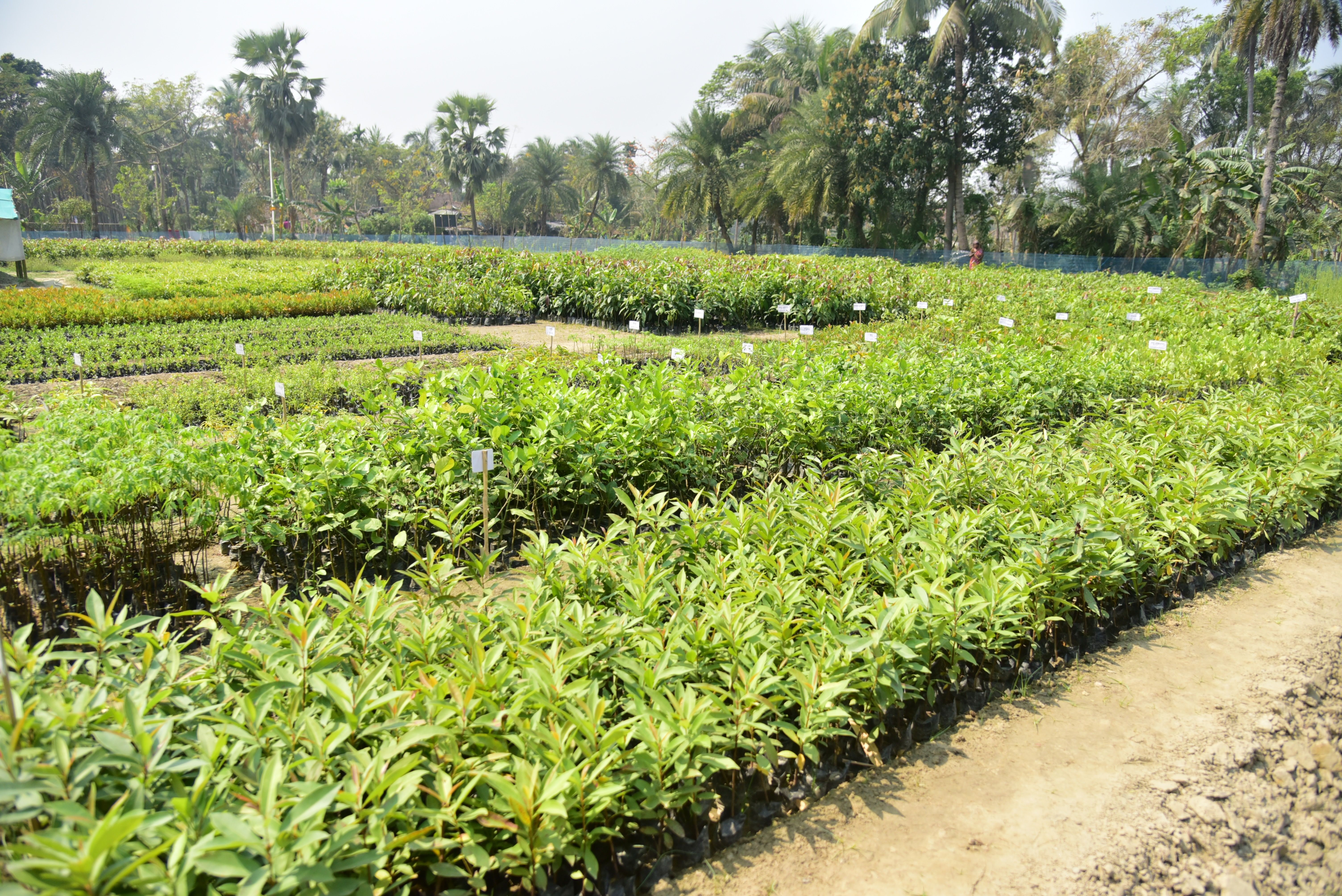
Between January and March 2026, the project completed two planting phases across East Medinipur, averaging 49 trees per participating household. Every sapling was registered and verified. The species mix is deliberately local: jackfruit, mango, guava, pomegranate, lemon, wood-apple, stone-apple, elephant apple, Indian olive, Indian blackberry (jamun) and sugar palm, each selected for native character and suitability to local soil. Because many gardens already held established trees, soil conditions were moderate to good at most sites. Planting inside household gardens also solves two problems that dog open-field restoration: the trees get natural boundary fencing, and they get the daily attention of the family living beside them. Early root and shoot development indicates the saplings are establishing well.
Section heading: What the farmers get out of it
The case for this project is best made by the people planting the trees. Kajol Mondal, a farmer in Uttar Pukuria village, received 39 saplings and now tends them with her family: "I believe my family will not have to buy fruits from the market, as we will get them from our garden itself. Family members, especially the children, will be able to consume good-quality and naturally grown produce, which will save us a sufficient amount of money that we can use for the children's education." She also sees the growing canopy as habitat for birds and other species she says have become increasingly rare locally.
Mihir Nayek, a smallholder in Sukunia village, planted 71 saplings in the open space around his homestead. "The empty space in our garden is now becoming something useful for our family," he says. "In the coming years, these trees will provide fruits, shade, and a greener environment around our home. I feel happy knowing that what we plant today will benefit both our children and our land in the future." Both accounts point at the same thing: a household asset that compounds. Fruit that does not have to be bought frees up cash for school fees. Shade and canopy make the plot more liveable as temperatures climb. And because the tree sits in the family's own garden, the incentive to keep it alive does not depend on a payment schedule.
Why this project?
Roughly 40% of rural India's population cannot afford two basic vegetarian meals a day. In West Bengal, where most households depend on smallholder farming, that gap between what the land yields and what a family needs shows up every season — in what ends up on the plate, and in what has to be bought at market instead.
This project takes a different route to closing it. Rather than working on communal plots or open fields, it plants native and domesticated fruit trees inside homestead gardens: land that participating families already own, already tend, and already protect. Working with over 56,000 rural households, the ambition is 2 million fruit-bearing trees. The logic is simple — a mango or jackfruit tree in your own garden is a food source, a small income stream, and a piece of canopy at the same time. Published research on agroforestry in India consistently finds the same pattern: integrating trees with food crops reduces household vulnerability by delivering both subsistence and cash returns, while strengthening food security. Done properly, it does not just restore land. It changes the economics of a household.
Section heading: Trees inside the garden gate
Before a single sapling goes into the ground, the work starts with people. Field teams run social surveys with participating households using the veritree app, and community meetings identify interested families and provide training in low-cost, scientifically grounded agroforestry practice. Local botanists and GIS specialists support the process from the outset, and community members build skills in grafting, nursery management and planting that outlast the planting season itself.
Between January and March 2026, the project completed two planting phases across East Medinipur, averaging 49 trees per participating household. Every sapling was registered and verified. The species mix is deliberately local: jackfruit, mango, guava, pomegranate, lemon, wood-apple, stone-apple, elephant apple, Indian olive, Indian blackberry (jamun) and sugar palm, each selected for native character and suitability to local soil. Because many gardens already held established trees, soil conditions were moderate to good at most sites. Planting inside household gardens also solves two problems that dog open-field restoration: the trees get natural boundary fencing, and they get the daily attention of the family living beside them. Early root and shoot development indicates the saplings are establishing well.
Section heading: What the farmers get out of it
The case for this project is best made by the people planting the trees. Kajol Mondal, a farmer in Uttar Pukuria village, received 39 saplings and now tends them with her family: "I believe my family will not have to buy fruits from the market, as we will get them from our garden itself. Family members, especially the children, will be able to consume good-quality and naturally grown produce, which will save us a sufficient amount of money that we can use for the children's education." She also sees the growing canopy as habitat for birds and other species she says have become increasingly rare locally.
Mihir Nayek, a smallholder in Sukunia village, planted 71 saplings in the open space around his homestead. "The empty space in our garden is now becoming something useful for our family," he says. "In the coming years, these trees will provide fruits, shade, and a greener environment around our home. I feel happy knowing that what we plant today will benefit both our children and our land in the future." Both accounts point at the same thing: a household asset that compounds. Fruit that does not have to be bought frees up cash for school fees. Shade and canopy make the plot more liveable as temperatures climb. And because the tree sits in the family's own garden, the incentive to keep it alive does not depend on a payment schedule.
Why this project?
Roughly 40% of rural India's population cannot afford two basic vegetarian meals a day. In West Bengal, where most households depend on smallholder farming, that gap between what the land yields and what a family needs shows up every season — in what ends up on the plate, and in what has to be bought at market instead.
This project takes a different route to closing it. Rather than working on communal plots or open fields, it plants native and domesticated fruit trees inside homestead gardens: land that participating families already own, already tend, and already protect. Working with over 56,000 rural households, the ambition is 2 million fruit-bearing trees. The logic is simple — a mango or jackfruit tree in your own garden is a food source, a small income stream, and a piece of canopy at the same time. Published research on agroforestry in India consistently finds the same pattern: integrating trees with food crops reduces household vulnerability by delivering both subsistence and cash returns, while strengthening food security. Done properly, it does not just restore land. It changes the economics of a household.
Section heading: Trees inside the garden gate
Before a single sapling goes into the ground, the work starts with people. Field teams run social surveys with participating households using the veritree app, and community meetings identify interested families and provide training in low-cost, scientifically grounded agroforestry practice. Local botanists and GIS specialists support the process from the outset, and community members build skills in grafting, nursery management and planting that outlast the planting season itself.
Between January and March 2026, the project completed two planting phases across East Medinipur, averaging 49 trees per participating household. Every sapling was registered and verified. The species mix is deliberately local: jackfruit, mango, guava, pomegranate, lemon, wood-apple, stone-apple, elephant apple, Indian olive, Indian blackberry (jamun) and sugar palm, each selected for native character and suitability to local soil. Because many gardens already held established trees, soil conditions were moderate to good at most sites. Planting inside household gardens also solves two problems that dog open-field restoration: the trees get natural boundary fencing, and they get the daily attention of the family living beside them. Early root and shoot development indicates the saplings are establishing well.
Section heading: What the farmers get out of it
The case for this project is best made by the people planting the trees. Kajol Mondal, a farmer in Uttar Pukuria village, received 39 saplings and now tends them with her family: "I believe my family will not have to buy fruits from the market, as we will get them from our garden itself. Family members, especially the children, will be able to consume good-quality and naturally grown produce, which will save us a sufficient amount of money that we can use for the children's education." She also sees the growing canopy as habitat for birds and other species she says have become increasingly rare locally.
Mihir Nayek, a smallholder in Sukunia village, planted 71 saplings in the open space around his homestead. "The empty space in our garden is now becoming something useful for our family," he says. "In the coming years, these trees will provide fruits, shade, and a greener environment around our home. I feel happy knowing that what we plant today will benefit both our children and our land in the future." Both accounts point at the same thing: a household asset that compounds. Fruit that does not have to be bought frees up cash for school fees. Shade and canopy make the plot more liveable as temperatures climb. And because the tree sits in the family's own garden, the incentive to keep it alive does not depend on a payment schedule.
Project Partner

This project is delivered by veritree, a restoration-technology and project-delivery company and a Certified B Corporation. veritree registers and verifies plantings at the individual tree level through its own field app and monitoring platform, with field teams collecting planting and household data on site. Rather than relying on a carbon registry, verification here rests on traceable planting records, geolocated sites and ongoing survival monitoring — which is what makes household-scale agroforestry auditable in the first place.
Gallery




Gallery
Location
East Medinipur, West Bengal, India
East Medinipur, West Bengal, India
United Nations' Sustainable Development Goals

Fruit harvests from homestead gardens reduce household spending on food and create a new small income stream for smallholder families.

Native fruit-bearing trees planted in family gardens improve dietary diversity and year-round access to nutritious produce.

Women farmers participate directly as landholders and tree stewards, with training delivered at household level.

Community members are trained and employed in grafting, nursery management and planting, building transferable skills locally.

Locally grown fruit replaces market-bought produce, shortening supply chains at household level.

Tree cover in homestead gardens sequesters carbon and delivers a localised cooling effect, improving household resilience to heat.

Planting native species restores degraded homestead land, improves soil health and provides habitat for birds and pollinators.
United Nations' Sustainable Development Goals
Fruit harvests from homestead gardens reduce household spending on food and create a new small income stream for smallholder families.
Native fruit-bearing trees planted in family gardens improve dietary diversity and year-round access to nutritious produce.
Women farmers participate directly as landholders and tree stewards, with training delivered at household level.
Community members are trained and employed in grafting, nursery management and planting, building transferable skills locally.
Locally grown fruit replaces market-bought produce, shortening supply chains at household level.
Tree cover in homestead gardens sequesters carbon and delivers a localised cooling effect, improving household resilience to heat.
Planting native species restores degraded homestead land, improves soil health and provides habitat for birds and pollinators.

Start supporting this high-quality project


Enter your details and out team will reach out about next steps.
Start supporting this high-quality project
Enter your details and out team will reach out about next steps.