In 2026, picking a carbon credit platform is a procurement decision with reputational consequences. Pick wrong and you fund credits that BeZero or Sylvera rate as junk, and you explain it to your auditor next year under CSRD disclosure requirements. Pick well and you lock in supply of high-integrity tonnes before the rest of the market catches up to a market where retirements fell 7% in 2025 even as corporate climate commitments surged 227% (Carbon Direct, 2026).
The five platforms below are the ones worth your shortlist. They are ranked on what actually matters in 2026: project quality, transparency on pricing and methodology, the buying process itself, and fit for European B2B buyers under the new Green Claims Directive and SBTi’s revised carbon credit guidance.
What types of carbon credit platforms exist in 2026?
Not every “carbon credit platform” does the same thing, and conflating them is the most common mistake in procurement. Buyers in 2026 generally choose between five distinct platform types:
Curated providers select a small portfolio of high-integrity projects and act as an extension of your sustainability team. Regreener.earth, Earthly, Senken and Goodcarbon fall here. Best when you want a quality filter and hands-on advisory.
Enterprise procurement platforms centralise sourcing, due diligence, contracting and reporting across a much wider universe of projects. Patch is the clearest example, with 25,000+ projects integrated into one workflow. Our free tool lets you draft a carbon credit RFP with scoring criteria.
API-first marketplaces plug directly into your e-commerce, payment, or supply chain systems for automated, transactional offsetting. Cloverly is the most established option here.
Science-led advisory and removals specialists combine consulting, project diligence, and forward offtake for durable carbon removal. Carbon Direct (post-Pachama acquisition) is the leading firm, alongside ClimatePartner and South Pole at larger scale.
Voluntary market exchanges provide liquidity, price discovery and standardised contracts for traders and large corporate buyers. Xpansiv (CBL), CME Group and Climate Impact X (CIX) operate here.
The right choice depends on your volume, your internal capacity, your reporting context, and how much you want to delegate. We expand on this in the Quality Framework for carbon credits.
What to look for in a carbon credit platform in 2026
To avoid reputational risk and maximise impact, prioritise these criteria:
Verification and independent ratings
Third-party verification is the floor, not the ceiling. Look for platforms that work with Verra (VCS), Gold Standard, Puro.earth or the Integrity Council for the Voluntary Carbon Market (ICVCM) and the Core Carbon Principles. But registry verification alone is no longer enough. According to Patch’s 2025 State of the Voluntary Carbon Market report, 79% of corporate buyers now require BeZero BBB or higher, and 83% require Sylvera Tier 2 or higher, before purchasing. Independent ratings from BeZero, Sylvera and Calyx Global are now the dominant quality filter.
Project quality and diversity
Your portfolio should align with your sustainability strategy. Whether you need nature-based solutions like reforestation and mangroves, or tech-based removals like direct air capture and biochar, the best platforms offer a curated selection rather than the full registry firehose. See our guide on project types for a deeper breakdown.
Pricing transparency
Hidden fees and intermediary margins erode trust. Transparent pricing, whether fixed, auction-based or custom-quoted, should be non-negotiable. Ask any platform for a margin breakdown between project cost, intermediary fee and retirement cost. Refusal is a red flag.
Compliance and reporting readiness
If you are subject to CBAM, CSRD, CDP or Science Based Targets initiative (SBTi) commitments, your platform must support compliance-grade credits with audit-ready documentation. Ask for sample retirement statements before contracting.
Strategic and procurement support
Beyond transactions, the best platforms provide expert guidance, from portfolio design to ESG integration. Regreener’s five years of operating experience, B Corp certification, and direct relationships with project developers enable us to act as a procurement extension of your team.
The 5 Best Carbon Credit Platforms of 2026
1. Regreener.earth
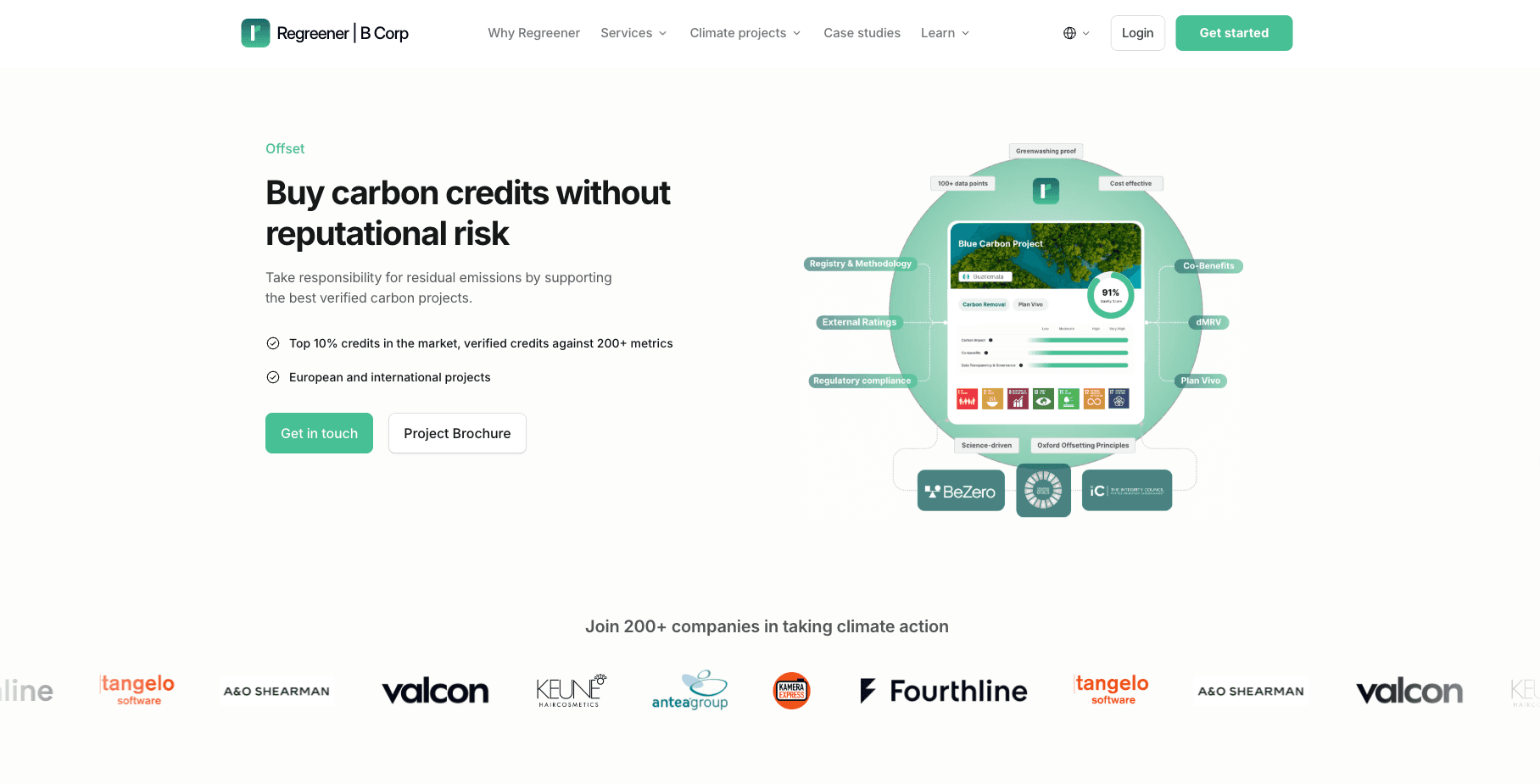
Regreener.earth is a B Corp-certified, Netherlands-based curated provider built for European B2B buyers that demand high-integrity credits without the cost or complexity of a full in-house procurement team. Our platform combines a proprietary data-driven vetting model, direct project developer relationships, and customised procurement strategy.
Key features:
Proprietary 200+ data-point analysis model screening for the top 10% of carbon credits.
Diverse portfolio across nature-based, hybrid and engineered removal projects.
Direct access to project developers for full traceability and impact reporting.
Tailored strategies covering both voluntary commitments (SBTi, BVCM) and compliance-grade reporting (CSRD, CDP).
B Corp certified; Netherlands-headquartered with European tax and reporting expertise.
Pros:
Independent quality filter aligned with BeZero, Sylvera and ICVCM CCP standards.
Acts as an extension of your procurement team rather than a self-serve marketplace.
Custom solutions sized for portfolios from 500 to 100,000+ tonnes.
Cons:
Quality-first focus means we are not a bulk commodity marketplace.
Custom pricing requires an initial consultation rather than instant checkout.
Best for: European B2B buyers who want a curated, science-backed filter on the broader market and prefer to delegate project selection to a specialist.
Named clients: Capital A (AirAsia parent), TCX Fund, SparkOptimus, plus a portfolio of mid-market European companies across logistics, technology, professional services and consumer goods.
Pricing: Custom-quoted based on project type, vintage, volume and reporting requirements. Request a tailored carbon credit shortlist.
2. Patch
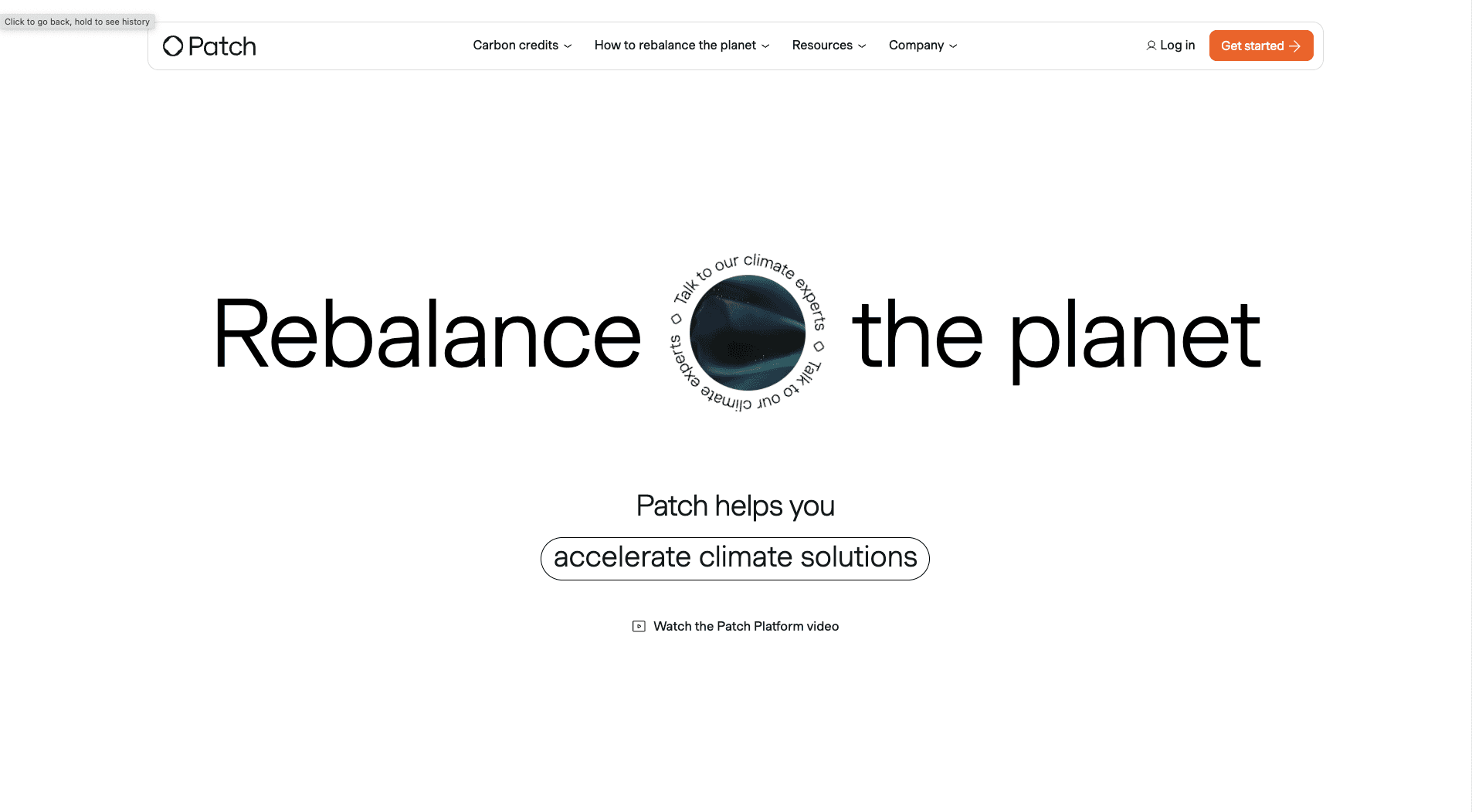
Patch repositioned dramatically in April 2025 from an SME-focused offsetting tool into an enterprise procurement platform aimed at Chief Sustainability Officers and corporate sustainability teams. The platform now centralises a database of more than 25,000 projects (covering 100% of ICROA-endorsed registries), AI-driven shortlisting, multi-year offtake contracts, and an in-house climate strategy advisory layer.
Key features:
Centralised project database with 25,000+ projects across all major registries.
AI-powered integrity heuristic and issuance/activity signals to filter shortlists.
Patch Climate Strategy and Solutions (CSS) team for hands-on portfolio design.
Multi-year offtake products and credit-swap default protection.
CarbonOS supplier-side software for project developers.
Pros:
Best-in-class breadth of project visibility across the voluntary carbon market.
Strong process discipline and audit-ready procurement documentation.
Suitable for both spot purchases and long-horizon offtake commitments.
Cons:
Software-first model means less hands-on guidance than a curated provider for first-time buyers.
Pricing not publicly disclosed; enterprise contracting required.
Best for: Mid-market and enterprise companies with internal sustainability capacity who want one operating system for their entire carbon credit programme.
Named clients: Maple Leaf Foods, IFS, Bain & Company, Docusign, Etsy, Nokia (per Patch’s own published guides and press materials).
Pricing: Enterprise contracts; not publicly disclosed. Patch’s repositioning means the older “$50/month subscription” pricing referenced in older comparisons is no longer accurate.
3. Cloverly
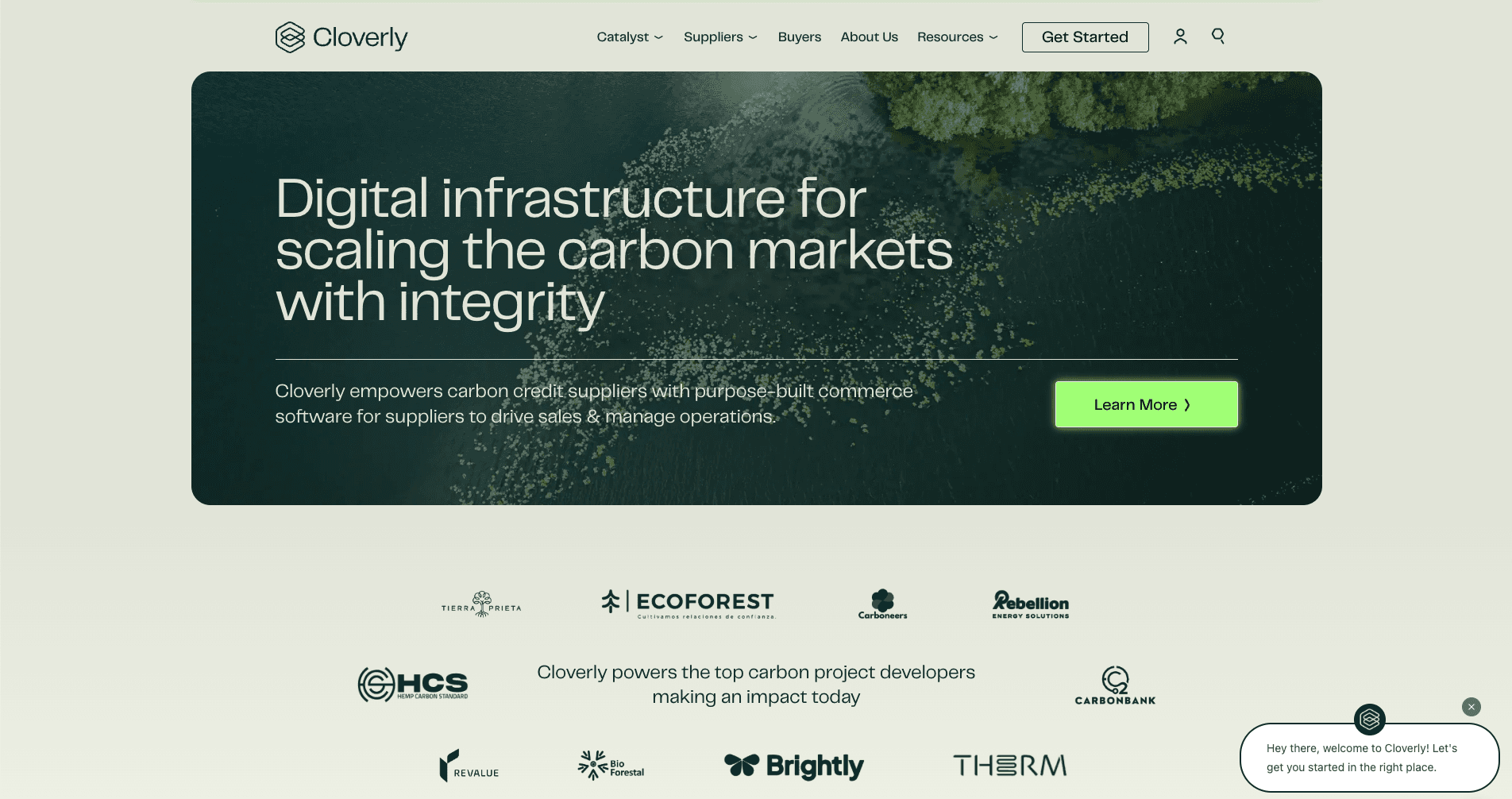
Cloverly is one of the longest-running API-first carbon credit platforms, founded in 2019 and now operating with a dual buyer-and-supplier model. The buyer-side marketplace remains active and is widely used by financial services, e-commerce and travel companies. The bigger story in 2025-2026 is Catalyst, Cloverly’s commercial software for project developers to manage inventory, sales pipelines, and distribution.
Key features:
API integrations for automated, transaction-level offsetting.
Marketplace of carbon removals and reductions vetted by in-house climate scientists.
Catalyst supplier software with proposal builder, branded portals and multi-channel distribution.
Insurance partnership with Oka for credit-default protection.
Pros:
Mature API and integration tooling for embedded climate features.
Genuine focus on infrastructure that scales the carbon market on both sides.
Established enterprise partnerships in financial services.
Cons:
Less focused on bespoke advisory or large-volume offtake than curated providers.
Buyer-side experience overshadowed in 2025-2026 by their supplier-software focus.
Best for: Companies wanting to embed carbon credit purchases into their own products, payments or supply chains, and project developers needing distribution software.
Named clients: Visa, Salesforce, American Express, plus 200+ enterprise customers.
Pricing: Pay-as-you-go through the marketplace; project-dependent per-tonne pricing. Catalyst pricing is by enterprise contract.
4. CarbonDirect
Carbon Direct is a science-led carbon management firm with a team of 70+ scientists, providing measurement, reduction, and high-integrity removal procurement. In November 2025, Carbon Direct acquired Pachama, the AI-powered forest carbon platform, significantly broadening their nature-based portfolio alongside their existing strength in engineered removals like direct air capture and biomass carbon removal and storage (BiCRS).
Key features:
1.6 million tonnes of vetted, high-quality carbon removal credits (per Carbon Direct, 2025).
Multi-year offtake contracts with delivery and substitution protections.
Carbon Portfolio Manager software for tracking project performance.
Post-Pachama acquisition: AI-driven forest carbon monitoring at scale.
Integrated science, policy and procurement advisory.
Pros:
Deepest scientific bench of any platform in this comparison.
Strong on engineered, durable removals where permanence matters most.
Audit-ready documentation favoured by Fortune 500 sustainability teams.
Cons:
Premium pricing (typically $50-$200+ per tonne for engineered removals).
Best-fit for buyers with both budget and ambition for durable removal credits.
Best for: Large corporates with net-zero commitments who prioritise permanent carbon storage and want a scientifically defensible portfolio.
Named clients: JPMorgan Chase, plus Fortune 500 sustainability programmes.
Pricing: Enterprise contracts; pricing reflects the higher cost of engineered removals.
5. Xpansiv
Xpansiv operates the leading global exchange for voluntary market environmental commodities, including carbon credits, renewable energy certificates and water credits. Through its CBL spot exchange and CME Group-listed contracts, Xpansiv brings price transparency, liquidity and standardised trading to corporates, brokers and asset managers.
Key features:
CBL spot exchange for spot voluntary carbon credits.
Standardised CME Group contracts (GEO, N-GEO and others).
Advanced analytics and market data tools.
Connects with major compliance markets indirectly via partner exchanges.
Pros:
Unmatched liquidity and price transparency for actively traded credit categories.
Robust tooling for high-volume traders and brokers.
Standardised contracts reduce counterparty and quality dispersion within categories.
Cons:
Built for sophisticated buyers, traders and brokers; complex for first-time procurement teams.
Less personalised support than curated providers or advisory firms.
Compliance market access (EU ETS, California cap-and-trade) generally goes through ICE rather than Xpansiv directly.
Best for: Corporates with active trading desks, brokers, and asset managers active in the voluntary carbon market.
Pricing: Market-driven, varies by credit type and contract.
Comparison of the top carbon credit platforms in 2026
Platform | Project Types | Verification & Ratings | Pricing Model | Buyer Type | Best For |
|---|---|---|---|---|---|
Regreener.earth | Nature-based, hybrid, engineered | Verra, Gold Standard, Puro.earth, ONCRA; aligned with BeZero, Sylvera, ICVCM CCPs | Custom quoted | European mid-market and enterprise B2B | High-integrity portfolios with hands-on advisory |
Patch | Diverse (25,000+ projects) | Verra, Gold Standard, Puro, Isometric and others | Enterprise contracts | Mid-market and enterprise with internal teams | Software-led procurement at scale |
Cloverly | Diverse (Verra, Gold Standard, Puro) | Verra, Gold Standard, Puro.earth | Pay-as-you-go via API | Embedded climate-action use cases | Automated, integrated offsetting |
Carbon Direct | Hybrid and engineered (post-Pachama: also nature-based) | ICVCM, Puro.earth, Verra | Enterprise contracts | Fortune 500 with durable-removal targets | Science-led, premium-quality removals |
Xpansiv | Exchange-traded VCM categories | Multiple registries | Market-driven | Traders, brokers, large corporates | Liquidity, price discovery, standardised trading |
Free tool
Shortlisting platforms? Put the questions on paper first
Draft an RFP with the quality criteria and scoring matrix buyers use to compare platforms, brokers and developers side by side.
Free · no account needed

Platforms are one of several ways to buy. Our comparison of brokers, marketplaces and developers shows the fees and risks of each channel.
How to choose the right carbon credit platform for your business
Define your goals. Compliance reporting, voluntary commitments under SBTi, ESG ratings improvement, or marketing and stakeholder communication. Each goal points to a different platform type.
Assess your internal capacity. If you have a dedicated sustainability or procurement team, an enterprise procurement platform like Patch may suit. If you do not, a curated provider like Regreener will do more of the work for you.
Match project preferences to your strategy. Balance nature-based and engineered removal projects according to your industry, geography and timelines. The Oxford Offsetting Principles recommend a shift toward removals over time.
Demand pricing transparency. Ask for a margin breakdown between project cost, intermediary fee and retirement. Refusal to provide one is a red flag.
Check independent ratings. Ask which BeZero, Sylvera or Calyx ratings the platform has on the projects you would buy. Vague answers indicate they are not screening for ratings.
Request a tailored shortlist. Book a free consultation with Regreener to see a project shortlist sized to your goals and budget within 48 hours.
If you are still undecided between providers and platforms more broadly, see also our comparisons of the best carbon credit providers in 2026 and the best carbon credit traders in 2026.
Common pitfalls when buying carbon credits online
Even well-intentioned buyers make costly mistakes. Avoid the most common ones:
Buying on price alone. According to Sylvera’s 2026 market data, high-rated credits now command prices more than 300% above lower-rated equivalents within the same project category. A cheap tonne is usually cheap for a reason.
Trusting registry verification as a quality signal. Verra or Gold Standard verification is the floor, not the ceiling. Independent ratings from BeZero, Sylvera and Calyx Global are now the dominant filter for serious buyers.
Skipping additionality questions. Your credits should fund projects that would not have happened otherwise. Ask the platform to explain the additionality argument for any project you are about to buy.
Ignoring the contract. For multi-year offtake or large spot purchases, look for delivery protection, substitution clauses and counterparty obligations. Soft contracts are silent until something goes wrong.
Using the wrong platform type for your use case. Buying 50,000 tonnes a year through an API-first marketplace is operationally fine but rarely commercially optimal. Curated providers or enterprise procurement platforms are usually a better fit at that volume.
Next step, request a shortlist
The right carbon credit platform protects your reputation, future-proofs your CSRD and SBTi reporting, and maximises real-world climate impact per euro spent. Whether you prioritise transparency, durable removals, or operational scale, the five platforms above represent the strongest options for European B2B buyers in 2026.
If you want a curated shortlist tailored to your goals and budget, book a free consultation with Regreener’s carbon credit experts. We will send you a project shortlist scored across our five-domain quality framework within 48 hours.