
In 2025, companies signed roughly $12.25 billion in carbon offtake agreements, according to Sylvera. That is more than twelve times the value of credits retired on the spot market in the same year. The number is not just a procurement trend. It is the signal that the voluntary carbon market is growing up, and offtake agreements are the instrument doing the work.
This article is part of our complete guide to carbon offtake agreements.
For corporate buyers with net-zero commitments running into 2030 and beyond, understanding how these contracts function is no longer optional. High-integrity carbon removal credits are scarce, projects need long lead times, and the buyers who move early are locking in supply at today’s prices while everyone else competes for the leftovers.
What is a carbon offtake agreement?
A carbon offtake agreement is a long-term contract between a buyer (typically a corporate emitter) and a seller (typically a carbon project developer or broker) in which the buyer commits to purchase a defined volume of future carbon credits at an agreed price over multiple years. Contracts typically run between 5 and 15 years, cover both voluntary and compliance markets, and specify volume, pricing model, delivery schedule, and quality criteria. The buyer secures long-term supply and price certainty; the developer secures the revenue commitment needed to finance the project.
The structure borrows directly from the energy sector. If a power purchase agreement (PPA) is how a wind farm gets financed, a carbon offtake agreement is how a direct air capture facility, a reforestation project, or an enhanced rock weathering operation gets financed.
How a carbon offtake agreement works
The mechanics are straightforward in principle, complex in execution.
The parties. On one side, a buyer with emissions to compensate and a multi-year procurement need. On the other, a project developer (or sometimes an intermediary holding rights to a portfolio of projects) with future credit issuances to sell.
The term. Most carbon offtake agreements run 5 to 15 years. Some early-stage removal projects ask for longer commitments to underwrite the capital expenditure required to build the facility in the first place.
The pricing. Three main models are used. Fixed-price contracts lock in a per-credit price for the full term. Indexed contracts tie price to a benchmark (a market index or a specific basket). Escalator contracts apply an annual percentage increase, often used to hedge against expected price appreciation in high-integrity removals.
The delivery schedule. Credits are typically delivered annually or in defined tranches once they are verified and issued by the registry (Verra, Gold Standard, Puro.earth, Isometric, Woodland Carbon Code, and others). The buyer retires them in their own registry account to claim the climate impact and prevent double counting.
The payments. Upfront payments are common for early-stage projects that need development capital. More mature projects use milestone payments tied to verification events, or periodic payments on delivery.
Carbon offtake agreement vs spot market vs forward contract
Carbon offtake agreements sit alongside two other procurement routes in the voluntary carbon market. Each has a different risk and reward profile.
Feature | Spot purchase | Forward contract | Carbon offtake agreement |
|---|---|---|---|
Duration | Single transaction | Short to medium term (1-5 years) | Long term (5-15 years) |
Credit status | Already issued | Not yet issued | Not yet issued |
Price certainty | Market price at point of purchase | Locked at signing | Locked or formula-based for full term |
Supply security | Low, depends on availability | Medium | High |
Project influence | None | Limited | Significant |
Best for | Immediate compensation needs | Near-term procurement planning | Long-term net-zero strategy |
Spot purchases work for companies meeting an in-year claim with credits that have already been verified and issued. Forward contracts work for buyers who want a degree of price certainty over a defined window but are not ready to commit a decade ahead. Carbon offtake agreements work for buyers with a clear long-term decarbonisation strategy who need volume security and want a seat at the table on project quality.
Most serious corporate climate programmes use a combination of all three.
Free tool
Would an offtake pay off for your volumes?
Enter your emissions and targets and get a budget range for spot buying versus locking in prices with an offtake.
Free · no account needed

Key components of a carbon offtake agreement
A well-structured carbon offtake agreement covers six core elements.
Volume and delivery schedule. Annual volumes, total contract volume, and tranche timing.
Pricing mechanism. Fixed, indexed, or escalator, with clarity on what happens if the market moves significantly.
Quality criteria. The registry, methodology, and verification standard the credits must meet (Verra VCS, Gold Standard, Puro.earth, Isometric, Woodland Carbon Code, ACR, CAR). Increasingly, contracts also reference independent ratings such as BeZero, Sylvera, or Calyx.
Underdelivery and replacement clauses. What happens if the project issues fewer credits than projected. Replacement from a backup pool, financial compensation, or contract adjustment.
Termination and default provisions. Conditions under which either party can exit and the consequences.
Reversal and buffer obligations. Especially for nature-based projects, who bears the risk if sequestered carbon is released (fire, disease, land-use change), and how the contract handles buffer pool drawdowns.
Why carbon offtake agreements matter now
Three forces are pushing offtake activity into the mainstream.
Supply is tightening. High-integrity carbon removal projects (afforestation and reforestation, biochar, enhanced rock weathering, direct air capture) take years to develop and verify. The pipeline cannot scale fast enough to meet 2030 and 2035 corporate net-zero targets through spot purchases alone.
Prices are rising. Spot market averages for low-quality avoidance credits remain in single digits. High-quality removal credits already trade above $100 per tonne. By 2030, the gap will widen further. Locking in volume today, at today’s prices, is a financial hedge against tomorrow’s scarcity premium.
Quality is concentrating. The 2025 offtake market was dominated by durable removals. The weighted average price across offtake deals was approximately $160 per credit, compared to roughly $6 per credit on the spot market. This is not a small difference. It reflects that buyers signing long-term contracts are doing so for a specific quality tier the spot market cannot reliably supply.
How offtake agreements are scaling the voluntary carbon market
Carbon offtake agreements are not just a procurement tool. They are market infrastructure. They are doing for the voluntary carbon market what power purchase agreements did for renewables: turning a fragmented spot market into a financeable, long-term asset class.
They unlock project finance. Removal projects are capital-intensive and pre-revenue for years. Direct air capture facilities, biochar plants, and large-scale reforestation programmes cannot raise debt or equity without proof of future demand. A signed offtake at a credible price is what makes a project bankable. No offtake, no project.
They send a price signal the spot market cannot. The 2025 weighted average offtake price of around $160 per credit tells developers what high-integrity credits are actually worth to serious buyers. That signal gives them the confidence to invest in robust monitoring, longer permanence, and stronger co-benefits, rather than racing to issue the cheapest tonne possible.
They pull supply toward removals and durability. Most 2025 offtake volume went to durable carbon removal, not avoidance. Long-term contracts are directing capital toward the credit types the global carbon budget actually requires, not the credit types that are easiest to issue.
They build the buyer-developer relationship the market has been missing. Spot trades are anonymous. Offtakes are partnerships. Buyers get visibility into measurement, reporting, and verification (MRV), co-benefits, and project execution. Developers get a counterparty invested in their success. That relationship is what separates a mature commodity market from a transactional one.
Benefits for buyers and project developers
For buyers, the case is straightforward: supply security, price certainty, influence over project quality, and a defensible climate strategy that does not rely on a thin and volatile spot market.
For developers, the offtake is often the difference between a project existing and a project staying on a PowerPoint slide. It provides bankable revenue, reduces the cost of capital, and lets developers focus on delivery rather than constantly hunting for the next buyer.
Risks and how to mitigate them
Carbon offtake agreements are not without risk. Four risks dominate.
Underdelivery. The project produces fewer credits than contracted. Mitigated through conservative volume forecasting, replacement clauses, and portfolio diversification across multiple projects.
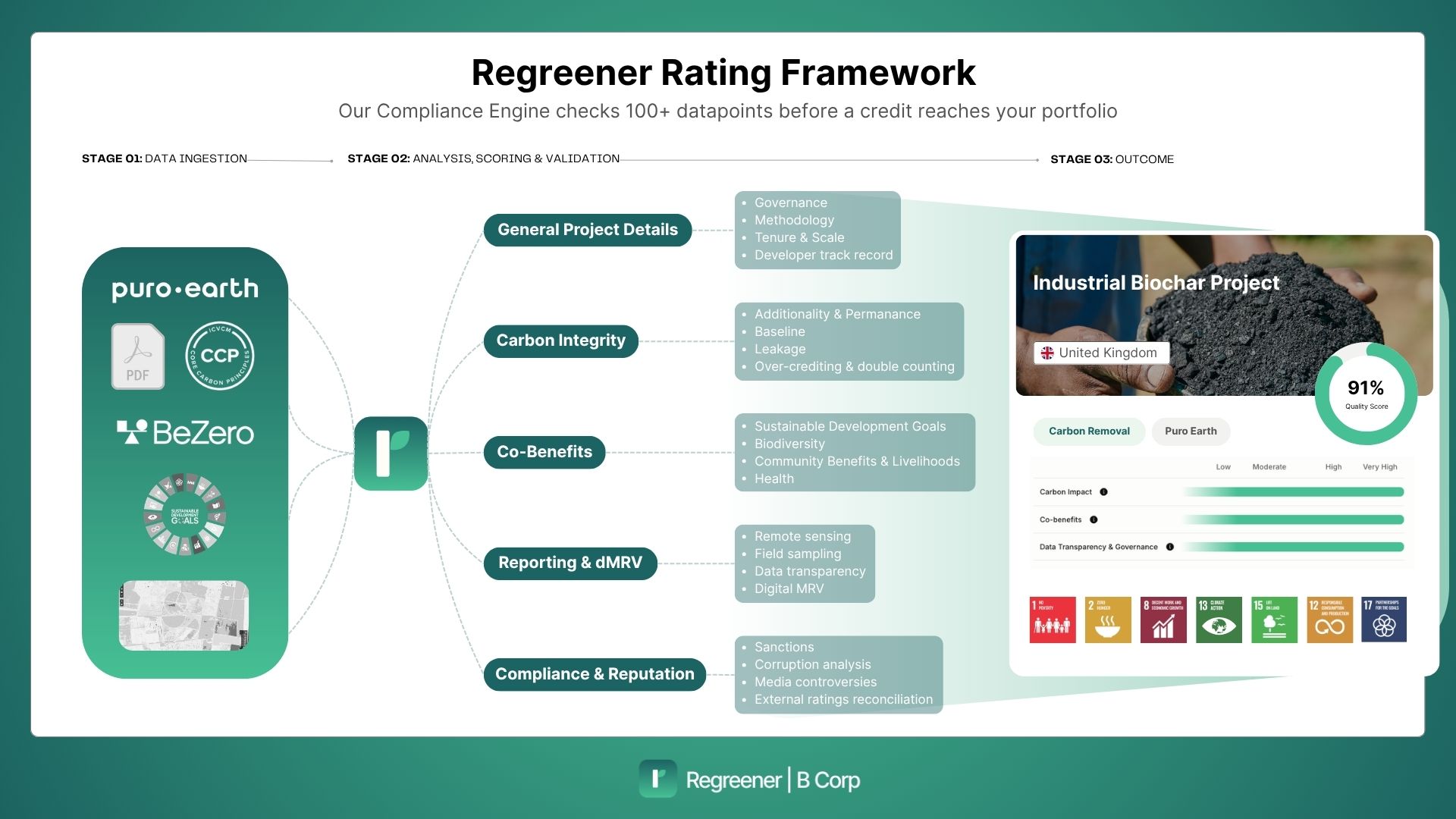
Quality risk. A project fails verification, gets downgraded by an independent rater, or loses registry approval. Mitigated through rigorous pre-contract due diligence, third-party project ratings, and contractual quality minimums.
Reputational risk. A project becomes the subject of media scrutiny or NGO criticism. Mitigated through credible standards, transparent MRV, and active monitoring throughout the contract term.
Counterparty risk. The developer fails financially or operationally. Mitigated through buyer due diligence on the developer’s track record, financial position, and project pipeline.
At Regreener, we structure offtake agreements as part of a diversified procurement portfolio rather than a single concentrated bet. A buyer signing for 100,000 tonnes a year is better served by three or four projects across different technologies and geographies than by a single project, no matter how promising it looks today.
When does a carbon offtake agreement make sense?
Carbon offtake agreements suit organisations with three characteristics: a clear multi-year net-zero or carbon neutrality commitment, an internal carbon price or budget that supports long-term contracting, and the operational maturity to manage a structured procurement relationship rather than transactional purchases.
For a company still defining its baseline or running annual ad-hoc offsetting, the spot or forward market is the right starting point. For a company with a 2030 or 2040 target, a board-level commitment, and growing scope 1 and 3 emissions to address, offtake agreements are increasingly the default.
The decision is rarely binary. Most mature programmes use offtakes for their durable removal allocation, forward contracts for medium-term planning, and spot purchases for tactical top-ups. That blend gives sustainability leaders both certainty and flexibility.
Ready to explore this mechanism further?
Book a call with a Regreener advisor. We will review your decarbonisation goals, your current procurement approach, and whether a carbon offtake agreement, forward contract, or portfolio mix is the right fit.