laat ons je terugbellen.

Carbon Credit Standards: Which to Trust in 2026

Carbon Credit Standards: Which to Trust in 2026

Laatst bijgewerkt:

29 april, 2025

29 april, 2025

6 minuten leestijd

6 minuten leestijd

Two companies can each retire one tonne of carbon credits and walk away with completely different climate claims. The difference usually comes down to one thing: the carbon credit standard that certified the credit in the first place.

Carbon credit standards set the rules for what counts as a real, additional and permanent tonne of CO2. They decide how a project is measured, who verifies it, and whether the resulting credit can survive scrutiny from your auditor, your board, and increasingly your regulator. Pick the wrong standard for your goal and you can overpay, under-deliver on your reporting, or expose yourself to a greenwashing challenge.

This guide compares the standards that actually matter for corporate buyers in 2026, and shows you how to match the standard to the claim you need to make.

Want to know which credits fit your company's climate strategy?

Book a free consultation today

The short answer

The main carbon credit standards in 2026 are Verra (VCS), Gold Standard, Plan Vivo, Puro.earth and Isometric, supported by regional programmes such as the American Carbon Registry (ACR) and the Climate Action Reserve (CAR). Verra and Gold Standard dominate avoidance and reduction credits. Plan Vivo specialises in community-led nature projects. Puro.earth and Isometric certify durable, engineered carbon removal. Above all of them sits the ICVCM Core Carbon Principles framework, an independent quality benchmark: credits that earn the CCP label have passed an extra integrity test for additionality, permanence, quantification and transparency.

No single standard is "best". The right one depends on whether you are buying avoidance or removal, how long the carbon needs to stay stored, and what you need to tell your stakeholders.

What a carbon credit standard actually controls

A standard is not the same thing as a project, and it is not the same thing as a registry. The standard is the rulebook. The registry is the database that issues, tracks and retires the credits so they cannot be double-counted. Most major standards run their own registry, which is why the two terms get used interchangeably.

When you compare standards, four things separate the strong from the weak:

  • Additionality: would the emission reduction or removal have happened anyway, without carbon finance?

  • Permanence and durability: how long is the carbon kept out of the atmosphere, and what happens if it is released?

  • MRV (measurement, reporting and verification): how rigorously is the climate benefit quantified, and is it checked by an accredited independent auditor?

  • Co-benefits: does the project also deliver verified social or biodiversity outcomes?

Every standard below makes different trade-offs across those four. That is the real basis for choosing.

Expert tip: "The standard tells you the rules a credit was created under. It does not tell you whether a specific project actually delivered. That is why we score every project ourselves before it reaches a client. Two credits from the same standard can be worlds apart."

  • Bernard de Wit, Founder Regreener

Verra (Verified Carbon Standard)

Verra runs the Verified Carbon Standard, the largest programme in the voluntary carbon market. By most industry estimates Verra accounts for the majority of all credits ever issued, and its credits, Verified Carbon Units (VCUs), cover the broadest range of project types: REDD+ and forestry, agriculture, renewable energy, waste, blue carbon and a growing set of removal methodologies.

That breadth and scale make Verra the default for large-volume procurement and for buyers who want choice. It also means quality varies widely between projects, and Verra's REDD+ methodologies in particular have faced heavy scrutiny over additionality and baselines. Verra has since tightened its rules, but the lesson stands: with Verra, project-level due diligence matters as much as the standard's logo.

Best for: large-scale, cost-effective, broad-choice procurement where you will do project-level diligence.

Gold Standard

Gold Standard, established in 2003 by WWF and other NGOs, built its reputation on co-benefits. Every project must demonstrate measurable contributions to the UN Sustainable Development Goals, not just tonnes of CO2.

That focus makes Gold Standard credits a natural fit for buyers whose ESG story leans on community and development impact: clean cookstoves, safe water access, off-grid solar and smallholder agriculture. The extra stakeholder consultation and co-benefit reporting raise the cost of certification, which is one reason Gold Standard credits typically trade at a premium to comparable Verra credits.

Best for: buyers who need a strong, verifiable social-impact and SDG narrative.

Plan Vivo (PV Climate)

Plan Vivo, with roots reaching back to the 1990s, is the longest-standing carbon standard in the voluntary market. Its carbon standard, PV Climate, certifies community-led and smallholder nature-based projects, with a distinctive revenue-sharing model that channels income directly to local communities.

Two 2026 developments matter for procurement. Plan Vivo's ICROA endorsement is being phased out as ICROA winds down its accreditation activities, with ICVCM and VCMI taking over as the primary integrity references; and Plan Vivo's programme-level ICVCM assessment is reported to be nearing completion. Plan Vivo has also launched PV Nature, a separate biodiversity standard, opening the door to dual climate-and-nature claims.

Best for: buyers prioritising deep community benefit, Indigenous and smallholder support, and biodiversity co-benefits.

Puro.earth

Puro.earth was the first standard built specifically for engineered, durable carbon removal. It certifies removals and issues CO2 Removal Certificates (CORCs) through a Nasdaq-backed registry, with methodologies designed to keep carbon stored for 100 to over 1,000 years. Crucially, Puro certifies removal only; avoided or reduced emissions are not mixed into the accounting.

This makes Puro.earth a strong choice for the durable-removal portion of a science-based net-zero plan, where you need credits that survive auditor and investor scrutiny. Its methodologies cover biochar, bio-based construction materials, geologically stored carbon and similar pathways. Recognisable buyers retiring CORCs include major corporates with public net-zero commitments, which is a useful signal of institutional confidence in the standard.

Best for: durable, engineered carbon removal to address residual emissions in a net-zero target.

Isometric

Isometric is a newer, science-led registry focused on high-durability carbon removal, with an emphasis on rigorous, digital MRV and publicly published protocols. It has positioned itself around scientific transparency, and several of its protocols have moved through external integrity assessment.

For buyers, Isometric is worth shortlisting alongside Puro.earth when the priority is engineered removal with strong scientific documentation. As the younger standard it carries a smaller issued volume, so availability for a given pathway can be tighter.

Best for: science-first buyers of durable removal who value detailed, transparent MRV.

ACR and Climate Action Reserve

The American Carbon Registry and the Climate Action Reserve are long-established North American standards, often associated with compliance-adjacent use such as California's cap-and-trade programme. Both have had methodologies recognised under the ICVCM Core Carbon Principles, which raises their relevance for international buyers who previously overlooked them.

Best for: buyers with North American project preferences or compliance-linked requirements.

Want to know which credits fit your company's climate strategy?

Book a free consultation today

The integrity layer: ICVCM, CORSIA and the EU CRCF

Choosing a standard is only half the decision in 2026. A second, independent layer now signals whether specific credits meet a global quality bar.

The ICVCM Core Carbon Principles (CCP) are the most important of these. The Integrity Council assesses both crediting programmes and individual methodologies, and credits that pass earn a CCP label inside registries like Verra and Gold Standard. The Integrity Council reports that, since 2023, a growing number of programmes and dozens of methodologies have been approved, with the approved-credit pool measured in the low hundreds of millions. These figures change with every assessment round, so treat any specific count as a snapshot and verify the current status before relying on it.

Two other reference points matter for European and aviation-exposed buyers: CORSIA, the eligibility scheme for international aviation, and the EU Carbon Removals Certification Framework (CRCF), under which the European Commission has begun adopting removal certification methodologies. Alignment with these frameworks is becoming a procurement filter in its own right.

The practical takeaway: where a CCP-labelled credit exists for the pathway you want, it is the lower-risk choice, regardless of which standard issued it.

Carbon credit standards compared at a glance

Standard

Best for

Credit type

Typical durability

Co-benefit focus

ICVCM CCP status (2026)

Verra (VCS)

Scale and breadth

Avoidance, reduction, removal

Varies by project

Moderate

Programme assessed; some methodologies CCP-approved

Gold Standard

SDG / social impact

Avoidance, reduction

Varies by project

High

Programme assessed; some methodologies CCP-approved

Plan Vivo (PV Climate)

Community-led nature

Nature-based reduction/removal

Long-term, nature-based

Very high

Assessment reported as nearing completion

Puro.earth

Durable engineered removal

Removal only (CORCs)

100 to 1,000+ years

Low to moderate

Programme/methodology assessment underway

Isometric

Science-led durable removal

Removal only

High durability

Low to moderate

Selected protocols assessed

ACR / CAR

North American / compliance

Avoidance, reduction, removal

Varies by project

Moderate

Selected methodologies CCP-approved

CCP status changes with each ICVCM assessment round. Confirm the current position at icvcm.org/assessment-status before publishing or quoting to a client.

How to choose the right standard for your goal

Start from the claim you need to make, then work back to the standard.

  • You are addressing residual emissions in a science-based net-zero target. Prioritise durable removal: Puro.earth or Isometric.

  • Your ESG story depends on community and biodiversity impact. Look at Plan Vivo and Gold Standard.

  • You need volume at a competitive price and will do project diligence. Verra gives you the widest choice.

  • You answer to auditors or operate in regulated contexts. Favour CCP-labelled credits and check CORSIA or EU CRCF alignment.

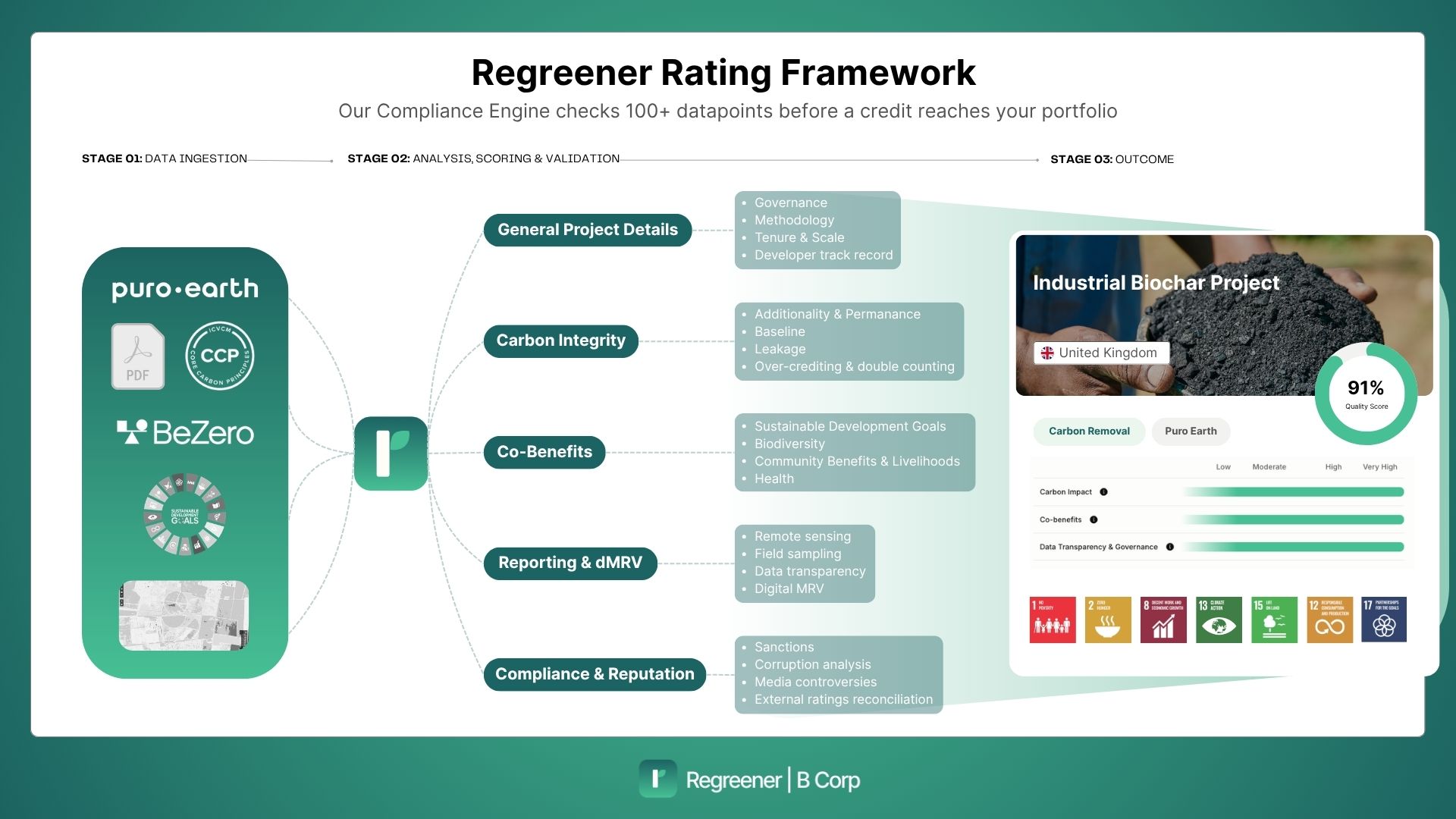
Whichever standard you choose, the logo on the credit is the floor, not the ceiling. Two Verra projects, or two Puro projects, can differ enormously in real-world quality. At Regreener we assess every project against our own multi-domain quality framework before it reaches a client, so the credits in a portfolio are vetted at the project level, not just the standard level.

een vliegtuig dat in de lucht vliegt met het woord 'go' erin geschreven

Explore our Guide: the best Carbon Credit Projects of 2026

Learn about the latest best practices, high-quality projects and strategic options

Two companies can each retire one tonne of carbon credits and walk away with completely different climate claims. The difference usually comes down to one thing: the carbon credit standard that certified the credit in the first place.

Carbon credit standards set the rules for what counts as a real, additional and permanent tonne of CO2. They decide how a project is measured, who verifies it, and whether the resulting credit can survive scrutiny from your auditor, your board, and increasingly your regulator. Pick the wrong standard for your goal and you can overpay, under-deliver on your reporting, or expose yourself to a greenwashing challenge.

This guide compares the standards that actually matter for corporate buyers in 2026, and shows you how to match the standard to the claim you need to make.

Want to know which credits fit your company's climate strategy?

Book a free consultation today

The short answer

The main carbon credit standards in 2026 are Verra (VCS), Gold Standard, Plan Vivo, Puro.earth and Isometric, supported by regional programmes such as the American Carbon Registry (ACR) and the Climate Action Reserve (CAR). Verra and Gold Standard dominate avoidance and reduction credits. Plan Vivo specialises in community-led nature projects. Puro.earth and Isometric certify durable, engineered carbon removal. Above all of them sits the ICVCM Core Carbon Principles framework, an independent quality benchmark: credits that earn the CCP label have passed an extra integrity test for additionality, permanence, quantification and transparency.

No single standard is "best". The right one depends on whether you are buying avoidance or removal, how long the carbon needs to stay stored, and what you need to tell your stakeholders.

What a carbon credit standard actually controls

A standard is not the same thing as a project, and it is not the same thing as a registry. The standard is the rulebook. The registry is the database that issues, tracks and retires the credits so they cannot be double-counted. Most major standards run their own registry, which is why the two terms get used interchangeably.

When you compare standards, four things separate the strong from the weak:

  • Additionality: would the emission reduction or removal have happened anyway, without carbon finance?

  • Permanence and durability: how long is the carbon kept out of the atmosphere, and what happens if it is released?

  • MRV (measurement, reporting and verification): how rigorously is the climate benefit quantified, and is it checked by an accredited independent auditor?

  • Co-benefits: does the project also deliver verified social or biodiversity outcomes?

Every standard below makes different trade-offs across those four. That is the real basis for choosing.

Expert tip: "The standard tells you the rules a credit was created under. It does not tell you whether a specific project actually delivered. That is why we score every project ourselves before it reaches a client. Two credits from the same standard can be worlds apart."

  • Bernard de Wit, Founder Regreener

Verra (Verified Carbon Standard)

Verra runs the Verified Carbon Standard, the largest programme in the voluntary carbon market. By most industry estimates Verra accounts for the majority of all credits ever issued, and its credits, Verified Carbon Units (VCUs), cover the broadest range of project types: REDD+ and forestry, agriculture, renewable energy, waste, blue carbon and a growing set of removal methodologies.

That breadth and scale make Verra the default for large-volume procurement and for buyers who want choice. It also means quality varies widely between projects, and Verra's REDD+ methodologies in particular have faced heavy scrutiny over additionality and baselines. Verra has since tightened its rules, but the lesson stands: with Verra, project-level due diligence matters as much as the standard's logo.

Best for: large-scale, cost-effective, broad-choice procurement where you will do project-level diligence.

Gold Standard

Gold Standard, established in 2003 by WWF and other NGOs, built its reputation on co-benefits. Every project must demonstrate measurable contributions to the UN Sustainable Development Goals, not just tonnes of CO2.

That focus makes Gold Standard credits a natural fit for buyers whose ESG story leans on community and development impact: clean cookstoves, safe water access, off-grid solar and smallholder agriculture. The extra stakeholder consultation and co-benefit reporting raise the cost of certification, which is one reason Gold Standard credits typically trade at a premium to comparable Verra credits.

Best for: buyers who need a strong, verifiable social-impact and SDG narrative.

Plan Vivo (PV Climate)

Plan Vivo, with roots reaching back to the 1990s, is the longest-standing carbon standard in the voluntary market. Its carbon standard, PV Climate, certifies community-led and smallholder nature-based projects, with a distinctive revenue-sharing model that channels income directly to local communities.

Two 2026 developments matter for procurement. Plan Vivo's ICROA endorsement is being phased out as ICROA winds down its accreditation activities, with ICVCM and VCMI taking over as the primary integrity references; and Plan Vivo's programme-level ICVCM assessment is reported to be nearing completion. Plan Vivo has also launched PV Nature, a separate biodiversity standard, opening the door to dual climate-and-nature claims.

Best for: buyers prioritising deep community benefit, Indigenous and smallholder support, and biodiversity co-benefits.

Puro.earth

Puro.earth was the first standard built specifically for engineered, durable carbon removal. It certifies removals and issues CO2 Removal Certificates (CORCs) through a Nasdaq-backed registry, with methodologies designed to keep carbon stored for 100 to over 1,000 years. Crucially, Puro certifies removal only; avoided or reduced emissions are not mixed into the accounting.

This makes Puro.earth a strong choice for the durable-removal portion of a science-based net-zero plan, where you need credits that survive auditor and investor scrutiny. Its methodologies cover biochar, bio-based construction materials, geologically stored carbon and similar pathways. Recognisable buyers retiring CORCs include major corporates with public net-zero commitments, which is a useful signal of institutional confidence in the standard.

Best for: durable, engineered carbon removal to address residual emissions in a net-zero target.

Isometric

Isometric is a newer, science-led registry focused on high-durability carbon removal, with an emphasis on rigorous, digital MRV and publicly published protocols. It has positioned itself around scientific transparency, and several of its protocols have moved through external integrity assessment.

For buyers, Isometric is worth shortlisting alongside Puro.earth when the priority is engineered removal with strong scientific documentation. As the younger standard it carries a smaller issued volume, so availability for a given pathway can be tighter.

Best for: science-first buyers of durable removal who value detailed, transparent MRV.

ACR and Climate Action Reserve

The American Carbon Registry and the Climate Action Reserve are long-established North American standards, often associated with compliance-adjacent use such as California's cap-and-trade programme. Both have had methodologies recognised under the ICVCM Core Carbon Principles, which raises their relevance for international buyers who previously overlooked them.

Best for: buyers with North American project preferences or compliance-linked requirements.

Want to know which credits fit your company's climate strategy?

Book a free consultation today

The integrity layer: ICVCM, CORSIA and the EU CRCF

Choosing a standard is only half the decision in 2026. A second, independent layer now signals whether specific credits meet a global quality bar.

The ICVCM Core Carbon Principles (CCP) are the most important of these. The Integrity Council assesses both crediting programmes and individual methodologies, and credits that pass earn a CCP label inside registries like Verra and Gold Standard. The Integrity Council reports that, since 2023, a growing number of programmes and dozens of methodologies have been approved, with the approved-credit pool measured in the low hundreds of millions. These figures change with every assessment round, so treat any specific count as a snapshot and verify the current status before relying on it.

Two other reference points matter for European and aviation-exposed buyers: CORSIA, the eligibility scheme for international aviation, and the EU Carbon Removals Certification Framework (CRCF), under which the European Commission has begun adopting removal certification methodologies. Alignment with these frameworks is becoming a procurement filter in its own right.

The practical takeaway: where a CCP-labelled credit exists for the pathway you want, it is the lower-risk choice, regardless of which standard issued it.

Carbon credit standards compared at a glance

Standard

Best for

Credit type

Typical durability

Co-benefit focus

ICVCM CCP status (2026)

Verra (VCS)

Scale and breadth

Avoidance, reduction, removal

Varies by project

Moderate

Programme assessed; some methodologies CCP-approved

Gold Standard

SDG / social impact

Avoidance, reduction

Varies by project

High

Programme assessed; some methodologies CCP-approved

Plan Vivo (PV Climate)

Community-led nature

Nature-based reduction/removal

Long-term, nature-based

Very high

Assessment reported as nearing completion

Puro.earth

Durable engineered removal

Removal only (CORCs)

100 to 1,000+ years

Low to moderate

Programme/methodology assessment underway

Isometric

Science-led durable removal

Removal only

High durability

Low to moderate

Selected protocols assessed

ACR / CAR

North American / compliance

Avoidance, reduction, removal

Varies by project

Moderate

Selected methodologies CCP-approved

CCP status changes with each ICVCM assessment round. Confirm the current position at icvcm.org/assessment-status before publishing or quoting to a client.

How to choose the right standard for your goal

Start from the claim you need to make, then work back to the standard.

  • You are addressing residual emissions in a science-based net-zero target. Prioritise durable removal: Puro.earth or Isometric.

  • Your ESG story depends on community and biodiversity impact. Look at Plan Vivo and Gold Standard.

  • You need volume at a competitive price and will do project diligence. Verra gives you the widest choice.

  • You answer to auditors or operate in regulated contexts. Favour CCP-labelled credits and check CORSIA or EU CRCF alignment.

Whichever standard you choose, the logo on the credit is the floor, not the ceiling. Two Verra projects, or two Puro projects, can differ enormously in real-world quality. At Regreener we assess every project against our own multi-domain quality framework before it reaches a client, so the credits in a portfolio are vetted at the project level, not just the standard level.

een vliegtuig dat door de lucht vliegt met het woord 'go' erin geschreven

Explore our Guide: the best Carbon Credit Projects of 2026

Learn about the latest best practices, high-quality projects and strategic options

Two companies can each retire one tonne of carbon credits and walk away with completely different climate claims. The difference usually comes down to one thing: the carbon credit standard that certified the credit in the first place.

Carbon credit standards set the rules for what counts as a real, additional and permanent tonne of CO2. They decide how a project is measured, who verifies it, and whether the resulting credit can survive scrutiny from your auditor, your board, and increasingly your regulator. Pick the wrong standard for your goal and you can overpay, under-deliver on your reporting, or expose yourself to a greenwashing challenge.

This guide compares the standards that actually matter for corporate buyers in 2026, and shows you how to match the standard to the claim you need to make.

Want to know which credits fit your company's climate strategy?

Book a free consultation today

The short answer

The main carbon credit standards in 2026 are Verra (VCS), Gold Standard, Plan Vivo, Puro.earth and Isometric, supported by regional programmes such as the American Carbon Registry (ACR) and the Climate Action Reserve (CAR). Verra and Gold Standard dominate avoidance and reduction credits. Plan Vivo specialises in community-led nature projects. Puro.earth and Isometric certify durable, engineered carbon removal. Above all of them sits the ICVCM Core Carbon Principles framework, an independent quality benchmark: credits that earn the CCP label have passed an extra integrity test for additionality, permanence, quantification and transparency.

No single standard is "best". The right one depends on whether you are buying avoidance or removal, how long the carbon needs to stay stored, and what you need to tell your stakeholders.

What a carbon credit standard actually controls

A standard is not the same thing as a project, and it is not the same thing as a registry. The standard is the rulebook. The registry is the database that issues, tracks and retires the credits so they cannot be double-counted. Most major standards run their own registry, which is why the two terms get used interchangeably.

When you compare standards, four things separate the strong from the weak:

  • Additionality: would the emission reduction or removal have happened anyway, without carbon finance?

  • Permanence and durability: how long is the carbon kept out of the atmosphere, and what happens if it is released?

  • MRV (measurement, reporting and verification): how rigorously is the climate benefit quantified, and is it checked by an accredited independent auditor?

  • Co-benefits: does the project also deliver verified social or biodiversity outcomes?

Every standard below makes different trade-offs across those four. That is the real basis for choosing.

Expert tip: "The standard tells you the rules a credit was created under. It does not tell you whether a specific project actually delivered. That is why we score every project ourselves before it reaches a client. Two credits from the same standard can be worlds apart."

  • Bernard de Wit, Founder Regreener

Verra (Verified Carbon Standard)

Verra runs the Verified Carbon Standard, the largest programme in the voluntary carbon market. By most industry estimates Verra accounts for the majority of all credits ever issued, and its credits, Verified Carbon Units (VCUs), cover the broadest range of project types: REDD+ and forestry, agriculture, renewable energy, waste, blue carbon and a growing set of removal methodologies.

That breadth and scale make Verra the default for large-volume procurement and for buyers who want choice. It also means quality varies widely between projects, and Verra's REDD+ methodologies in particular have faced heavy scrutiny over additionality and baselines. Verra has since tightened its rules, but the lesson stands: with Verra, project-level due diligence matters as much as the standard's logo.

Best for: large-scale, cost-effective, broad-choice procurement where you will do project-level diligence.

Gold Standard

Gold Standard, established in 2003 by WWF and other NGOs, built its reputation on co-benefits. Every project must demonstrate measurable contributions to the UN Sustainable Development Goals, not just tonnes of CO2.

That focus makes Gold Standard credits a natural fit for buyers whose ESG story leans on community and development impact: clean cookstoves, safe water access, off-grid solar and smallholder agriculture. The extra stakeholder consultation and co-benefit reporting raise the cost of certification, which is one reason Gold Standard credits typically trade at a premium to comparable Verra credits.

Best for: buyers who need a strong, verifiable social-impact and SDG narrative.

Plan Vivo (PV Climate)

Plan Vivo, with roots reaching back to the 1990s, is the longest-standing carbon standard in the voluntary market. Its carbon standard, PV Climate, certifies community-led and smallholder nature-based projects, with a distinctive revenue-sharing model that channels income directly to local communities.

Two 2026 developments matter for procurement. Plan Vivo's ICROA endorsement is being phased out as ICROA winds down its accreditation activities, with ICVCM and VCMI taking over as the primary integrity references; and Plan Vivo's programme-level ICVCM assessment is reported to be nearing completion. Plan Vivo has also launched PV Nature, a separate biodiversity standard, opening the door to dual climate-and-nature claims.

Best for: buyers prioritising deep community benefit, Indigenous and smallholder support, and biodiversity co-benefits.

Puro.earth

Puro.earth was the first standard built specifically for engineered, durable carbon removal. It certifies removals and issues CO2 Removal Certificates (CORCs) through a Nasdaq-backed registry, with methodologies designed to keep carbon stored for 100 to over 1,000 years. Crucially, Puro certifies removal only; avoided or reduced emissions are not mixed into the accounting.

This makes Puro.earth a strong choice for the durable-removal portion of a science-based net-zero plan, where you need credits that survive auditor and investor scrutiny. Its methodologies cover biochar, bio-based construction materials, geologically stored carbon and similar pathways. Recognisable buyers retiring CORCs include major corporates with public net-zero commitments, which is a useful signal of institutional confidence in the standard.

Best for: durable, engineered carbon removal to address residual emissions in a net-zero target.

Isometric

Isometric is a newer, science-led registry focused on high-durability carbon removal, with an emphasis on rigorous, digital MRV and publicly published protocols. It has positioned itself around scientific transparency, and several of its protocols have moved through external integrity assessment.

For buyers, Isometric is worth shortlisting alongside Puro.earth when the priority is engineered removal with strong scientific documentation. As the younger standard it carries a smaller issued volume, so availability for a given pathway can be tighter.

Best for: science-first buyers of durable removal who value detailed, transparent MRV.

ACR and Climate Action Reserve

The American Carbon Registry and the Climate Action Reserve are long-established North American standards, often associated with compliance-adjacent use such as California's cap-and-trade programme. Both have had methodologies recognised under the ICVCM Core Carbon Principles, which raises their relevance for international buyers who previously overlooked them.

Best for: buyers with North American project preferences or compliance-linked requirements.

Want to know which credits fit your company's climate strategy?

Book a free consultation today

The integrity layer: ICVCM, CORSIA and the EU CRCF

Choosing a standard is only half the decision in 2026. A second, independent layer now signals whether specific credits meet a global quality bar.

The ICVCM Core Carbon Principles (CCP) are the most important of these. The Integrity Council assesses both crediting programmes and individual methodologies, and credits that pass earn a CCP label inside registries like Verra and Gold Standard. The Integrity Council reports that, since 2023, a growing number of programmes and dozens of methodologies have been approved, with the approved-credit pool measured in the low hundreds of millions. These figures change with every assessment round, so treat any specific count as a snapshot and verify the current status before relying on it.

Two other reference points matter for European and aviation-exposed buyers: CORSIA, the eligibility scheme for international aviation, and the EU Carbon Removals Certification Framework (CRCF), under which the European Commission has begun adopting removal certification methodologies. Alignment with these frameworks is becoming a procurement filter in its own right.

The practical takeaway: where a CCP-labelled credit exists for the pathway you want, it is the lower-risk choice, regardless of which standard issued it.

Carbon credit standards compared at a glance

Standard

Best for

Credit type

Typical durability

Co-benefit focus

ICVCM CCP status (2026)

Verra (VCS)

Scale and breadth

Avoidance, reduction, removal

Varies by project

Moderate

Programme assessed; some methodologies CCP-approved

Gold Standard

SDG / social impact

Avoidance, reduction

Varies by project

High

Programme assessed; some methodologies CCP-approved

Plan Vivo (PV Climate)

Community-led nature

Nature-based reduction/removal

Long-term, nature-based

Very high

Assessment reported as nearing completion

Puro.earth

Durable engineered removal

Removal only (CORCs)

100 to 1,000+ years

Low to moderate

Programme/methodology assessment underway

Isometric

Science-led durable removal

Removal only

High durability

Low to moderate

Selected protocols assessed

ACR / CAR

North American / compliance

Avoidance, reduction, removal

Varies by project

Moderate

Selected methodologies CCP-approved

CCP status changes with each ICVCM assessment round. Confirm the current position at icvcm.org/assessment-status before publishing or quoting to a client.

How to choose the right standard for your goal

Start from the claim you need to make, then work back to the standard.

  • You are addressing residual emissions in a science-based net-zero target. Prioritise durable removal: Puro.earth or Isometric.

  • Your ESG story depends on community and biodiversity impact. Look at Plan Vivo and Gold Standard.

  • You need volume at a competitive price and will do project diligence. Verra gives you the widest choice.

  • You answer to auditors or operate in regulated contexts. Favour CCP-labelled credits and check CORSIA or EU CRCF alignment.

Whichever standard you choose, the logo on the credit is the floor, not the ceiling. Two Verra projects, or two Puro projects, can differ enormously in real-world quality. At Regreener we assess every project against our own multi-domain quality framework before it reaches a client, so the credits in a portfolio are vetted at the project level, not just the standard level.

een vliegtuig dat in de lucht vliegt met het woord 'go' erin geschreven

Explore our Guide: the best Carbon Credit Projects of 2026

Learn about the latest best practices, high-quality projects and strategic options
Over de Auteur:

bernard de wit of regreener
Bernard de Wit

Bernard is de oprichter van Regreener, dat hij in 2020 startte na zijn rechtenstudie in Leiden (Nederland) en Oxford (Verenigd Koninkrijk). Hij is gepassioneerd over klimaatactie, duurzaamheid en CO2-creditsmarkten en helpt bedrijven om betrouwbare, impactvolle klimaatmaatregelen te nemen door inzichten en best practices te delen. Als hij niet bezig is met het delen van kennis of het adviseren van bedrijven over hun duurzaamheidsdoelstellingen, kun je Bernard vinden op de tennisbaan of bij vrienden.

INHOUDSOPGAVE

Artikel Delen

Artikel Delen

Veelgestelde vragen

What is the best carbon credit standard?

There is no single best standard. Verra offers the widest choice and scale, Gold Standard leads on social co-benefits, Plan Vivo on community-led nature projects, and Puro.earth and Isometric on durable engineered removal. The best choice depends on whether you need avoidance or removal and what climate claim you intend to make.

Is Verra or Gold Standard better?

Neither is universally better. Verra is broader and more cost-effective for high-volume buying, while Gold Standard commands a premium for its verified SDG and community co-benefits. Buyers focused on volume and choice tend toward Verra; buyers building a social-impact narrative tend toward Gold Standard.

What is the difference between a carbon credit standard and a registry?

A standard is the rulebook that defines how a project is measured, verified and certified. A registry is the database that issues, tracks and retires the resulting credits to prevent double-counting. Most major standards operate their own registry, which is why the terms are often used interchangeably.

What does the ICVCM CCP label mean?

The Core Carbon Principles (CCP) label is awarded by the Integrity Council for the Voluntary Carbon Market to credits that meet an independent global quality threshold for additionality, permanence, quantification and transparency. A CCP-labelled credit has passed an extra integrity check on top of its issuing standard.

Are carbon removal standards better than avoidance standards

They are different, not strictly better. Durable removal standards such as Puro.earth and Isometric are essential for the residual emissions in a credible net-zero target, while avoidance and reduction credits remain important for near-term climate finance. A robust portfolio usually combines both.

Greenwashing-proof klimaatactie

Sluit je aan bij 200+ bedrijven die impact maken met Regreener