
laat ons je terugbellen.

Spot vs Forward vs Offtake: Carbon Credit Pricing in 2026

Spot vs Forward vs Offtake: Carbon Credit Pricing in 2026

Laatst bijgewerkt:

29 april, 2025

29 april, 2025

5 minuten leestijd

5 minuten leestijd

In 2025, the weighted average spot price for a voluntary carbon credit was €6.10. The weighted average forward offtake price was €180. That is not a typo. The same market, the same year, pricing the same underlying tonne of CO2 thirty times apart depending on how and when you buy it.

The split is the most important pricing story in the voluntary carbon market right now, and it changes how serious corporate buyers structure their procurement. Spot, forward, and offtake are three different ways to buy the same product, with different commercial logic, different risk profiles, and very different price tags.

Spot vs Forward vs Offtake: The Short Answer

Spot, forward, and offtake are the three primary procurement mechanisms for carbon credits, each suited to different buyer needs and project types. Spot purchases are credits already issued and available for immediate retirement, used across all quality tiers and priced between €1 and €50 per tonne depending on project integrity. Forward contracts lock in a defined volume of pre-issuance credits for delivery in 1 to 5 years, often with upfront payment, and are common for nature-based projects scaling up production. Offtake agreements are long-term contracts (5 to 15 years) used predominantly for durable removals and premium nature-based projects, with credits delivered annually as the project issues them. The mechanism does not set the price. The project does. Offtakes appear expensive in aggregate because they are the mechanism used to fund the most expensive credit categories, not because the contract structure adds cost.

At-a-Glance Comparison


Spot

Forward

Offtake

Contract length

Single transaction

1 to 5 years

5 to 15 years

Credit status

Already issued

Usually pre-issuance

Issued annually over term

Payment timing

At purchase

Upfront or milestone

On delivery

Typical project type

All categories

Nature-based, mid-cost removals

Durable removals, premium nature-based

Typical 2026 price range

€1 to €60 (spot avg €6.10)

15 to 30% below expected future spot

€150 to €1,000+ depending on project

Buyer benefit

Flexibility, immediate retirement

Price lock-in, supply security

Long-term supply, project influence

Main risk

Price volatility, scarcity of quality

Project delivery, methodology change

Long-term project performance

Best for

Variable volumes, residual coverage

3 to 5 year supply security

Strategic, decade-plus commitments

Spot: Immediate Delivery, Market Price

Spot purchases are the simplest mechanism in the market. You buy credits that have already been verified, issued, and parked in a registry account. They are transferred to your account and retired, usually within days. The price you pay is the price on the day you transact.

Spot is where most of the voluntary market's transaction volume still happens. In 2025, around 168 million credits were retired on the spot market with a total value of roughly €1.04 billion, according to Sylvera's State of Carbon Credits 2025. The weighted average price of €6.10 hides enormous variation by project type and quality rating.

Typical spot price ranges in 2026:

  • Generic avoidance credits with no quality label: below €1 per tonne

  • Lower-rated REDD+ and afforestation credits: €2 to €14 per tonne

  • BBB+ rated ARR credits: around €26 per tonne

  • High-integrity nature-based credits with CCP labelling: €10 to €35 per tonne

  • Premium nature-based removals: up to €60 per tonne

  • Biochar and engineered removals: €100 to €400 per tonne

Spot makes sense for buyers with smaller, variable annual volumes, for buyers entering the market for the first time who want to see what they are buying before committing, and for buyers covering a residual gap after a longer-term procurement programme has run its course.

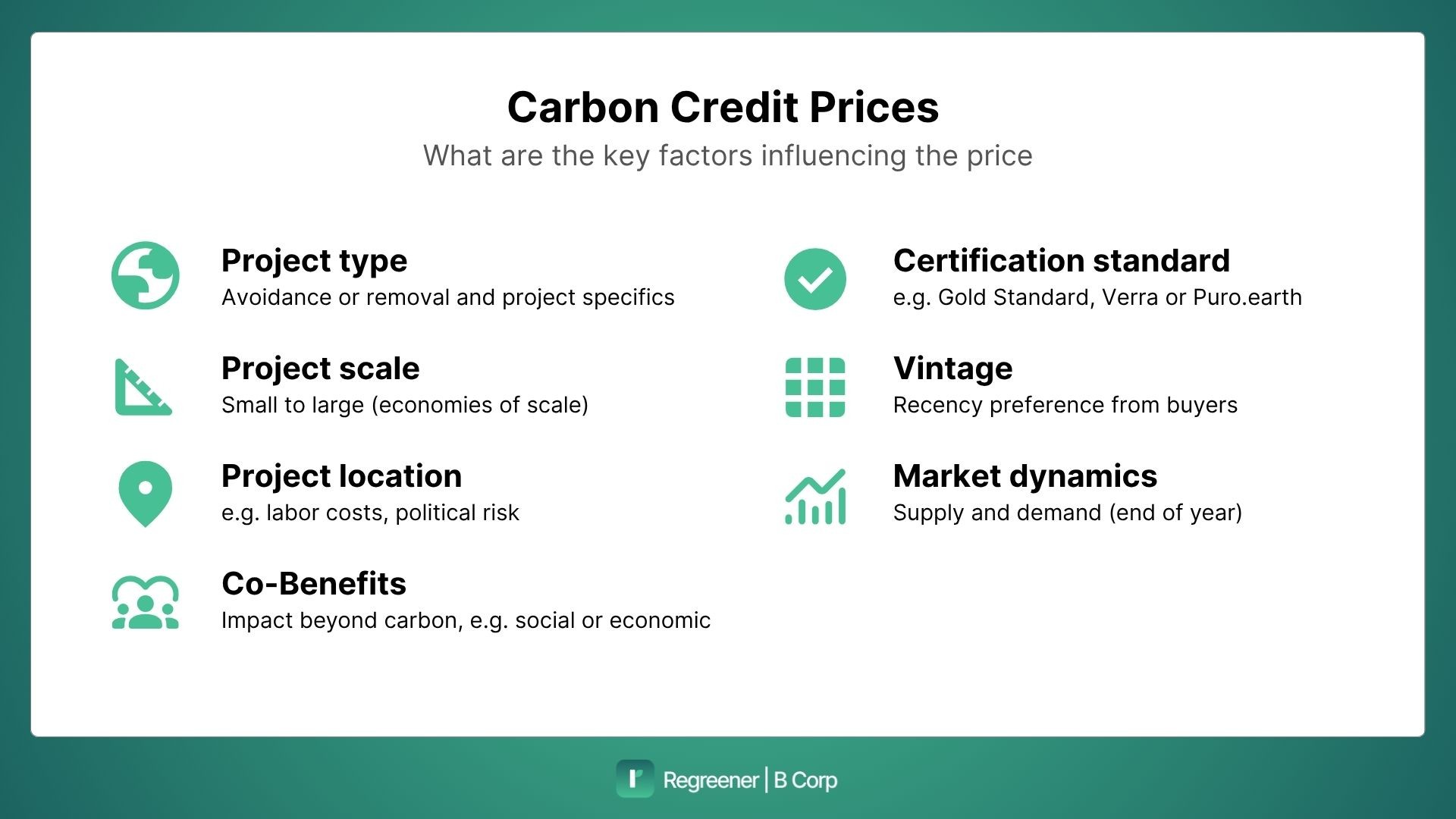
The downside is exposure. Spot prices for high-quality credits have risen as supply tightens, and the highest-integrity categories are increasingly unavailable on the spot market at all because they have been pre-sold through forward and offtake contracts. For current price ranges by methodology and quality tier, see our carbon credit prices and forecasts for 2026.
Forward: Pay Today, Take Delivery Later

Forward contracts sit between spot and offtake. The buyer commits to a defined volume of credits to be delivered in 1 to 5 years, usually paying upfront or in milestone tranches. The credits are typically pre-issuance, meaning the project has been registered but the specific credits have not yet been verified and issued.

The commercial logic is straightforward. The project developer gets capital to scale the project. The buyer gets a price discount against expected future spot, plus first claim on the credits when they are issued. Forward pricing is typically 15 to 30 percent below the buyer's expected spot price at the future delivery date, which is the developer's compensation for shifting financing risk to the buyer.

Three pricing models dominate forward contracts:

  • Fixed forward price. A single per-credit price for the entire forward volume. Simple and clean, exposed to market movement in both directions.

  • Indexed forward. Price tracks a benchmark or basket at delivery. Used when both parties want exposure to where the market actually lands.

  • Forward with escalator. Starting price with a defined annual uplift, often 2 to 5 percent. A middle ground between fixed and indexed.

The risk is delivery. If the project under-issues, is suspended by the registry, or has its methodology revised, the buyer is exposed. Forward contracts typically include replacement clauses, but the buyer is still carrying the project-specific risk in a way they would not be on the spot market. Forwards are most common for nature-based projects with shorter crediting cycles and for buyers who want supply security over the next 3 to 5 years without committing to a decade-long agreement.

Offtake: Long-Term, Structured, Used For Premium Projects

Offtake agreements are the procurement instrument that has reshaped the upper end of the voluntary carbon market over the last two years. An offtake is a long-term contract (typically 5 to 15 years) in which the buyer commits to purchase a defined volume of credits delivered annually as the project issues them. Payment is usually on delivery, sometimes with milestone payments tied to project development stages.

The numbers tell the story. According to Sylvera, offtake deals announced in 2025 totalled €12.3 billion, up from €3.95 billion in 2024, while delivering only around 12 million credits annually through 2035 at a weighted average price of €180 per credit. That weighted average is dragged up by the durable removals category. Direct air capture sits at €450 to over €1,000 per tonne in 2026 forward offers. BECCS, biochar, and enhanced rock weathering offtakes typically sit between €150 and €400 per tonne.

Three things explain why credits traded through offtake agreements typically sit so far above the spot average. None of them is the contract structure itself.

First, the projects being funded are expensive. Most large offtakes are for durable removal projects that need committed long-term buyers to underwrite the capital expenditure required to build the project in the first place. The price reflects the cost of building and operating the facility, not the cost of the contract.

Second, they lock in scarce supply. Sylvera's 2025 data shows the forward offtake market is a different universe from the spot market. It is concentrated, removal-heavy, and dominated by buyers (Microsoft, Google, Stripe, Frontier coalition members) who are pricing in their own future scarcity.

Third, they include structured risk-allocation clauses. Offtake contracts include make good provisions, reversal protections, quality floors, and detailed force majeure terms. These do not add to the headline price, but they reflect a level of commercial structuring that does not exist in a spot transaction. For a clause-by-clause breakdown, see our guide to key contract terms in a carbon credit offtake agreement.

For the full mechanics of how offtakes work, see our complete guide to carbon offtake agreements.

The Price Gap: It Is The Projects, Not The Mechanism

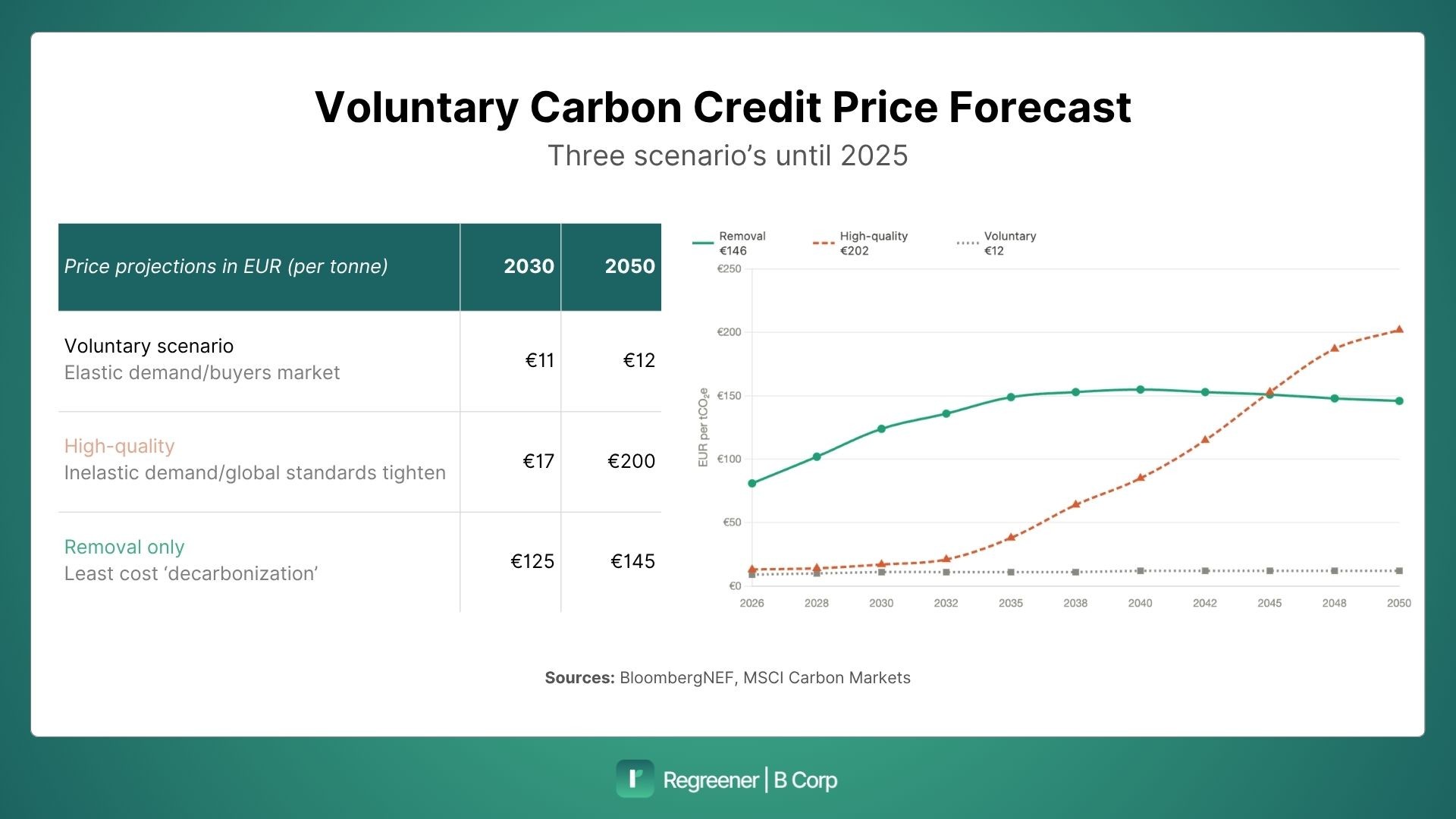
The 30x gap between €6.10 spot and €180 forward offtake is often described as if the offtake mechanism itself adds cost. It does not. The gap exists because spot and offtake are now used for almost entirely different categories of project.

The spot market is dominated by legacy avoidance credits, older vintages, and projects that did not survive the integrity reset of 2023 and 2024. Most of this supply will continue to trade at low prices indefinitely. The offtake market is dominated by durable removals (DAC, BECCS, biochar, mineralisation, enhanced rock weathering) which command high prices wherever they are sold, because the underlying cost of removing a tonne of CO2 through these technologies is structurally high and supply is constrained.

Put differently: if a DAC credit ever traded on the spot market in meaningful volume, it would still cost several hundred euros per tonne. The mechanism is not the price driver. The project type, methodology, permanence, and quality rating are. Offtakes happen to be the mechanism used to fund these credits, because they are the only way to underwrite the capital expenditure required to build first-of-a-kind facilities.

What this means for buyers is that the spot market price is no longer a useful benchmark for what a serious climate programme costs. A net-zero strategy aligned with science-based targets typically requires a portfolio that combines lower-cost high-integrity nature-based credits with a meaningful allocation to durable removals. The blended cost of that portfolio sits well above the spot average because of what is in it, not how it was bought.
How Buyers Combine All Three

Most serious corporate buyers use all three mechanisms. The mix depends on volume profile, climate strategy, and risk tolerance, but a common structure looks like this:

  • Spot (10 to 30 percent of volume). Used for flexibility, for residual coverage at year-end, and for testing new project types before committing to longer agreements.

  • Forward (20 to 40 percent of volume). Used for 3 to 5 year supply security on nature-based credits and mid-cost removals, with payment timed to support the developer's project finance needs.

  • Offtake (40 to 70 percent of volume). Used for durable removals and for high-quality nature-based projects where 10 to 15 year supply security is a strategic requirement.

CORE Markets describes the most risk-averse hedge as a 50/50 split between long-term offtake and spot. That logic still applies for buyers with predictable annual volumes, although the proportion of forward and offtake usually rises as the buyer's net-zero deadline approaches and durable removal volumes become non-negotiable.

The framing that matters is not "which mechanism is best." It is "what mix matches our emissions trajectory, our budget cycle, and our reporting obligations." That is the question worth investing real strategic time in, because the answer compounds over a decade.

Build The Procurement Mix That Fits Your Business

The voluntary carbon market is no longer one market. It is three, with very different prices, very different time horizons, and very different strategic implications. The buyers who treat spot, forward, and offtake as interchangeable end up overpaying for some credits and under-securing supply on others. The buyers who design a deliberate mix lock in tomorrow's high-integrity credits at today's prices, smooth their budget cycles over multiple years, and turn carbon procurement into a strategic asset rather than an annual cost line.

What the right mix looks like for your business depends on the variables only you can see clearly: your emissions trajectory, your reporting obligations, the methodologies that fit your strategy, and the budget profile you can commit to over the next decade. We help corporate buyers think it through and build the procurement structure from the ground up, with the project diligence, market context, and contract experience to back it up.
een vliegtuig dat in de lucht vliegt met het woord 'go' erin geschreven

Explore our Guide: the best Carbon Credit Projects of 2026

Learn about the latest best practices, high-quality projects and strategic options

In 2025, the weighted average spot price for a voluntary carbon credit was €6.10. The weighted average forward offtake price was €180. That is not a typo. The same market, the same year, pricing the same underlying tonne of CO2 thirty times apart depending on how and when you buy it.

The split is the most important pricing story in the voluntary carbon market right now, and it changes how serious corporate buyers structure their procurement. Spot, forward, and offtake are three different ways to buy the same product, with different commercial logic, different risk profiles, and very different price tags.

Spot vs Forward vs Offtake: The Short Answer

Spot, forward, and offtake are the three primary procurement mechanisms for carbon credits, each suited to different buyer needs and project types. Spot purchases are credits already issued and available for immediate retirement, used across all quality tiers and priced between €1 and €50 per tonne depending on project integrity. Forward contracts lock in a defined volume of pre-issuance credits for delivery in 1 to 5 years, often with upfront payment, and are common for nature-based projects scaling up production. Offtake agreements are long-term contracts (5 to 15 years) used predominantly for durable removals and premium nature-based projects, with credits delivered annually as the project issues them. The mechanism does not set the price. The project does. Offtakes appear expensive in aggregate because they are the mechanism used to fund the most expensive credit categories, not because the contract structure adds cost.

At-a-Glance Comparison


Spot

Forward

Offtake

Contract length

Single transaction

1 to 5 years

5 to 15 years

Credit status

Already issued

Usually pre-issuance

Issued annually over term

Payment timing

At purchase

Upfront or milestone

On delivery

Typical project type

All categories

Nature-based, mid-cost removals

Durable removals, premium nature-based

Typical 2026 price range

€1 to €60 (spot avg €6.10)

15 to 30% below expected future spot

€150 to €1,000+ depending on project

Buyer benefit

Flexibility, immediate retirement

Price lock-in, supply security

Long-term supply, project influence

Main risk

Price volatility, scarcity of quality

Project delivery, methodology change

Long-term project performance

Best for

Variable volumes, residual coverage

3 to 5 year supply security

Strategic, decade-plus commitments

Spot: Immediate Delivery, Market Price

Spot purchases are the simplest mechanism in the market. You buy credits that have already been verified, issued, and parked in a registry account. They are transferred to your account and retired, usually within days. The price you pay is the price on the day you transact.

Spot is where most of the voluntary market's transaction volume still happens. In 2025, around 168 million credits were retired on the spot market with a total value of roughly €1.04 billion, according to Sylvera's State of Carbon Credits 2025. The weighted average price of €6.10 hides enormous variation by project type and quality rating.

Typical spot price ranges in 2026:

  • Generic avoidance credits with no quality label: below €1 per tonne

  • Lower-rated REDD+ and afforestation credits: €2 to €14 per tonne

  • BBB+ rated ARR credits: around €26 per tonne

  • High-integrity nature-based credits with CCP labelling: €10 to €35 per tonne

  • Premium nature-based removals: up to €60 per tonne

  • Biochar and engineered removals: €100 to €400 per tonne

Spot makes sense for buyers with smaller, variable annual volumes, for buyers entering the market for the first time who want to see what they are buying before committing, and for buyers covering a residual gap after a longer-term procurement programme has run its course.

The downside is exposure. Spot prices for high-quality credits have risen as supply tightens, and the highest-integrity categories are increasingly unavailable on the spot market at all because they have been pre-sold through forward and offtake contracts. For current price ranges by methodology and quality tier, see our carbon credit prices and forecasts for 2026.

Forward: Pay Today, Take Delivery Later

Forward contracts sit between spot and offtake. The buyer commits to a defined volume of credits to be delivered in 1 to 5 years, usually paying upfront or in milestone tranches. The credits are typically pre-issuance, meaning the project has been registered but the specific credits have not yet been verified and issued.

The commercial logic is straightforward. The project developer gets capital to scale the project. The buyer gets a price discount against expected future spot, plus first claim on the credits when they are issued. Forward pricing is typically 15 to 30 percent below the buyer's expected spot price at the future delivery date, which is the developer's compensation for shifting financing risk to the buyer.

Three pricing models dominate forward contracts:

  • Fixed forward price. A single per-credit price for the entire forward volume. Simple and clean, exposed to market movement in both directions.

  • Indexed forward. Price tracks a benchmark or basket at delivery. Used when both parties want exposure to where the market actually lands.

  • Forward with escalator. Starting price with a defined annual uplift, often 2 to 5 percent. A middle ground between fixed and indexed.

The risk is delivery. If the project under-issues, is suspended by the registry, or has its methodology revised, the buyer is exposed. Forward contracts typically include replacement clauses, but the buyer is still carrying the project-specific risk in a way they would not be on the spot market. Forwards are most common for nature-based projects with shorter crediting cycles and for buyers who want supply security over the next 3 to 5 years without committing to a decade-long agreement.

Offtake: Long-Term, Structured, Used For Premium Projects

Offtake agreements are the procurement instrument that has reshaped the upper end of the voluntary carbon market over the last two years. An offtake is a long-term contract (typically 5 to 15 years) in which the buyer commits to purchase a defined volume of credits delivered annually as the project issues them. Payment is usually on delivery, sometimes with milestone payments tied to project development stages.

The numbers tell the story. According to Sylvera, offtake deals announced in 2025 totalled €12.3 billion, up from €3.95 billion in 2024, while delivering only around 12 million credits annually through 2035 at a weighted average price of €180 per credit. That weighted average is dragged up by the durable removals category. Direct air capture sits at €450 to over €1,000 per tonne in 2026 forward offers. BECCS, biochar, and enhanced rock weathering offtakes typically sit between €150 and €400 per tonne.

Three things explain why credits traded through offtake agreements typically sit so far above the spot average. None of them is the contract structure itself.

First, the projects being funded are expensive. Most large offtakes are for durable removal projects that need committed long-term buyers to underwrite the capital expenditure required to build the project in the first place. The price reflects the cost of building and operating the facility, not the cost of the contract.

Second, they lock in scarce supply. Sylvera's 2025 data shows the forward offtake market is a different universe from the spot market. It is concentrated, removal-heavy, and dominated by buyers (Microsoft, Google, Stripe, Frontier coalition members) who are pricing in their own future scarcity.

Third, they include structured risk-allocation clauses. Offtake contracts include make good provisions, reversal protections, quality floors, and detailed force majeure terms. These do not add to the headline price, but they reflect a level of commercial structuring that does not exist in a spot transaction. For a clause-by-clause breakdown, see our guide to key contract terms in a carbon credit offtake agreement.

For the full mechanics of how offtakes work, see our complete guide to carbon offtake agreements.

The Price Gap: It Is The Projects, Not The Mechanism

The 30x gap between €6.10 spot and €180 forward offtake is often described as if the offtake mechanism itself adds cost. It does not. The gap exists because spot and offtake are now used for almost entirely different categories of project.

The spot market is dominated by legacy avoidance credits, older vintages, and projects that did not survive the integrity reset of 2023 and 2024. Most of this supply will continue to trade at low prices indefinitely. The offtake market is dominated by durable removals (DAC, BECCS, biochar, mineralisation, enhanced rock weathering) which command high prices wherever they are sold, because the underlying cost of removing a tonne of CO2 through these technologies is structurally high and supply is constrained.

Put differently: if a DAC credit ever traded on the spot market in meaningful volume, it would still cost several hundred euros per tonne. The mechanism is not the price driver. The project type, methodology, permanence, and quality rating are. Offtakes happen to be the mechanism used to fund these credits, because they are the only way to underwrite the capital expenditure required to build first-of-a-kind facilities.

What this means for buyers is that the spot market price is no longer a useful benchmark for what a serious climate programme costs. A net-zero strategy aligned with science-based targets typically requires a portfolio that combines lower-cost high-integrity nature-based credits with a meaningful allocation to durable removals. The blended cost of that portfolio sits well above the spot average because of what is in it, not how it was bought.

How Buyers Combine All Three

Most serious corporate buyers use all three mechanisms. The mix depends on volume profile, climate strategy, and risk tolerance, but a common structure looks like this:

  • Spot (10 to 30 percent of volume). Used for flexibility, for residual coverage at year-end, and for testing new project types before committing to longer agreements.

  • Forward (20 to 40 percent of volume). Used for 3 to 5 year supply security on nature-based credits and mid-cost removals, with payment timed to support the developer's project finance needs.

  • Offtake (40 to 70 percent of volume). Used for durable removals and for high-quality nature-based projects where 10 to 15 year supply security is a strategic requirement.

CORE Markets describes the most risk-averse hedge as a 50/50 split between long-term offtake and spot. That logic still applies for buyers with predictable annual volumes, although the proportion of forward and offtake usually rises as the buyer's net-zero deadline approaches and durable removal volumes become non-negotiable.

The framing that matters is not "which mechanism is best." It is "what mix matches our emissions trajectory, our budget cycle, and our reporting obligations." That is the question worth investing real strategic time in, because the answer compounds over a decade.

Build The Procurement Mix That Fits Your Business

The voluntary carbon market is no longer one market. It is three, with very different prices, very different time horizons, and very different strategic implications. The buyers who treat spot, forward, and offtake as interchangeable end up overpaying for some credits and under-securing supply on others. The buyers who design a deliberate mix lock in tomorrow's high-integrity credits at today's prices, smooth their budget cycles over multiple years, and turn carbon procurement into a strategic asset rather than an annual cost line.

What the right mix looks like for your business depends on the variables only you can see clearly: your emissions trajectory, your reporting obligations, the methodologies that fit your strategy, and the budget profile you can commit to over the next decade. We help corporate buyers think it through and build the procurement structure from the ground up, with the project diligence, market context, and contract experience to back it up.

een vliegtuig dat door de lucht vliegt met het woord 'go' erin geschreven

Explore our Guide: the best Carbon Credit Projects of 2026

Learn about the latest best practices, high-quality projects and strategic options

In 2025, the weighted average spot price for a voluntary carbon credit was €6.10. The weighted average forward offtake price was €180. That is not a typo. The same market, the same year, pricing the same underlying tonne of CO2 thirty times apart depending on how and when you buy it.

The split is the most important pricing story in the voluntary carbon market right now, and it changes how serious corporate buyers structure their procurement. Spot, forward, and offtake are three different ways to buy the same product, with different commercial logic, different risk profiles, and very different price tags.

Spot vs Forward vs Offtake: The Short Answer

Spot, forward, and offtake are the three primary procurement mechanisms for carbon credits, each suited to different buyer needs and project types. Spot purchases are credits already issued and available for immediate retirement, used across all quality tiers and priced between €1 and €50 per tonne depending on project integrity. Forward contracts lock in a defined volume of pre-issuance credits for delivery in 1 to 5 years, often with upfront payment, and are common for nature-based projects scaling up production. Offtake agreements are long-term contracts (5 to 15 years) used predominantly for durable removals and premium nature-based projects, with credits delivered annually as the project issues them. The mechanism does not set the price. The project does. Offtakes appear expensive in aggregate because they are the mechanism used to fund the most expensive credit categories, not because the contract structure adds cost.

At-a-Glance Comparison


Spot

Forward

Offtake

Contract length

Single transaction

1 to 5 years

5 to 15 years

Credit status

Already issued

Usually pre-issuance

Issued annually over term

Payment timing

At purchase

Upfront or milestone

On delivery

Typical project type

All categories

Nature-based, mid-cost removals

Durable removals, premium nature-based

Typical 2026 price range

€1 to €60 (spot avg €6.10)

15 to 30% below expected future spot

€150 to €1,000+ depending on project

Buyer benefit

Flexibility, immediate retirement

Price lock-in, supply security

Long-term supply, project influence

Main risk

Price volatility, scarcity of quality

Project delivery, methodology change

Long-term project performance

Best for

Variable volumes, residual coverage

3 to 5 year supply security

Strategic, decade-plus commitments

Spot: Immediate Delivery, Market Price

Spot purchases are the simplest mechanism in the market. You buy credits that have already been verified, issued, and parked in a registry account. They are transferred to your account and retired, usually within days. The price you pay is the price on the day you transact.

Spot is where most of the voluntary market's transaction volume still happens. In 2025, around 168 million credits were retired on the spot market with a total value of roughly €1.04 billion, according to Sylvera's State of Carbon Credits 2025. The weighted average price of €6.10 hides enormous variation by project type and quality rating.

Typical spot price ranges in 2026:

  • Generic avoidance credits with no quality label: below €1 per tonne

  • Lower-rated REDD+ and afforestation credits: €2 to €14 per tonne

  • BBB+ rated ARR credits: around €26 per tonne

  • High-integrity nature-based credits with CCP labelling: €10 to €35 per tonne

  • Premium nature-based removals: up to €60 per tonne

  • Biochar and engineered removals: €100 to €400 per tonne

Spot makes sense for buyers with smaller, variable annual volumes, for buyers entering the market for the first time who want to see what they are buying before committing, and for buyers covering a residual gap after a longer-term procurement programme has run its course.

The downside is exposure. Spot prices for high-quality credits have risen as supply tightens, and the highest-integrity categories are increasingly unavailable on the spot market at all because they have been pre-sold through forward and offtake contracts. For current price ranges by methodology and quality tier, see our carbon credit prices and forecasts for 2026.

Forward: Pay Today, Take Delivery Later

Forward contracts sit between spot and offtake. The buyer commits to a defined volume of credits to be delivered in 1 to 5 years, usually paying upfront or in milestone tranches. The credits are typically pre-issuance, meaning the project has been registered but the specific credits have not yet been verified and issued.

The commercial logic is straightforward. The project developer gets capital to scale the project. The buyer gets a price discount against expected future spot, plus first claim on the credits when they are issued. Forward pricing is typically 15 to 30 percent below the buyer's expected spot price at the future delivery date, which is the developer's compensation for shifting financing risk to the buyer.

Three pricing models dominate forward contracts:

  • Fixed forward price. A single per-credit price for the entire forward volume. Simple and clean, exposed to market movement in both directions.

  • Indexed forward. Price tracks a benchmark or basket at delivery. Used when both parties want exposure to where the market actually lands.

  • Forward with escalator. Starting price with a defined annual uplift, often 2 to 5 percent. A middle ground between fixed and indexed.

The risk is delivery. If the project under-issues, is suspended by the registry, or has its methodology revised, the buyer is exposed. Forward contracts typically include replacement clauses, but the buyer is still carrying the project-specific risk in a way they would not be on the spot market. Forwards are most common for nature-based projects with shorter crediting cycles and for buyers who want supply security over the next 3 to 5 years without committing to a decade-long agreement.

Offtake: Long-Term, Structured, Used For Premium Projects

Offtake agreements are the procurement instrument that has reshaped the upper end of the voluntary carbon market over the last two years. An offtake is a long-term contract (typically 5 to 15 years) in which the buyer commits to purchase a defined volume of credits delivered annually as the project issues them. Payment is usually on delivery, sometimes with milestone payments tied to project development stages.

The numbers tell the story. According to Sylvera, offtake deals announced in 2025 totalled €12.3 billion, up from €3.95 billion in 2024, while delivering only around 12 million credits annually through 2035 at a weighted average price of €180 per credit. That weighted average is dragged up by the durable removals category. Direct air capture sits at €450 to over €1,000 per tonne in 2026 forward offers. BECCS, biochar, and enhanced rock weathering offtakes typically sit between €150 and €400 per tonne.

Three things explain why credits traded through offtake agreements typically sit so far above the spot average. None of them is the contract structure itself.

First, the projects being funded are expensive. Most large offtakes are for durable removal projects that need committed long-term buyers to underwrite the capital expenditure required to build the project in the first place. The price reflects the cost of building and operating the facility, not the cost of the contract.

Second, they lock in scarce supply. Sylvera's 2025 data shows the forward offtake market is a different universe from the spot market. It is concentrated, removal-heavy, and dominated by buyers (Microsoft, Google, Stripe, Frontier coalition members) who are pricing in their own future scarcity.

Third, they include structured risk-allocation clauses. Offtake contracts include make good provisions, reversal protections, quality floors, and detailed force majeure terms. These do not add to the headline price, but they reflect a level of commercial structuring that does not exist in a spot transaction. For a clause-by-clause breakdown, see our guide to key contract terms in a carbon credit offtake agreement.

For the full mechanics of how offtakes work, see our complete guide to carbon offtake agreements.

The Price Gap: It Is The Projects, Not The Mechanism

The 30x gap between €6.10 spot and €180 forward offtake is often described as if the offtake mechanism itself adds cost. It does not. The gap exists because spot and offtake are now used for almost entirely different categories of project.

The spot market is dominated by legacy avoidance credits, older vintages, and projects that did not survive the integrity reset of 2023 and 2024. Most of this supply will continue to trade at low prices indefinitely. The offtake market is dominated by durable removals (DAC, BECCS, biochar, mineralisation, enhanced rock weathering) which command high prices wherever they are sold, because the underlying cost of removing a tonne of CO2 through these technologies is structurally high and supply is constrained.

Put differently: if a DAC credit ever traded on the spot market in meaningful volume, it would still cost several hundred euros per tonne. The mechanism is not the price driver. The project type, methodology, permanence, and quality rating are. Offtakes happen to be the mechanism used to fund these credits, because they are the only way to underwrite the capital expenditure required to build first-of-a-kind facilities.

What this means for buyers is that the spot market price is no longer a useful benchmark for what a serious climate programme costs. A net-zero strategy aligned with science-based targets typically requires a portfolio that combines lower-cost high-integrity nature-based credits with a meaningful allocation to durable removals. The blended cost of that portfolio sits well above the spot average because of what is in it, not how it was bought.

How Buyers Combine All Three

Most serious corporate buyers use all three mechanisms. The mix depends on volume profile, climate strategy, and risk tolerance, but a common structure looks like this:

  • Spot (10 to 30 percent of volume). Used for flexibility, for residual coverage at year-end, and for testing new project types before committing to longer agreements.

  • Forward (20 to 40 percent of volume). Used for 3 to 5 year supply security on nature-based credits and mid-cost removals, with payment timed to support the developer's project finance needs.

  • Offtake (40 to 70 percent of volume). Used for durable removals and for high-quality nature-based projects where 10 to 15 year supply security is a strategic requirement.

CORE Markets describes the most risk-averse hedge as a 50/50 split between long-term offtake and spot. That logic still applies for buyers with predictable annual volumes, although the proportion of forward and offtake usually rises as the buyer's net-zero deadline approaches and durable removal volumes become non-negotiable.

The framing that matters is not "which mechanism is best." It is "what mix matches our emissions trajectory, our budget cycle, and our reporting obligations." That is the question worth investing real strategic time in, because the answer compounds over a decade.

Build The Procurement Mix That Fits Your Business

The voluntary carbon market is no longer one market. It is three, with very different prices, very different time horizons, and very different strategic implications. The buyers who treat spot, forward, and offtake as interchangeable end up overpaying for some credits and under-securing supply on others. The buyers who design a deliberate mix lock in tomorrow's high-integrity credits at today's prices, smooth their budget cycles over multiple years, and turn carbon procurement into a strategic asset rather than an annual cost line.

What the right mix looks like for your business depends on the variables only you can see clearly: your emissions trajectory, your reporting obligations, the methodologies that fit your strategy, and the budget profile you can commit to over the next decade. We help corporate buyers think it through and build the procurement structure from the ground up, with the project diligence, market context, and contract experience to back it up.

een vliegtuig dat in de lucht vliegt met het woord 'go' erin geschreven

Explore our Guide: the best Carbon Credit Projects of 2026

Learn about the latest best practices, high-quality projects and strategic options
Over de Auteur:

Boris Bekkering van Regreener
Boris Bekkering

Boris is Commercieel Directeur bij Regreener en sloot zich aan bij het bedrijf in 2022. Hij heeft een masterdiploma in Milieu- & Resource Management en heeft eerdere professionele ervaring in venture capital gericht op energietransitie. Boris is gepassioneerd over het helpen van bedrijven bij het navigeren door koolstofmarkten en geniet ervan om ondernemingen te ondersteunen bij het afstemmen van duurzaamheidsdoelen. Hij gelooft dat ambitieuze doelen, gecombineerd met transparante communicatie, bedrijven kunnen sturen naar duurzame en commerciële vooruitgang. In zijn vrije tijd geniet Boris van zijn vele hobby’s, die allemaal plaatsvinden op het water of in de natuur.

INHOUDSOPGAVE

Artikel Delen

Artikel Delen

Greenwashing-proof klimaatactie

Sluit je aan bij 200+ bedrijven die impact maken met Regreener