Buying Carbon Credits in the UAE: What Companies Need to Know
The UAE has rewritten the rules. Since December 2024, Cabinet Resolution No. 67 is in force — establishing the National Register of Carbon Credits (NRCC) and mandating compliance by 28 June 2025 for entities emitting over 500,000 tonnes of CO₂ equivalent annually. At the same time, voluntary purchasing is accelerating across the region, driven by net zero commitments and the UAE’s ambition to become a global carbon market hub.
The question is no longer whether your business needs carbon credits. The question is: which ones do you buy, and from whom?
Why the UAE Carbon Market Matters Right Now
One carbon credit represents the avoidance or removal of one tonne of CO₂ equivalent. Companies purchase them to offset emissions they cannot yet eliminate — as part of a broader decarbonisation strategy, or to meet new NRCC compliance requirements.
The UAE is moving decisively. The Dubai Financial Market (DFM) launched a carbon credit trading pilot at COP28. Abu Dhabi Global Market (ADGM) established the world’s first regulated carbon credit trading exchange. The UAE Carbon Alliance — backed by Mubadala, First Abu Dhabi Bank, and Masdar — has committed to purchasing hundreds of millions of dollars in high-quality credits by 2030.
The UAE is no longer an emerging carbon market. It is a maturing one, now backed by binding regulation.
The New Regulation: What NRCC Compliance Means for Your Business
Cabinet Resolution No. 67 of 2024 applies to public and private entities — including those in free zones — with annual emissions of 0.5 million tonnes of CO₂e or more from both direct and indirect sources.
Under the Resolution, affected entities must:
Register with the NRCC through the Ministry of Climate Change and Environment (MOCCAE)
Implement a Monitoring, Reporting and Verification (MRV) system and submit annual emissions reports
Purchase carbon credits to offset non-reduced emissions, via SCA-approved trading platforms
Entities that miss the 28 June 2025 deadline face fines of up to AED 1 million (approximately USD 272,000) and potential suspension of trading rights.
At Regreener, we work with companies that are already preparing — not waiting for the deadline. Acting early means better credit availability, better pricing, and a stronger position when regulators and stakeholders start asking questions.
Voluntary and Compliance: Both Sides of the Market Are Growing
Beyond mandatory compliance, voluntary carbon credit purchasing is expanding rapidly across the UAE. Sectors with the largest emissions footprints — construction, logistics, aviation, energy, and utilities — are increasingly buying credits to support science-based net zero targets.
The UAE has also extended its 0% corporate tax rate to environmental commodities, including carbon credits. This makes the UAE one of the most fiscally attractive markets in the world for carbon credit procurement.
How to Choose High-Quality Carbon Credits
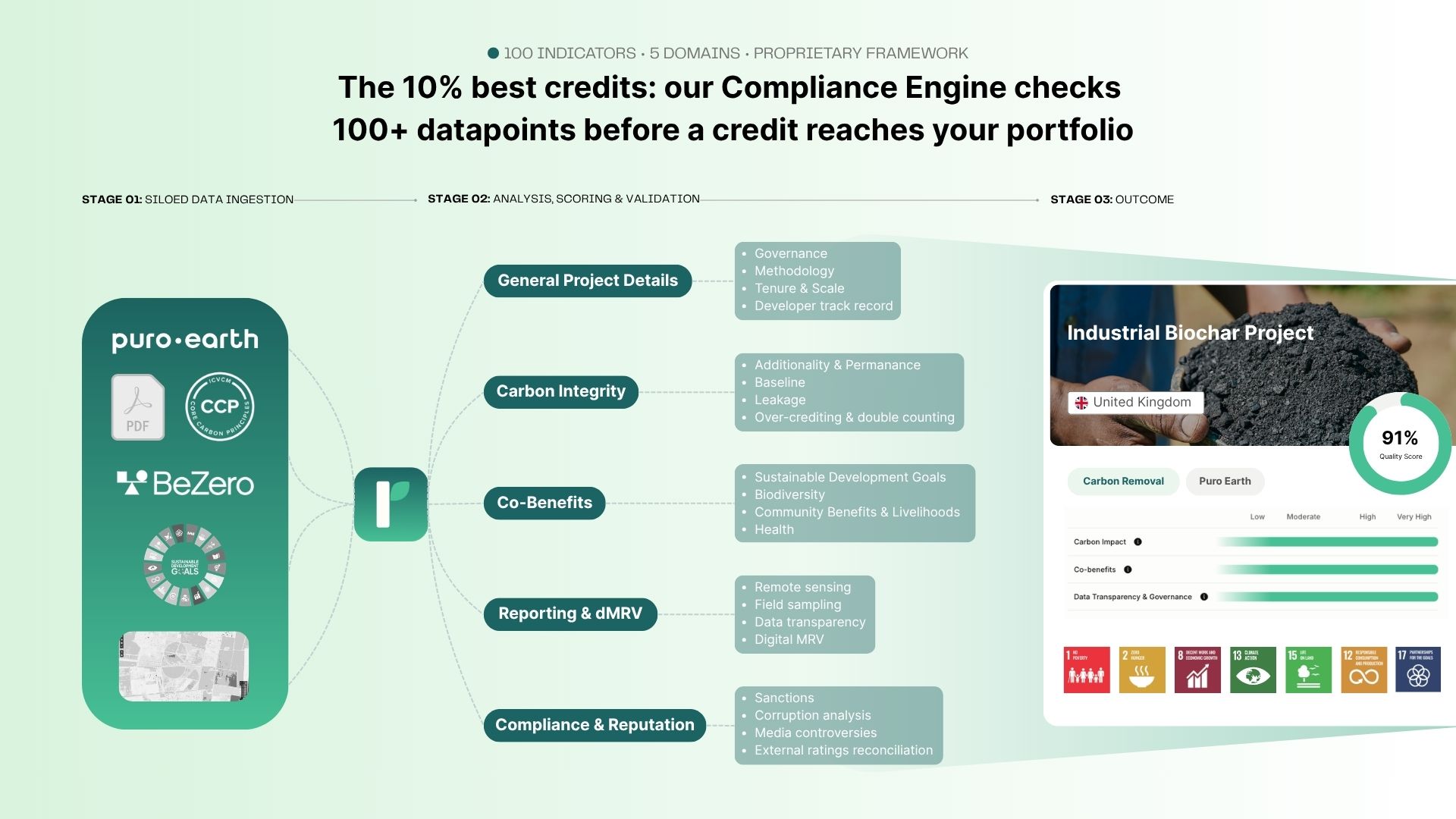
Not all carbon credits are equal. The market spans a wide quality spectrum, and the credits you choose directly affect your reputation, your regulatory standing, and — increasingly — your legal liability.
1. Certified by a recognised standard
Only buy credits certified under Gold Standard, Verra (VCS), or equivalent internationally recognised frameworks. These require independent third-party verification of the emissions reduction or removal claimed.
2. High on the Oxford Principles ladder
The Oxford Principles for Net Zero Aligned Offsetting rank credit types by climate impact. Removal credits — such as peatland restoration or biochar — rank higher than avoidance credits alone. A future-proof portfolio includes a growing share of removals.
3. Protected against double counting
With Article 6 of the Paris Agreement now operational, double counting is a genuine risk: the same credit can in principle be claimed both by the host country and the purchasing company. Ensure your credits carry the appropriate Corresponding Adjustments — this is not a technical footnote, it is a baseline requirement for any credible purchase.
Regreener has supported companies across the GCC in building NRCC-aligned portfolios since early 2025. See our Case Studies for more information.
What Do Carbon Credits Cost in the UAE?
Credit prices vary significantly. Cheap credits — below $5 per tonne — are almost always a signal of poor quality: weak methodologies, outdated projects, or insufficient additionality. In regulated compliance markets such as the UK Emissions Trading System, prices sit around $52 per tonne.
For a high-quality, NRCC-compliant portfolio, expect to pay in the range of $10–$30 per tonne, depending on project type, vintage, and certification. The reputational cost of a greenwashing claim will always exceed the savings from buying cheap credits.
Price per tonne | Signals | |
|---|---|---|
Low-Quality Credits | Below $5 | Weak methodologies, outdated projects, or insufficient additionality |
High-Quality Credits (NRCC-compliant) | $10–$30 | High-integrity project types, recent vintages, and best-practice certification |
Next Steps: Buying Carbon Credits in the UAE
Ready to build a carbon credit portfolio that meets UAE compliance requirements and holds up to scrutiny? Talk to a Regreener expert and get tailored advice for your business.
Frequently Asked Questions about the UAE and Carbon Credits
Which UAE companies are required to buy carbon credits?
Entities emitting 0.5 million tonnes of CO₂ equivalent or more annually — from both direct and indirect sources — must register with the NRCC and may purchase carbon credits to offset their reported emissions. The compliance deadline is 28 June 2025. The regulation applies across all sectors and includes companies in UAE free zones.
Can UAE companies buy international carbon credits?
Yes. The NRCC permits both domestic and international credits, provided they are approved by MOCCAE and traded through SCA-regulated platforms. Credits certified under Verra or Gold Standard are generally eligible, subject to MOCCAE approval.
How do I avoid greenwashing when buying carbon credits in the UAE?
Purchase only certified credits backed by transparent project documentation, independent verification, and clear evidence of additionality. Have your portfolio assessed against the Oxford Principles by an adviser with demonstrated expertise in voluntary carbon markets.
What is the difference between compliance and voluntary carbon credits?
Compliance credits are required to meet legal emissions obligations under frameworks like the NRCC. Voluntary credits are purchased by choice, in support of net zero targets or sustainability commitments. Both categories can be high-quality — the distinction lies in the motivation, not the certification standard.