
have us call you right now.

Carbon Offtake Agreements: A Buyer's Guide

Carbon Offtake Agreements: A Buyer's Guide

Last updated:

Apr 29, 2025

Apr 29, 2025

5 minute read

5 minute read


Choosing the right project is the easy part. The agreement you sign around it decides whether you actually receive the quality and volume you paid for, three, five, or ten years from now. A carbon offtake agreement locks you and a project developer together for the long term, and the terms inside it carry far more risk than most buyers price in.

This guide is written for the buyer side of the table: what to negotiate, how to structure pricing, how much of your demand to commit, and when an offtake is the wrong instrument entirely.

Direct Answer: a carbon offtake agreement is a multi-year contract in which a buyer commits to purchase a defined volume of a carbon project's future credits at an agreed price, delivered on a set schedule. For buyers, it secures long-term supply and price certainty in exchange for taking on delivery and counterparty risk. The terms that protect a buyer most are the volume range, the pricing mechanism, the shortfall remedies, and the quality-downgrade rights, not the headline price per credit.

What a carbon offtake agreement actually commits you to

The structure is close to a renewable energy power purchase agreement, which is why the buyers most comfortable with offtakes are often the ones already running PPAs. The developer gets bankable, multi-year revenue that helps finance the project; you get a secured pipeline of credits and a known cost.

For a full breakdown of how these contracts work and the risks on both sides, see our companion guide on what a carbon offtake agreement is. This article assumes you know the basics and focuses on the buyer's decision.

Want to know which credits fit your company's climate strategy?

Book a free consultation today

Offtake, forward, or spot: pick the right instrument first

Before negotiating terms, confirm an offtake is even the right tool. There are three main ways to buy in the voluntary carbon market, and they suit different buyers.

Spot purchases are credits bought and delivered now. Flexible, immediate, but exposed to whatever the market price is on the day. Forward purchases secure a set volume for near-term future delivery, usually paid upfront, which protects you against price rises but carries delivery risk if the project underperforms. Offtake agreements are the long-term version: a commitment to buy a recurring volume on a schedule over several years, often with phased payments, giving you price certainty and a direct relationship with the project.

The trade-off is straightforward but uncomfortable. The longer the commitment, the more price and supply certainty you gain, and the more delivery and counterparty risk you take on.

The clauses that actually protect a buyer

This is where most buyers underinvest. The project gets weeks of diligence; the contract gets a skim. Reverse that. These are the terms worth fighting for.

Volume, minimum, and maximum

Forecast volumes are estimates, not guarantees. A well-drafted agreement defines a contracted quantity plus an acceptable delivery range (a minimum and maximum), so that minor under-production is not a breach but a meaningful shortfall is. Pin down what happens at each boundary before you sign.
Pricing mechanism: fixed, floating, or collar

Fixed pricing locks a per-credit price for the whole term, giving you complete budget certainty and full exposure if market prices later fall. Floating pricing tracks an index, keeping you closer to market but removing certainty. A collar (a floor and a ceiling) splits the difference and is often the most defensible structure for a buyer protecting a multi-year budget. Decide which risk you actually want to hold before the developer decides for you.

Delivery, shortfall, and remedies

Define the delivery schedule precisely, then define what happens when it slips. The strongest buyer protections are replacement clauses (the developer sources equivalent credits from elsewhere), make-good provisions across future contract years, and refund or price-adjustment mechanisms. A contract that names a shortfall but specifies no remedy is a contract that protects the seller.

Quality and downgrade protection

Between signing and delivery, a project's design can change, a methodology can be revised, or an independent rater can downgrade it. Without protection, you are obliged to take and pay for credits that no longer meet your standard. Negotiate technical quality specifications, the right to reject credits that fall below a defined rating, and ongoing diligence checkpoints at registry milestones. This is the single most overlooked buyer protection in the market.

Expert tip: "Most buyers spend weeks choosing a project and ten minutes on the delivery clause. That ratio is backwards. The contract is where you keep or lose the quality you paid for,"

- Bernard de Wit, Founder of Regreener.

Title transfer and retirement

The contract must state exactly when title passes, that credits are delivered into your registry account, and that they are unencumbered and free of double counting. For credits that may carry a host-country claim, address corresponding adjustments under Article 6 explicitly, so you know whether the tonnes count toward your target or only toward someone else's.

Change in law, methodology, and termination

Carbon markets are governed by moving parts: registries revise protocols, the EU tightens green-claims rules, standards bodies update their criteria. A change-in-law and change-in-methodology clause decides who bears that risk. Pair it with clear termination and default provisions, and with counterparty security (parent guarantees, performance bonds, or staged payments) sized to the developer's financial strength.

a plane flying in the sky with the word go written in it

Explore our Guide: the best Carbon Credit Projects of 2026

Learn about the latest best practices, high-quality projects and strategic options

Why additionality and permanence change your contract, not just your shortlist

Additionality and permanence are usually discussed as quality labels. For an offtake buyer they are contract terms in disguise.

Additionality determines whether the tonnes you buy represent real, extra climate impact. A project that would have happened anyway produces credits that rating agencies and regulators increasingly discount, which is exactly the downgrade scenario your quality clause needs to anticipate. Build the right to reject or reprice downgraded credits into the agreement from the start.

Permanence dictates who carries reversal risk. For nature-based credits exposed to fire, disease, or land-use change, confirm the project contributes to a credible buffer pool and that the contract assigns reversal liability clearly, so a reversal several years after delivery does not land on your balance sheet. Engineered removals price permanence differently, but the principle holds: the durability of the credit should be written into the terms, not assumed.

How much of your demand should you lock in

You do not need to cover 100% of your requirement through a single long-term offtake. A balanced approach, and one advisers commonly recommend, is to split exposure: secure part of your forecast demand through long-term offtake for price and supply certainty, and meet the rest on the spot market as needs arise. A 50/50 split between contracted and spot is a frequently cited starting point for a risk-averse buyer. The right ratio depends on your residual emissions trajectory and how much budget certainty your finance team needs.

Diversification matters as much as ratio. A buyer committing to a large annual volume is almost always better served by three or four projects across different technologies and geographies than by one concentrated bet, however strong that single project looks today. At Regreener, we structure offtake commitments as part of a diversified procurement portfolio for exactly this reason.

Due diligence before you sign

Offtake diligence has two objects, and most buyers only examine the first.

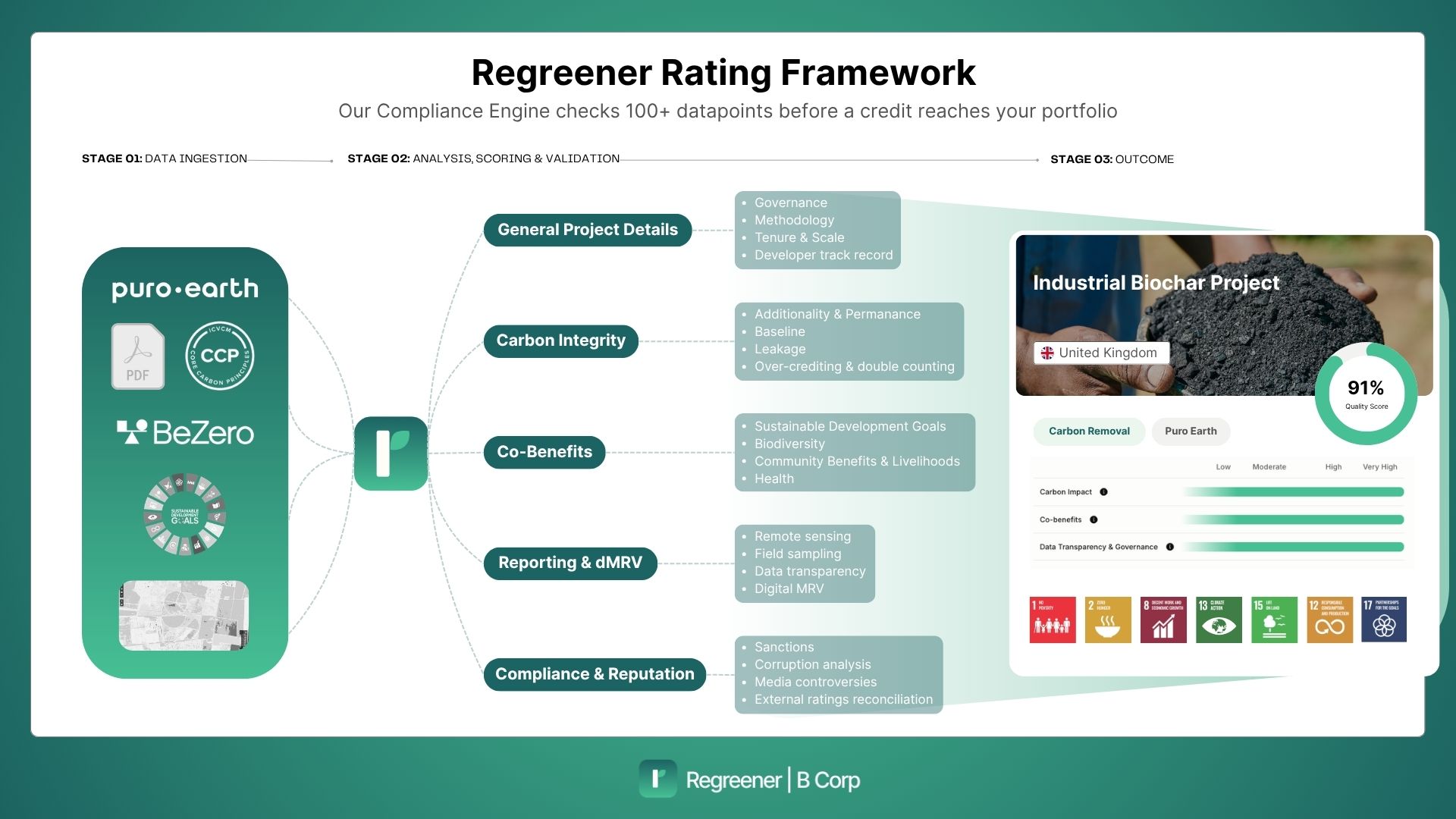
The project: additionality, permanence, the robustness of its MRV (measurement, reporting, and verification), its registry and methodology, and its standing with independent rating agencies. Credits aligned with the ICVCM Core Carbon Principles and issued under credible standards such as Verra or Gold Standard start from a stronger baseline.

The developer: the counterparty you are tied to for years. Examine their track record of delivery, financial position, and project pipeline. A flawless project run by a developer who cannot survive to the delivery date is not a safe purchase. One advantage of offtakes is efficiency here: diligence is done once at signing rather than repeated at every annual spot purchase.

Demand is real, and so is the scrutiny

Corporate appetite for long-term, high-quality removal supply is genuine. Workday, for example, disclosed a multi-year offtake structured through Patch covering projects with Pachama, Planboo, and Tradewater, spanning forest protection, biochar removal, and methane abatement. On the nature-based side, Tullow Oil signed an agreement with the Ghana Forestry Commission to deliver more than 10 million tonnes of REDD+ credits over ten years. (Both are public announcements; verify current status before citing them in a live deal.)

The direction of travel shows in the data too. According to MSCI's analysis of nature-based offtake deals, the number of disclosed nature-based offtake deals in the first half of 2024 was double the total for all of 2023. Treat that as a 2024 data point rather than a current figure, and check the latest before you quote it.

When an offtake is the wrong tool

An offtake suits an organisation with three traits: a clear multi-year net-zero or neutrality commitment, an internal carbon budget that supports long-term contracting, and the operational maturity to manage a structured procurement relationship. If you lack any of the three, the spot market is usually the smarter call. Smaller buyers, or those with uncertain future demand, take on delivery and financial risk in an offtake that they cannot easily justify, and they are typically better served buying verified credits as they need them.

Signing a ten-year commitment to solve a one-year problem is the most expensive mistake a first-time buyer can make.

Reviewing an offtake agreement, or deciding whether to sign one? Talk to a Regreener carbon expert about structuring a diversified, high-quality procurement portfolio that matches your net-zero timeline.

Want to know which credits fit your company's climate strategy?

Book a free consultation today


Choosing the right project is the easy part. The agreement you sign around it decides whether you actually receive the quality and volume you paid for, three, five, or ten years from now. A carbon offtake agreement locks you and a project developer together for the long term, and the terms inside it carry far more risk than most buyers price in.

This guide is written for the buyer side of the table: what to negotiate, how to structure pricing, how much of your demand to commit, and when an offtake is the wrong instrument entirely.

Direct Answer: a carbon offtake agreement is a multi-year contract in which a buyer commits to purchase a defined volume of a carbon project's future credits at an agreed price, delivered on a set schedule. For buyers, it secures long-term supply and price certainty in exchange for taking on delivery and counterparty risk. The terms that protect a buyer most are the volume range, the pricing mechanism, the shortfall remedies, and the quality-downgrade rights, not the headline price per credit.

What a carbon offtake agreement actually commits you to

The structure is close to a renewable energy power purchase agreement, which is why the buyers most comfortable with offtakes are often the ones already running PPAs. The developer gets bankable, multi-year revenue that helps finance the project; you get a secured pipeline of credits and a known cost.

For a full breakdown of how these contracts work and the risks on both sides, see our companion guide on what a carbon offtake agreement is. This article assumes you know the basics and focuses on the buyer's decision.

Want to know which credits fit your company's climate strategy?

Book a free consultation today

Offtake, forward, or spot: pick the right instrument first

Before negotiating terms, confirm an offtake is even the right tool. There are three main ways to buy in the voluntary carbon market, and they suit different buyers.

Spot purchases are credits bought and delivered now. Flexible, immediate, but exposed to whatever the market price is on the day. Forward purchases secure a set volume for near-term future delivery, usually paid upfront, which protects you against price rises but carries delivery risk if the project underperforms. Offtake agreements are the long-term version: a commitment to buy a recurring volume on a schedule over several years, often with phased payments, giving you price certainty and a direct relationship with the project.

The trade-off is straightforward but uncomfortable. The longer the commitment, the more price and supply certainty you gain, and the more delivery and counterparty risk you take on.

The clauses that actually protect a buyer

This is where most buyers underinvest. The project gets weeks of diligence; the contract gets a skim. Reverse that. These are the terms worth fighting for.

Volume, minimum, and maximum

Forecast volumes are estimates, not guarantees. A well-drafted agreement defines a contracted quantity plus an acceptable delivery range (a minimum and maximum), so that minor under-production is not a breach but a meaningful shortfall is. Pin down what happens at each boundary before you sign.

Pricing mechanism: fixed, floating, or collar

Fixed pricing locks a per-credit price for the whole term, giving you complete budget certainty and full exposure if market prices later fall. Floating pricing tracks an index, keeping you closer to market but removing certainty. A collar (a floor and a ceiling) splits the difference and is often the most defensible structure for a buyer protecting a multi-year budget. Decide which risk you actually want to hold before the developer decides for you.

Delivery, shortfall, and remedies

Define the delivery schedule precisely, then define what happens when it slips. The strongest buyer protections are replacement clauses (the developer sources equivalent credits from elsewhere), make-good provisions across future contract years, and refund or price-adjustment mechanisms. A contract that names a shortfall but specifies no remedy is a contract that protects the seller.

Quality and downgrade protection

Between signing and delivery, a project's design can change, a methodology can be revised, or an independent rater can downgrade it. Without protection, you are obliged to take and pay for credits that no longer meet your standard. Negotiate technical quality specifications, the right to reject credits that fall below a defined rating, and ongoing diligence checkpoints at registry milestones. This is the single most overlooked buyer protection in the market.

Expert tip: "Most buyers spend weeks choosing a project and ten minutes on the delivery clause. That ratio is backwards. The contract is where you keep or lose the quality you paid for,"

- Bernard de Wit, Founder of Regreener.

Title transfer and retirement

The contract must state exactly when title passes, that credits are delivered into your registry account, and that they are unencumbered and free of double counting. For credits that may carry a host-country claim, address corresponding adjustments under Article 6 explicitly, so you know whether the tonnes count toward your target or only toward someone else's.

Change in law, methodology, and termination

Carbon markets are governed by moving parts: registries revise protocols, the EU tightens green-claims rules, standards bodies update their criteria. A change-in-law and change-in-methodology clause decides who bears that risk. Pair it with clear termination and default provisions, and with counterparty security (parent guarantees, performance bonds, or staged payments) sized to the developer's financial strength.

a plane flying in the sky with the word go written in it

Explore our Guide: the best Carbon Credit Projects of 2026

Learn about the latest best practices, high-quality projects and strategic options

Why additionality and permanence change your contract, not just your shortlist

Additionality and permanence are usually discussed as quality labels. For an offtake buyer they are contract terms in disguise.

Additionality determines whether the tonnes you buy represent real, extra climate impact. A project that would have happened anyway produces credits that rating agencies and regulators increasingly discount, which is exactly the downgrade scenario your quality clause needs to anticipate. Build the right to reject or reprice downgraded credits into the agreement from the start.

Permanence dictates who carries reversal risk. For nature-based credits exposed to fire, disease, or land-use change, confirm the project contributes to a credible buffer pool and that the contract assigns reversal liability clearly, so a reversal several years after delivery does not land on your balance sheet. Engineered removals price permanence differently, but the principle holds: the durability of the credit should be written into the terms, not assumed.

How much of your demand should you lock in

You do not need to cover 100% of your requirement through a single long-term offtake. A balanced approach, and one advisers commonly recommend, is to split exposure: secure part of your forecast demand through long-term offtake for price and supply certainty, and meet the rest on the spot market as needs arise. A 50/50 split between contracted and spot is a frequently cited starting point for a risk-averse buyer. The right ratio depends on your residual emissions trajectory and how much budget certainty your finance team needs.

Diversification matters as much as ratio. A buyer committing to a large annual volume is almost always better served by three or four projects across different technologies and geographies than by one concentrated bet, however strong that single project looks today. At Regreener, we structure offtake commitments as part of a diversified procurement portfolio for exactly this reason.

Due diligence before you sign

Offtake diligence has two objects, and most buyers only examine the first.

The project: additionality, permanence, the robustness of its MRV (measurement, reporting, and verification), its registry and methodology, and its standing with independent rating agencies. Credits aligned with the ICVCM Core Carbon Principles and issued under credible standards such as Verra or Gold Standard start from a stronger baseline.

The developer: the counterparty you are tied to for years. Examine their track record of delivery, financial position, and project pipeline. A flawless project run by a developer who cannot survive to the delivery date is not a safe purchase. One advantage of offtakes is efficiency here: diligence is done once at signing rather than repeated at every annual spot purchase.

Demand is real, and so is the scrutiny

Corporate appetite for long-term, high-quality removal supply is genuine. Workday, for example, disclosed a multi-year offtake structured through Patch covering projects with Pachama, Planboo, and Tradewater, spanning forest protection, biochar removal, and methane abatement. On the nature-based side, Tullow Oil signed an agreement with the Ghana Forestry Commission to deliver more than 10 million tonnes of REDD+ credits over ten years. (Both are public announcements; verify current status before citing them in a live deal.)

The direction of travel shows in the data too. According to MSCI's analysis of nature-based offtake deals, the number of disclosed nature-based offtake deals in the first half of 2024 was double the total for all of 2023. Treat that as a 2024 data point rather than a current figure, and check the latest before you quote it.

When an offtake is the wrong tool

An offtake suits an organisation with three traits: a clear multi-year net-zero or neutrality commitment, an internal carbon budget that supports long-term contracting, and the operational maturity to manage a structured procurement relationship. If you lack any of the three, the spot market is usually the smarter call. Smaller buyers, or those with uncertain future demand, take on delivery and financial risk in an offtake that they cannot easily justify, and they are typically better served buying verified credits as they need them.

Signing a ten-year commitment to solve a one-year problem is the most expensive mistake a first-time buyer can make.

Reviewing an offtake agreement, or deciding whether to sign one? Talk to a Regreener carbon expert about structuring a diversified, high-quality procurement portfolio that matches your net-zero timeline.

Want to know which credits fit your company's climate strategy?

Book a free consultation today


Choosing the right project is the easy part. The agreement you sign around it decides whether you actually receive the quality and volume you paid for, three, five, or ten years from now. A carbon offtake agreement locks you and a project developer together for the long term, and the terms inside it carry far more risk than most buyers price in.

This guide is written for the buyer side of the table: what to negotiate, how to structure pricing, how much of your demand to commit, and when an offtake is the wrong instrument entirely.

Direct Answer: a carbon offtake agreement is a multi-year contract in which a buyer commits to purchase a defined volume of a carbon project's future credits at an agreed price, delivered on a set schedule. For buyers, it secures long-term supply and price certainty in exchange for taking on delivery and counterparty risk. The terms that protect a buyer most are the volume range, the pricing mechanism, the shortfall remedies, and the quality-downgrade rights, not the headline price per credit.

What a carbon offtake agreement actually commits you to

The structure is close to a renewable energy power purchase agreement, which is why the buyers most comfortable with offtakes are often the ones already running PPAs. The developer gets bankable, multi-year revenue that helps finance the project; you get a secured pipeline of credits and a known cost.

For a full breakdown of how these contracts work and the risks on both sides, see our companion guide on what a carbon offtake agreement is. This article assumes you know the basics and focuses on the buyer's decision.

Want to know which credits fit your company's climate strategy?

Book a free consultation today

Offtake, forward, or spot: pick the right instrument first

Before negotiating terms, confirm an offtake is even the right tool. There are three main ways to buy in the voluntary carbon market, and they suit different buyers.

Spot purchases are credits bought and delivered now. Flexible, immediate, but exposed to whatever the market price is on the day. Forward purchases secure a set volume for near-term future delivery, usually paid upfront, which protects you against price rises but carries delivery risk if the project underperforms. Offtake agreements are the long-term version: a commitment to buy a recurring volume on a schedule over several years, often with phased payments, giving you price certainty and a direct relationship with the project.

The trade-off is straightforward but uncomfortable. The longer the commitment, the more price and supply certainty you gain, and the more delivery and counterparty risk you take on.

The clauses that actually protect a buyer

This is where most buyers underinvest. The project gets weeks of diligence; the contract gets a skim. Reverse that. These are the terms worth fighting for.

Volume, minimum, and maximum

Forecast volumes are estimates, not guarantees. A well-drafted agreement defines a contracted quantity plus an acceptable delivery range (a minimum and maximum), so that minor under-production is not a breach but a meaningful shortfall is. Pin down what happens at each boundary before you sign.

Pricing mechanism: fixed, floating, or collar

Fixed pricing locks a per-credit price for the whole term, giving you complete budget certainty and full exposure if market prices later fall. Floating pricing tracks an index, keeping you closer to market but removing certainty. A collar (a floor and a ceiling) splits the difference and is often the most defensible structure for a buyer protecting a multi-year budget. Decide which risk you actually want to hold before the developer decides for you.

Delivery, shortfall, and remedies

Define the delivery schedule precisely, then define what happens when it slips. The strongest buyer protections are replacement clauses (the developer sources equivalent credits from elsewhere), make-good provisions across future contract years, and refund or price-adjustment mechanisms. A contract that names a shortfall but specifies no remedy is a contract that protects the seller.

Quality and downgrade protection

Between signing and delivery, a project's design can change, a methodology can be revised, or an independent rater can downgrade it. Without protection, you are obliged to take and pay for credits that no longer meet your standard. Negotiate technical quality specifications, the right to reject credits that fall below a defined rating, and ongoing diligence checkpoints at registry milestones. This is the single most overlooked buyer protection in the market.

Expert tip: "Most buyers spend weeks choosing a project and ten minutes on the delivery clause. That ratio is backwards. The contract is where you keep or lose the quality you paid for,"

- Bernard de Wit, Founder of Regreener.

Title transfer and retirement

The contract must state exactly when title passes, that credits are delivered into your registry account, and that they are unencumbered and free of double counting. For credits that may carry a host-country claim, address corresponding adjustments under Article 6 explicitly, so you know whether the tonnes count toward your target or only toward someone else's.

Change in law, methodology, and termination

Carbon markets are governed by moving parts: registries revise protocols, the EU tightens green-claims rules, standards bodies update their criteria. A change-in-law and change-in-methodology clause decides who bears that risk. Pair it with clear termination and default provisions, and with counterparty security (parent guarantees, performance bonds, or staged payments) sized to the developer's financial strength.

a plane flying in the sky with the word go written in it

Explore our Guide: the best Carbon Credit Projects of 2026

Learn about the latest best practices, high-quality projects and strategic options

Why additionality and permanence change your contract, not just your shortlist

Additionality and permanence are usually discussed as quality labels. For an offtake buyer they are contract terms in disguise.

Additionality determines whether the tonnes you buy represent real, extra climate impact. A project that would have happened anyway produces credits that rating agencies and regulators increasingly discount, which is exactly the downgrade scenario your quality clause needs to anticipate. Build the right to reject or reprice downgraded credits into the agreement from the start.

Permanence dictates who carries reversal risk. For nature-based credits exposed to fire, disease, or land-use change, confirm the project contributes to a credible buffer pool and that the contract assigns reversal liability clearly, so a reversal several years after delivery does not land on your balance sheet. Engineered removals price permanence differently, but the principle holds: the durability of the credit should be written into the terms, not assumed.

How much of your demand should you lock in

You do not need to cover 100% of your requirement through a single long-term offtake. A balanced approach, and one advisers commonly recommend, is to split exposure: secure part of your forecast demand through long-term offtake for price and supply certainty, and meet the rest on the spot market as needs arise. A 50/50 split between contracted and spot is a frequently cited starting point for a risk-averse buyer. The right ratio depends on your residual emissions trajectory and how much budget certainty your finance team needs.

Diversification matters as much as ratio. A buyer committing to a large annual volume is almost always better served by three or four projects across different technologies and geographies than by one concentrated bet, however strong that single project looks today. At Regreener, we structure offtake commitments as part of a diversified procurement portfolio for exactly this reason.

Due diligence before you sign

Offtake diligence has two objects, and most buyers only examine the first.

The project: additionality, permanence, the robustness of its MRV (measurement, reporting, and verification), its registry and methodology, and its standing with independent rating agencies. Credits aligned with the ICVCM Core Carbon Principles and issued under credible standards such as Verra or Gold Standard start from a stronger baseline.

The developer: the counterparty you are tied to for years. Examine their track record of delivery, financial position, and project pipeline. A flawless project run by a developer who cannot survive to the delivery date is not a safe purchase. One advantage of offtakes is efficiency here: diligence is done once at signing rather than repeated at every annual spot purchase.

Demand is real, and so is the scrutiny

Corporate appetite for long-term, high-quality removal supply is genuine. Workday, for example, disclosed a multi-year offtake structured through Patch covering projects with Pachama, Planboo, and Tradewater, spanning forest protection, biochar removal, and methane abatement. On the nature-based side, Tullow Oil signed an agreement with the Ghana Forestry Commission to deliver more than 10 million tonnes of REDD+ credits over ten years. (Both are public announcements; verify current status before citing them in a live deal.)

The direction of travel shows in the data too. According to MSCI's analysis of nature-based offtake deals, the number of disclosed nature-based offtake deals in the first half of 2024 was double the total for all of 2023. Treat that as a 2024 data point rather than a current figure, and check the latest before you quote it.

When an offtake is the wrong tool

An offtake suits an organisation with three traits: a clear multi-year net-zero or neutrality commitment, an internal carbon budget that supports long-term contracting, and the operational maturity to manage a structured procurement relationship. If you lack any of the three, the spot market is usually the smarter call. Smaller buyers, or those with uncertain future demand, take on delivery and financial risk in an offtake that they cannot easily justify, and they are typically better served buying verified credits as they need them.

Signing a ten-year commitment to solve a one-year problem is the most expensive mistake a first-time buyer can make.

Reviewing an offtake agreement, or deciding whether to sign one? Talk to a Regreener carbon expert about structuring a diversified, high-quality procurement portfolio that matches your net-zero timeline.

Want to know which credits fit your company's climate strategy?

Book a free consultation today

About the Author

bernard de wit of regreener
Bernard de Wit

Bernard is the Founder of Regreener, starting in 2020 after studying Law in Leiden (the Netherlands) and Oxford (United Kingdom). Passionate about climate action and carbon credit markets, he helps companies take trustworthy, impactful climate action by sharing insights and best practices. Since 2020, he has assessed hundreds carbon projects against Regreener's 100+ datapoint quality framework. He writes regularly on voluntary carbon market integrity, Article 6 mechanisms, and the SBTi Net-Zero Standard v2.0. When he’s not writing or advising businesses on their sustainability goals, you might find Bernard on the tennis court or catching up with friends.

TABLE OF CONTENTS

Share Article

Share Article

FAQs

What is carbon offtake due diligence?

It is the assessment a buyer runs before committing to a multi-year carbon credit contract, covering project integrity, MRV, delivery risk, contract terms, counterparty strength and ongoing monitoring. Unlike spot-purchase diligence, it must scrutinise the contract clauses, because the buyer carries project and delivery risk for the full term.

How is offtake diligence different from buying spot credits?

Spot credits already exist and are verified, so the buyer carries almost no project risk. An offtake commits you to future credits, so you must assess whether the project will deliver over years, and the contract's underdelivery and replacement clauses become as important as the credit's quality rating.

What is the main risk of an offtake versus an annual purchase?

Delivery and project risk. With an annual purchase you buy credits that already exist and passed verification, so you carry almost no project risk. With an offtake you commit to future credits, so under-issuance, registry suspension or methodology changes can affect delivery. Strong underdelivery and replacement clauses are how good contracts manage this.

What happens if the project under-delivers?

The make good clause governs. Depending on how it is drafted, the seller may deliver replacement credits from a backup pool, receive a delivery extension in exchange for an increased volume, or pay liquidated damages per credit shortfall. The strongest contracts combine all three options and leave the buyer with a meaningful financial remedy regardless of which cure path the seller takes.

Are spot prices going to rise?

High-quality spot prices have been rising and are expected to continue rising as supply tightens. Low-quality avoidance credits without integrity labels are likely to remain cheap or fall further. The two ends of the market are diverging, not converging.

Greenwashing-proof carbon removal

Get a free consultation with Regreener's carbon removal experts