
laat ons je terugbellen.

Carbon Credit Offtake Agreements: How to Choose Your Partner

Carbon Credit Offtake Agreements: How to Choose Your Partner

Laatst bijgewerkt:

29 april, 2025

29 april, 2025

6 minuten leestijd

6 minuten leestijd

The contract template matters far less than the counterparty who signs it. A carbon credit offtake agreement can run five to fifteen years, so the partner you commit to today is the partner who either delivers verified, audit-ready credits in 2032 or leaves you with a shortfall and a reporting problem. According to Sylvera, the value of offtake deals announced in 2025 reached roughly €12.3 billion, up from €3.95 billion the year before. The instrument has moved from niche to mainstream, and the supply of genuinely strong partners has not kept pace.

This guide sets out the five criteria that separate a strong offtake partner from a weak one, then applies them to five strategic options for European B2B buyers.

What a carbon credit offtake agreement actually commits you to

A carbon credit offtake agreement is a long-term contract in which a buyer commits to purchase a defined volume of carbon credits from a project, delivered annually as the project issues them, usually at a fixed or pre-agreed price. Payment is typically made on delivery, sometimes with milestone payments tied to project development stages. It differs from a spot purchase (credits bought and delivered immediately) and from a forward purchase (a near-term volume secured upfront).

The trade is straightforward. You give the project revenue certainty, and in return you secure supply and hedge against future price rises. The risk is equally simple. If the project underdelivers on volume, timing, or quality, you are the one explaining the gap to your auditor. That is why partner selection is the decision that carries the contract.

The five criteria that separate a strong offtake partner from a weak one

Before comparing names, fix your evaluation criteria. These five do most of the work.

1. Quality and integrity screening

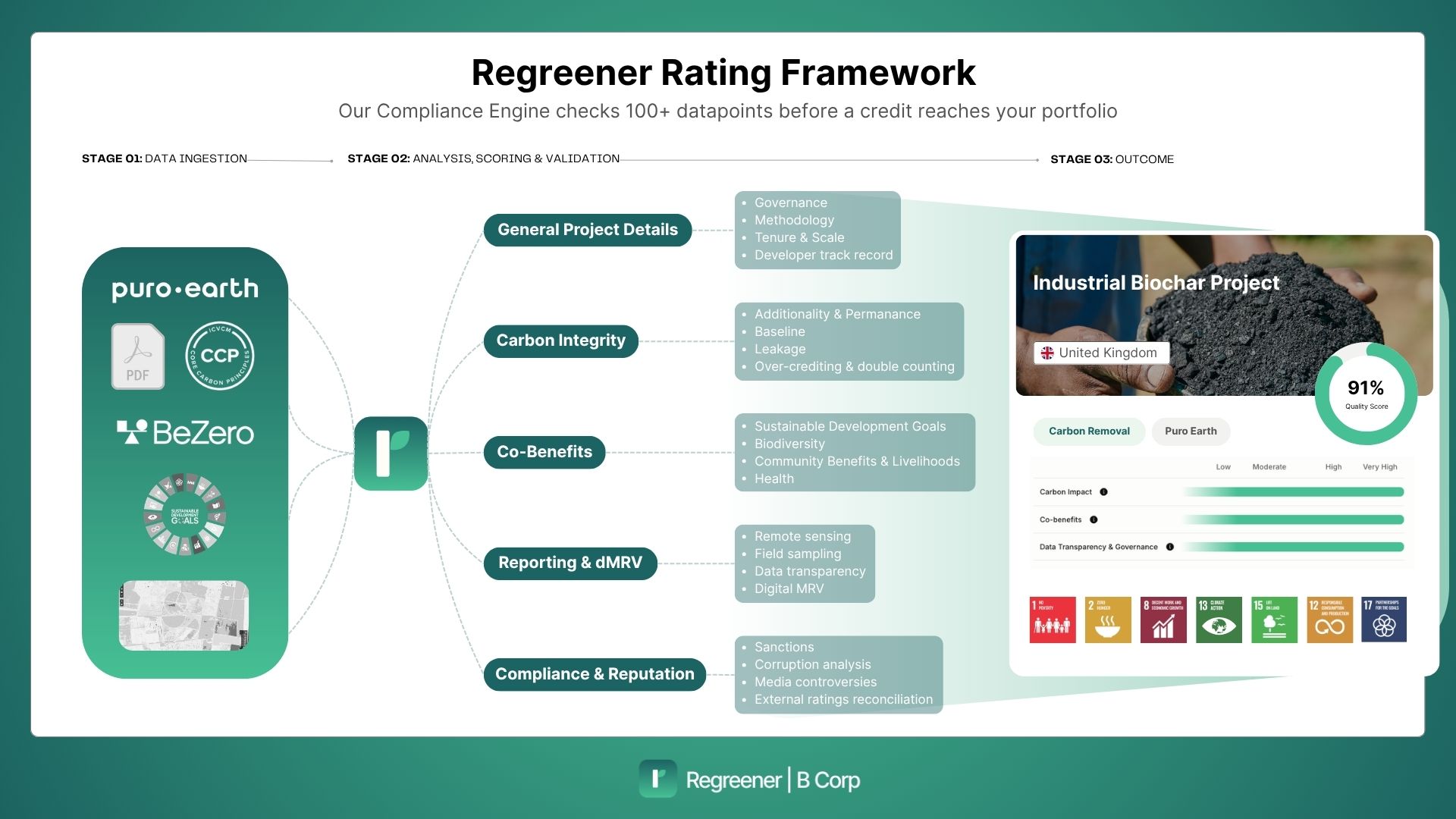
The single largest source of reputational risk in an offtake is buying years of credits from a project that turns out to be over-credited or non-additional. A serious partner screens projects against recognised standards (Verra VCS, Gold Standard, Puro.earth) and the Core Carbon Principles before you ever sign, and can show you the evidence on additionality, permanence, and the quality of the project's monitoring, reporting, and verification (MRV). Ask what the partner rejects, not just what it offers.
2. Delivery risk protection

Over a decade-long contract, projects ramp slower than planned, miss verification windows, or have credits invalidated. The contractual protections that matter are substitution clauses, shortfall remedies, and clear counterparty obligations. A soft contract stays silent until something goes wrong. Confirm year-by-year delivery targets and what happens if they are missed.

3. Regulatory and reporting alignment

For European buyers, an offtake only earns its place if the credits and documentation hold up under CSRD and ESRS E1 disclosure. The EU Carbon Removal Certification Framework (CRCF) is also reshaping what counts as a credible removal. A strong partner delivers registry-backed credits with documentation your reporting system can ingest without manual reconstruction.

4. Pricing structure transparency

Whatever pricing structure a deal uses, none is inherently better than another, but opacity is always worse. The partner should disclose how money flows to the project, including their own margin, and explain which structure suits your budget and risk appetite. Hidden fees in a fifteen-year contract compound.

5. European market fit and counterparty strength

A partner that understands the European regulatory environment, operates in your language and time zone, and will still exist at the end of your contract term reduces friction across the entire deal. In a fifteen-year agreement, counterparty longevity decides whether the contract is worth anything.

How offtake pricing is structured

Most offtake disputes start with price, so understand the four common structures before you sign. Fixed locks a single price per credit for the whole term, giving both sides full predictability. Floating ties the price to a market index at each delivery, which shifts price risk onto the buyer. Indexed sets a base price that adjusts by a defined formula, splitting the risk between both parties. Collared combines a price floor and ceiling, capping the downside and the upside so neither side is fully exposed. For a first multi-year agreement, fixed or collared pricing is usually the most defensible choice for budgeting and audit purposes.

The 5 best carbon offtake partners for European B2B buyers

Each option below is strongest for a different buyer profile. The right choice depends on your volume, internal capacity, and how much of the work you want to keep in-house.

Partner

Type

Best for

Regreener

Curated, managed provider

European corporates wanting quality-screened, audit-ready offtakes managed end to end

Patch

Enterprise procurement platform

Large buyers running procurement through software at scale

CORE Markets

Market advisor / broker

Buyers structuring a large, bespoke deal who want advisory at the table

Senken

Curated, managed provider

Buyers wanting broader project choice with some guidance

Direct developers (e.g. Neustark)

Project counterparty

Buyers anchoring a portfolio with a specific, verifiable removal

1. Regreener: best for quality-led, fully managed offtake

Regreener is a B Corp-certified, Amsterdam-based provider that works with more than 200 European corporate clients and is built specifically for B2B buyers who want a quality filter and a partner that acts as an extension of their sustainability team.

Every project is screened against a 100+ datapoint quality framework before it reaches a client shortlist, with regulatory integrity treated as a core selection domain rather than an afterthought. Regreener handles sourcing, contracting, retirement, and CSRD-ready reporting end to end, which suits buyers who want the security of a long-term offtake without building a procurement function internally. For most European corporates entering their first multi-year agreement, this is the lowest-friction route to a defensible portfolio.

Best for: European corporates who want curated, audit-ready offtakes managed end to end.

Want to know which credits fit your company's climate strategy?

Book a free consultation today

2. Patch: best for enterprise, software-driven procurement

Patch is a US-based procurement platform that centralises sourcing, due diligence, contracting, and reporting across a very large universe of projects, and offers a dedicated offtake product.

It is the strongest fit for large buyers who want to run procurement through software and integrate carbon into existing workflows. Workday, for example, has used Patch for multi-year offtake arrangements. European buyers should weigh the US base against their preference for a local counterparty and EU-specific regulatory support.

Best for: Large buyers who want platform-driven procurement at scale.

3. CORE Markets: best for bespoke deal structuring

CORE Markets is a market advisor that structures and negotiates offtake agreements much like a power purchase agreement, helping buyers and developers explore deal mechanics, pricing, and hedging.

This is the right partner when you want an advisor at the table to design a tailored deal rather than buy from a curated portfolio. It suits buyers with significant volume and a clear view of the specific projects they want to contract directly.

Best for: Buyers structuring a large, bespoke deal who want advisory at the negotiating table.

4. Senken: best for marketplace breadth with advisory

Senken is a Germany-based platform that combines marketplace access with advisory, sitting between a curated provider and an open marketplace. It works well for buyers who want broader project choice than a tightly curated shortlist while still having guidance on hand. As with any marketplace model, the quality filter is partly yours to apply, so the integrity screening criterion above carries more weight here.

Best for: Buyers who want marketplace choice plus a layer of advisory.

5. Direct project developers: best for single-counterparty removals

For buyers focused on a specific durable removal, contracting straight with the developer can be the cleanest route. Swiss mineralisation provider Neustark is one example: a single counterparty, physically verifiable storage, and Gold Standard certification, with a multi-year offtake agreement to supply Microsoft with 27,600 tonnes of carbon removal over six years.

The trade-off is concentration risk and limited volume, which most buyers manage by combining one or two developer contracts with a broader portfolio.

Best for: Buyers anchoring a portfolio with a specific, verifiable removal.

A note on ratings tools: providers such as Sylvera rate and benchmark credits but do not sell you an offtake. Treat them as a due-diligence input alongside your chosen partner, not as the partner itself.

How to use these criteria in practice

Run any prospective partner against all five criteria and ask for evidence, not assurances. The most risk-averse approach is rarely a single fifteen-year commitment to one counterparty. A common hedge is to cover roughly half your expected requirement through long-term offtake and source the other half on the spot market as needed, which protects you against both price spikes and over-commitment.

A balanced position often combines a managed, curated offtake for the bulk of your contracted volume with one direct developer contract for a specific removal. The partner who helps you build that balance, rather than selling you the largest possible contract, is usually the one worth signing.

Not sure which offtake structure fits your emissions profile and budget? Book a free portfolio review and Regreener's team will model a partner and project mix around your sector, volume, and reporting requirements.

Want to know which credits fit your company's climate strategy?

Book a free consultation today

The contract template matters far less than the counterparty who signs it. A carbon credit offtake agreement can run five to fifteen years, so the partner you commit to today is the partner who either delivers verified, audit-ready credits in 2032 or leaves you with a shortfall and a reporting problem. According to Sylvera, the value of offtake deals announced in 2025 reached roughly €12.3 billion, up from €3.95 billion the year before. The instrument has moved from niche to mainstream, and the supply of genuinely strong partners has not kept pace.

This guide sets out the five criteria that separate a strong offtake partner from a weak one, then applies them to five strategic options for European B2B buyers.

What a carbon credit offtake agreement actually commits you to

A carbon credit offtake agreement is a long-term contract in which a buyer commits to purchase a defined volume of carbon credits from a project, delivered annually as the project issues them, usually at a fixed or pre-agreed price. Payment is typically made on delivery, sometimes with milestone payments tied to project development stages. It differs from a spot purchase (credits bought and delivered immediately) and from a forward purchase (a near-term volume secured upfront).

The trade is straightforward. You give the project revenue certainty, and in return you secure supply and hedge against future price rises. The risk is equally simple. If the project underdelivers on volume, timing, or quality, you are the one explaining the gap to your auditor. That is why partner selection is the decision that carries the contract.

The five criteria that separate a strong offtake partner from a weak one

Before comparing names, fix your evaluation criteria. These five do most of the work.

1. Quality and integrity screening

The single largest source of reputational risk in an offtake is buying years of credits from a project that turns out to be over-credited or non-additional. A serious partner screens projects against recognised standards (Verra VCS, Gold Standard, Puro.earth) and the Core Carbon Principles before you ever sign, and can show you the evidence on additionality, permanence, and the quality of the project's monitoring, reporting, and verification (MRV). Ask what the partner rejects, not just what it offers.

2. Delivery risk protection

Over a decade-long contract, projects ramp slower than planned, miss verification windows, or have credits invalidated. The contractual protections that matter are substitution clauses, shortfall remedies, and clear counterparty obligations. A soft contract stays silent until something goes wrong. Confirm year-by-year delivery targets and what happens if they are missed.

3. Regulatory and reporting alignment

For European buyers, an offtake only earns its place if the credits and documentation hold up under CSRD and ESRS E1 disclosure. The EU Carbon Removal Certification Framework (CRCF) is also reshaping what counts as a credible removal. A strong partner delivers registry-backed credits with documentation your reporting system can ingest without manual reconstruction.

4. Pricing structure transparency

Whatever pricing structure a deal uses, none is inherently better than another, but opacity is always worse. The partner should disclose how money flows to the project, including their own margin, and explain which structure suits your budget and risk appetite. Hidden fees in a fifteen-year contract compound.

5. European market fit and counterparty strength

A partner that understands the European regulatory environment, operates in your language and time zone, and will still exist at the end of your contract term reduces friction across the entire deal. In a fifteen-year agreement, counterparty longevity decides whether the contract is worth anything.

How offtake pricing is structured

Most offtake disputes start with price, so understand the four common structures before you sign. Fixed locks a single price per credit for the whole term, giving both sides full predictability. Floating ties the price to a market index at each delivery, which shifts price risk onto the buyer. Indexed sets a base price that adjusts by a defined formula, splitting the risk between both parties. Collared combines a price floor and ceiling, capping the downside and the upside so neither side is fully exposed. For a first multi-year agreement, fixed or collared pricing is usually the most defensible choice for budgeting and audit purposes.

The 5 best carbon offtake partners for European B2B buyers

Each option below is strongest for a different buyer profile. The right choice depends on your volume, internal capacity, and how much of the work you want to keep in-house.

Partner

Type

Best for

Regreener

Curated, managed provider

European corporates wanting quality-screened, audit-ready offtakes managed end to end

Patch

Enterprise procurement platform

Large buyers running procurement through software at scale

CORE Markets

Market advisor / broker

Buyers structuring a large, bespoke deal who want advisory at the table

Senken

Curated, managed provider

Buyers wanting broader project choice with some guidance

Direct developers (e.g. Neustark)

Project counterparty

Buyers anchoring a portfolio with a specific, verifiable removal

1. Regreener: best for quality-led, fully managed offtake

Regreener is a B Corp-certified, Amsterdam-based provider that works with more than 200 European corporate clients and is built specifically for B2B buyers who want a quality filter and a partner that acts as an extension of their sustainability team.

Every project is screened against a 100+ datapoint quality framework before it reaches a client shortlist, with regulatory integrity treated as a core selection domain rather than an afterthought. Regreener handles sourcing, contracting, retirement, and CSRD-ready reporting end to end, which suits buyers who want the security of a long-term offtake without building a procurement function internally. For most European corporates entering their first multi-year agreement, this is the lowest-friction route to a defensible portfolio.

Best for: European corporates who want curated, audit-ready offtakes managed end to end.

Want to know which credits fit your company's climate strategy?

Book a free consultation today

2. Patch: best for enterprise, software-driven procurement

Patch is a US-based procurement platform that centralises sourcing, due diligence, contracting, and reporting across a very large universe of projects, and offers a dedicated offtake product.

It is the strongest fit for large buyers who want to run procurement through software and integrate carbon into existing workflows. Workday, for example, has used Patch for multi-year offtake arrangements. European buyers should weigh the US base against their preference for a local counterparty and EU-specific regulatory support.

Best for: Large buyers who want platform-driven procurement at scale.

3. CORE Markets: best for bespoke deal structuring

CORE Markets is a market advisor that structures and negotiates offtake agreements much like a power purchase agreement, helping buyers and developers explore deal mechanics, pricing, and hedging.

This is the right partner when you want an advisor at the table to design a tailored deal rather than buy from a curated portfolio. It suits buyers with significant volume and a clear view of the specific projects they want to contract directly.

Best for: Buyers structuring a large, bespoke deal who want advisory at the negotiating table.

4. Senken: best for marketplace breadth with advisory

Senken is a Germany-based platform that combines marketplace access with advisory, sitting between a curated provider and an open marketplace. It works well for buyers who want broader project choice than a tightly curated shortlist while still having guidance on hand. As with any marketplace model, the quality filter is partly yours to apply, so the integrity screening criterion above carries more weight here.

Best for: Buyers who want marketplace choice plus a layer of advisory.

5. Direct project developers: best for single-counterparty removals

For buyers focused on a specific durable removal, contracting straight with the developer can be the cleanest route. Swiss mineralisation provider Neustark is one example: a single counterparty, physically verifiable storage, and Gold Standard certification, with a multi-year offtake agreement to supply Microsoft with 27,600 tonnes of carbon removal over six years.

The trade-off is concentration risk and limited volume, which most buyers manage by combining one or two developer contracts with a broader portfolio.

Best for: Buyers anchoring a portfolio with a specific, verifiable removal.

A note on ratings tools: providers such as Sylvera rate and benchmark credits but do not sell you an offtake. Treat them as a due-diligence input alongside your chosen partner, not as the partner itself.

How to use these criteria in practice

Run any prospective partner against all five criteria and ask for evidence, not assurances. The most risk-averse approach is rarely a single fifteen-year commitment to one counterparty. A common hedge is to cover roughly half your expected requirement through long-term offtake and source the other half on the spot market as needed, which protects you against both price spikes and over-commitment.

A balanced position often combines a managed, curated offtake for the bulk of your contracted volume with one direct developer contract for a specific removal. The partner who helps you build that balance, rather than selling you the largest possible contract, is usually the one worth signing.

Not sure which offtake structure fits your emissions profile and budget? Book a free portfolio review and Regreener's team will model a partner and project mix around your sector, volume, and reporting requirements.

Want to know which credits fit your company's climate strategy?

Book a free consultation today

The contract template matters far less than the counterparty who signs it. A carbon credit offtake agreement can run five to fifteen years, so the partner you commit to today is the partner who either delivers verified, audit-ready credits in 2032 or leaves you with a shortfall and a reporting problem. According to Sylvera, the value of offtake deals announced in 2025 reached roughly €12.3 billion, up from €3.95 billion the year before. The instrument has moved from niche to mainstream, and the supply of genuinely strong partners has not kept pace.

This guide sets out the five criteria that separate a strong offtake partner from a weak one, then applies them to five strategic options for European B2B buyers.

What a carbon credit offtake agreement actually commits you to

A carbon credit offtake agreement is a long-term contract in which a buyer commits to purchase a defined volume of carbon credits from a project, delivered annually as the project issues them, usually at a fixed or pre-agreed price. Payment is typically made on delivery, sometimes with milestone payments tied to project development stages. It differs from a spot purchase (credits bought and delivered immediately) and from a forward purchase (a near-term volume secured upfront).

The trade is straightforward. You give the project revenue certainty, and in return you secure supply and hedge against future price rises. The risk is equally simple. If the project underdelivers on volume, timing, or quality, you are the one explaining the gap to your auditor. That is why partner selection is the decision that carries the contract.

The five criteria that separate a strong offtake partner from a weak one

Before comparing names, fix your evaluation criteria. These five do most of the work.

1. Quality and integrity screening

The single largest source of reputational risk in an offtake is buying years of credits from a project that turns out to be over-credited or non-additional. A serious partner screens projects against recognised standards (Verra VCS, Gold Standard, Puro.earth) and the Core Carbon Principles before you ever sign, and can show you the evidence on additionality, permanence, and the quality of the project's monitoring, reporting, and verification (MRV). Ask what the partner rejects, not just what it offers.

2. Delivery risk protection

Over a decade-long contract, projects ramp slower than planned, miss verification windows, or have credits invalidated. The contractual protections that matter are substitution clauses, shortfall remedies, and clear counterparty obligations. A soft contract stays silent until something goes wrong. Confirm year-by-year delivery targets and what happens if they are missed.

3. Regulatory and reporting alignment

For European buyers, an offtake only earns its place if the credits and documentation hold up under CSRD and ESRS E1 disclosure. The EU Carbon Removal Certification Framework (CRCF) is also reshaping what counts as a credible removal. A strong partner delivers registry-backed credits with documentation your reporting system can ingest without manual reconstruction.

4. Pricing structure transparency

Whatever pricing structure a deal uses, none is inherently better than another, but opacity is always worse. The partner should disclose how money flows to the project, including their own margin, and explain which structure suits your budget and risk appetite. Hidden fees in a fifteen-year contract compound.

5. European market fit and counterparty strength

A partner that understands the European regulatory environment, operates in your language and time zone, and will still exist at the end of your contract term reduces friction across the entire deal. In a fifteen-year agreement, counterparty longevity decides whether the contract is worth anything.

How offtake pricing is structured

Most offtake disputes start with price, so understand the four common structures before you sign. Fixed locks a single price per credit for the whole term, giving both sides full predictability. Floating ties the price to a market index at each delivery, which shifts price risk onto the buyer. Indexed sets a base price that adjusts by a defined formula, splitting the risk between both parties. Collared combines a price floor and ceiling, capping the downside and the upside so neither side is fully exposed. For a first multi-year agreement, fixed or collared pricing is usually the most defensible choice for budgeting and audit purposes.

The 5 best carbon offtake partners for European B2B buyers

Each option below is strongest for a different buyer profile. The right choice depends on your volume, internal capacity, and how much of the work you want to keep in-house.

Partner

Type

Best for

Regreener

Curated, managed provider

European corporates wanting quality-screened, audit-ready offtakes managed end to end

Patch

Enterprise procurement platform

Large buyers running procurement through software at scale

CORE Markets

Market advisor / broker

Buyers structuring a large, bespoke deal who want advisory at the table

Senken

Curated, managed provider

Buyers wanting broader project choice with some guidance

Direct developers (e.g. Neustark)

Project counterparty

Buyers anchoring a portfolio with a specific, verifiable removal

1. Regreener: best for quality-led, fully managed offtake

Regreener is a B Corp-certified, Amsterdam-based provider that works with more than 200 European corporate clients and is built specifically for B2B buyers who want a quality filter and a partner that acts as an extension of their sustainability team.

Every project is screened against a 100+ datapoint quality framework before it reaches a client shortlist, with regulatory integrity treated as a core selection domain rather than an afterthought. Regreener handles sourcing, contracting, retirement, and CSRD-ready reporting end to end, which suits buyers who want the security of a long-term offtake without building a procurement function internally. For most European corporates entering their first multi-year agreement, this is the lowest-friction route to a defensible portfolio.

Best for: European corporates who want curated, audit-ready offtakes managed end to end.

Want to know which credits fit your company's climate strategy?

Book a free consultation today

2. Patch: best for enterprise, software-driven procurement

Patch is a US-based procurement platform that centralises sourcing, due diligence, contracting, and reporting across a very large universe of projects, and offers a dedicated offtake product.

It is the strongest fit for large buyers who want to run procurement through software and integrate carbon into existing workflows. Workday, for example, has used Patch for multi-year offtake arrangements. European buyers should weigh the US base against their preference for a local counterparty and EU-specific regulatory support.

Best for: Large buyers who want platform-driven procurement at scale.

3. CORE Markets: best for bespoke deal structuring

CORE Markets is a market advisor that structures and negotiates offtake agreements much like a power purchase agreement, helping buyers and developers explore deal mechanics, pricing, and hedging.

This is the right partner when you want an advisor at the table to design a tailored deal rather than buy from a curated portfolio. It suits buyers with significant volume and a clear view of the specific projects they want to contract directly.

Best for: Buyers structuring a large, bespoke deal who want advisory at the negotiating table.

4. Senken: best for marketplace breadth with advisory

Senken is a Germany-based platform that combines marketplace access with advisory, sitting between a curated provider and an open marketplace. It works well for buyers who want broader project choice than a tightly curated shortlist while still having guidance on hand. As with any marketplace model, the quality filter is partly yours to apply, so the integrity screening criterion above carries more weight here.

Best for: Buyers who want marketplace choice plus a layer of advisory.

5. Direct project developers: best for single-counterparty removals

For buyers focused on a specific durable removal, contracting straight with the developer can be the cleanest route. Swiss mineralisation provider Neustark is one example: a single counterparty, physically verifiable storage, and Gold Standard certification, with a multi-year offtake agreement to supply Microsoft with 27,600 tonnes of carbon removal over six years.

The trade-off is concentration risk and limited volume, which most buyers manage by combining one or two developer contracts with a broader portfolio.

Best for: Buyers anchoring a portfolio with a specific, verifiable removal.

A note on ratings tools: providers such as Sylvera rate and benchmark credits but do not sell you an offtake. Treat them as a due-diligence input alongside your chosen partner, not as the partner itself.

How to use these criteria in practice

Run any prospective partner against all five criteria and ask for evidence, not assurances. The most risk-averse approach is rarely a single fifteen-year commitment to one counterparty. A common hedge is to cover roughly half your expected requirement through long-term offtake and source the other half on the spot market as needed, which protects you against both price spikes and over-commitment.

A balanced position often combines a managed, curated offtake for the bulk of your contracted volume with one direct developer contract for a specific removal. The partner who helps you build that balance, rather than selling you the largest possible contract, is usually the one worth signing.

Not sure which offtake structure fits your emissions profile and budget? Book a free portfolio review and Regreener's team will model a partner and project mix around your sector, volume, and reporting requirements.

Want to know which credits fit your company's climate strategy?

Book a free consultation today
Over de Auteur:

bernard de wit of regreener
Bernard de Wit

Bernard is de oprichter van Regreener, dat hij in 2020 startte na zijn rechtenstudie in Leiden (Nederland) en Oxford (Verenigd Koninkrijk). Hij is gepassioneerd over klimaatactie, duurzaamheid en CO2-creditsmarkten en helpt bedrijven om betrouwbare, impactvolle klimaatmaatregelen te nemen door inzichten en best practices te delen. Als hij niet bezig is met het delen van kennis of het adviseren van bedrijven over hun duurzaamheidsdoelstellingen, kun je Bernard vinden op de tennisbaan of bij vrienden.

INHOUDSOPGAVE

Artikel Delen

Artikel Delen

Veelgestelde vragen

Can a smaller company use offtake agreements?

Offtakes are no longer just for hyperscalers. Mid-market corporate buyers with multi-year climate commitments are entering the offtake market, typically through advisors or brokers who aggregate demand across multiple buyers to reach the minimum volume thresholds project developers require.

What is the difference between a forward contract and an offtake agreement?

A forward contract is typically a shorter-term commitment (1 to 5 years) for a defined volume of pre-issuance credits, often paid upfront. An offtake agreement is longer (5 to 15 years), with credits delivered annually as the project issues them and payment usually on delivery. Offtakes also tend to include more detailed risk-allocation clauses around make good, reversal, and force majeure.

Which procurement mechanism is best for a corporate buyer?

Most serious buyers use all three. Spot for flexibility and residual coverage, forward for 3 to 5 year supply security, and offtake for 10 to 15 year commitments on durable removals. The right mix depends on annual volume, net-zero deadline, methodology preference, and risk tolerance.

Why is the average forward offtake price so much higher than the average spot price?

Because the two markets are used for different project types. Spot transactions are dominated by lower-cost avoidance credits and legacy supply across all quality levels. Offtakes are dominated by durable removals (DAC, BECCS, biochar, ERW) which command high prices regardless of how they are sold. The offtake mechanism itself does not add cost. It is the mechanism through which expensive, scarce, high-permanence credits are typically procured, because long-term contracts are what makes those projects financeable in the first place.

What is the difference between a carbon offtake agreement and a forward contract?

A forward contract typically covers a short to medium term (1-5 years) with a fixed volume and price. A carbon offtake agreement is longer (5-15 years), covers larger total volumes, and usually includes more detailed provisions on quality, underdelivery, and replacement.

How long is a typical carbon offtake agreement?

Most carbon offtake agreements run between 5 and 15 years. Early-stage removal projects, particularly direct air capture and large-scale afforestation, sometimes ask for longer terms to underwrite the project's capital expenditure.

Are carbon offtake agreements only for large companies?

No, but they are most common among large emitters with multi-year decarbonisation commitments. Smaller companies can participate through aggregated offtakes structured by brokers and advisors, which pool demand from multiple buyers into a single contract.

Greenwashing-proof klimaatactie

Sluit je aan bij 200+ bedrijven die impact maken met Regreener