
have us call you right now.

Buyer Guide: How to Set Up a Carbon Credit Tender (RFP)

Buyer Guide: How to Set Up a Carbon Credit Tender (RFP)

Last updated:

Apr 29, 2025

Apr 29, 2025

8 minute read

8 minute read

One phone call to a provider, a few quotes chosen on gut feeling, and done. That's how most companies buy their first carbon credits. It works - until the CSRD auditor asks how you assessed quality. Or a journalist probes those low-quality REDD+ credits that just made headlines. Then the paper trail is missing, and so is the story.

A carbon credit tender is the answer. It's a structured procurement process that enforces transparency, comparability, and quality assurance. This guide covers the entire process: from the regulatory developments that make a tender essential, to the exact steps for running one successfully.

Quick Answer: A carbon credit tender (or Request for Proposal / RFP) is a structured procurement process in which a company invites multiple suppliers to submit proposals for the delivery of carbon credits, evaluated against quality criteria, pricing, and delivery terms.

The process typically consists of eight steps: establishing internal parameters (volume, budget, timeline), defining an offsetting philosophy (reduction versus removal, CCP requirements), setting quality criteria (registry, project type, vintage, additionality, independent ratings), drafting and distributing the RFP document, selecting suppliers, evaluating proposals using a scoring matrix, negotiating and contracting, and continuously monitoring and reviewing the portfolio.

A tender is recommended for volumes above 10,000 tCO₂e per year, annual spend exceeding €100,000, or when reporting obligations such as the CSRD or claims frameworks like the VCMI Claims Code require an auditable selection process.

When to Run a Tender - and When Not To

Not every procurement moment calls for a full tender process. Whether a formal RFP is the right approach depends on three factors: tonnage, spend, and applicable rules.

Tonnage. For purchases above 10,000 tCO₂e per year, a tender almost always pays off. You have enough scale for multiple suppliers to submit serious proposals, and quality differences between offerings become more material at higher volumes. For smaller purchases reaching out to vetted provider is usually more efficient.

Total spend. Regardless of tonnage, the total euro amount can justify a tender on its own. When your annual carbon credit budget exceeds €100,000, a structured procurement process becomes a matter of sound financial governance. At those amounts, finance and procurement teams typically expect a comparative selection process with documented justification — just as they would for any other purchase of similar scale.

Applicable rules and reporting obligations. For some companies, the trigger isn't volume or budget — it's the regulations that apply to their business. If your organisation falls under the CSRD, you need to substantiate your offsetting strategy with verifiable data and a transparent selection process. If you want to make a VCMI Carbon Integrity Claim, CCP-Approved credits are required — and documentation of your procurement process is part of the assurance framework.

If your company operates in sectors with CORSIA obligations (aviation), national compliance requirements, or strict internal ESG governance, a tender isn't a nice-to-have but an obligation. The same applies to companies planning public climate claims: under the EU Empowering Consumers Directive, you must be able to demonstrate that your procurement was conducted in a substantiated, independently verifiable manner.

The rule of thumb: as soon as any one of these three factors carries weight — high tonnage, substantial spend, or strict reporting and compliance requirements — a full tender pays for itself. If none of the three cross the threshold, an RFQ or direct procurement through a specialised provider will suffice.


Want to know which credits fit your company's climate strategy?

Book a free consultation Today

Key Terms Explained

Before we walk through the tender process, here's a reference for the most important terminology:

Carbon credit. A tradable certificate representing the reduction or removal of one tonne of CO₂ equivalent, issued by a recognised standard after independent verification.

Additionality. The principle that the emission reduction or removal would not have occurred without carbon credit financing. This is the most fundamental quality criterion in the voluntary carbon market.

Permanence. The assurance that stored or avoided CO₂ remains out of the atmosphere long-term. Forest-based projects are more vulnerable (fire, logging) than geological or mineralised storage.

Vintage. The year in which the emission reduction actually occurred. The market is shifting toward recent vintages — 3 to 5 years maximum.

Registry. The system where credits are issued, tracked, and retired. The major registries include Verra (VCS), Gold Standard, Plan Vivo, Puro.earth, ACR, Climate Action Reserve, and Isometric.

Retirement. Permanently removing a carbon credit from circulation, thereby claiming the emission reduction. A retired credit cannot be resold or transferred.

CCP label. The quality label from the ICVCM, awarded to credits that meet the ten Core Carbon Principles. Requires both a CCP-Eligible programme and a CCP-Approved methodology (the "two-tick" system).

VCMI Carbon Integrity Claim. A standardised, verifiable claim at Silver, Gold, or Platinum level, indicating that a company invests in high-quality carbon credits on top of its own emission reductions.

Contribution claim. The modern approach to carbon credits: not as "offsetting" of a company's own emissions, but as a contribution to global climate action beyond internal reductions. This framing aligns with VCMI guidance and EU regulation.

Co-benefits. Positive outcomes of a climate project beyond CO₂ reduction, such as biodiversity, clean water, local employment, or gender equality. Often linked to the UN Sustainable Development Goals (SDGs).

Emission Reduction Purchase Agreement (ERPA). A contract between a carbon credit buyer and a project developer for the delivery of credits as they are issued — a common structure for forward purchases.

Relevant Developments for Carbon Credit RFP's in 2026

The voluntary carbon market has fundamentally changed. Three developments make a professional procurement process no longer optional.

The ICVCM Core Carbon Principles (CCP)

The Integrity Council for the Voluntary Carbon Market (ICVCM) has established a global quality benchmark through its ten Core Carbon Principles — science-based standards covering additionality, permanence, quantification, and transparency. Credits meeting these principles receive a CCP label in registries like Verra and Gold Standard.

As of early 2026, approximately 105 million credits have been approved for the CCP label across 36+ methodologies. Eight carbon-crediting programmes are CCP-Eligible, including Verra (VCS), Gold Standard, ACR, Climate Action Reserve, and Isometric. The CCP uses a "two-tick" system: both the programme and the specific methodology must be approved before credits can carry the label.

Supply of CCP-labelled credits is expected to grow significantly through 2026 as major project types — including REDD+ (via VM0048), cookstoves (via VM0050), biochar, and sustainable agriculture — transition to new, CCP-approved methodologies. Verra issued its first CCP-labelled cookstove credits in February 2026.

For procurement teams, this means CCP is rapidly becoming the market's minimum quality standard. A tender allows you to hardcode CCP compliance into your requirements.

The VCMI Claims Code of Practice

The Voluntary Carbon Markets Integrity Initiative (VCMI) focuses on the demand side: how companies can credibly use carbon credits and communicate about them. Its Claims Code of Practice offers three tiers of Carbon Integrity Claims — Silver, Gold, and Platinum — recognising increasing levels of climate action beyond a company's own emission reductions.

Critically: from 1 January 2026, the VCMI requires companies making a claim to retire CCP-Approved credits. Together, ICVCM and VCMI form an "end-to-end" integrity framework — ICVCM guards supply-side quality, VCMI guards demand-side credibility.

A professional tender helps you procure credits that meet VCMI requirements, positioning your company to make a credible Carbon Integrity Claim.

a plane flying in the sky with the word go written in it

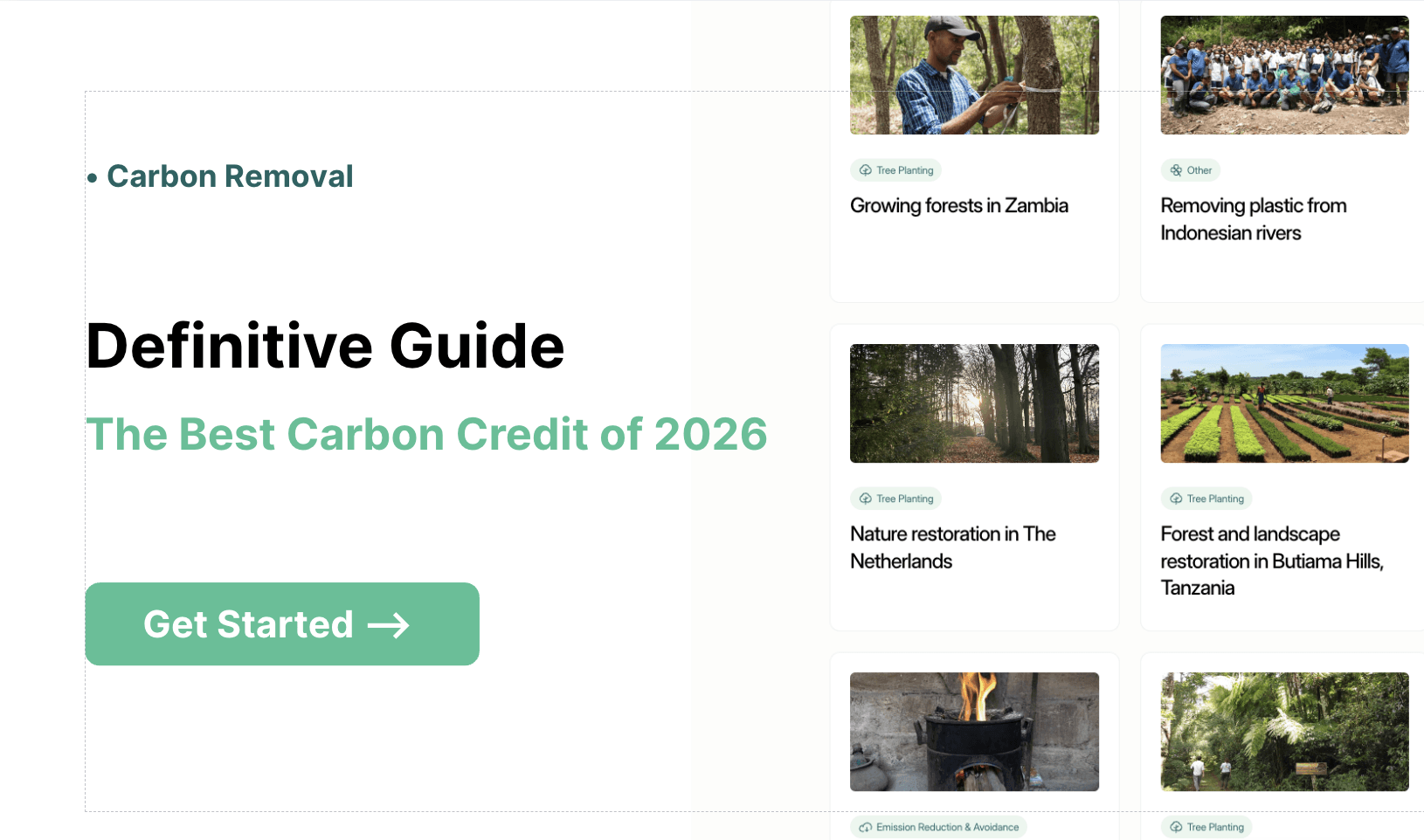
Explore our Guide: the best Carbon Credit Projects of 2026

Learn about the latest best practices, the best projects and strategic choices

The EU Empowering Consumers Directive (EmpCo)

From 27 September 2026, the EU Empowering Consumers Directive (Directive 2024/825) prohibits companies from claiming that a product has a neutral, reduced, or positive environmental impact based on carbon offsetting outside the product's own value chain. Claims like "climate neutral," "CO₂ neutral certified," or "climate net zero" are banned when based on offsetting.

Companies can still communicate about their investments in climate projects — but cannot present these as direct compensation for their emissions. Future-oriented claims ("carbon neutral by 2030") require a detailed, independently verified implementation plan.

Germany is already ahead: the Federal Court of Justice ruled in June 2024 that using "klimaneutral" in advertising without clear explanation of whether neutrality is achieved through reduction or compensation is misleading. The Deutsche Umwelthilfe has launched over 100 legal proceedings against misleading climate claims.

The combination of ICVCM, VCMI, and EmpCo means both the quality of your carbon credits and the process you use to procure them must be demonstrably sound — legally and reputationally. A tender is the instrument to achieve that.

The Tender Process in 8 Steps

Step 1: Map Your Starting Position

Don't start with suppliers — start with yourself. Map out:

  • Your offset footprint: How many tCO₂e do you want to address? Base this on your GHG Protocol-compliant footprint calculation (scope 1, 2, and where relevant, scope 3).

  • Your budget: What can you spend? Expect a wide price range — from €5–15/tCO₂e for standard emission reductions to €150–250+/tCO₂e for durable removals (DAC, biochar).

  • Your timeline: When do credits need to be delivered and retired? Avoid the Q4 rush — the entire market scrambles to meet year-end targets, and both pricing and availability suffer.

  • Your stakeholders: Involve sustainability, finance, procurement, and legal. At Regreener, we see that companies skipping this alignment phase inevitably face internal roadblocks later.

Step 2: Define Your Offsetting Philosophy

This is a strategic choice that carries through your entire tender. Ask yourself:

  • Reduction or removal? Do you accept only carbon removal credits (physical removal of CO₂ from the atmosphere), or also emission reduction credits (avoided emissions)? The Oxford Principles for Net Zero Aligned Carbon Offsetting recommend shifting toward removals over time, but a blended portfolio is realistic for most companies.

  • CCP requirement: Is CCP labelling a hard requirement or a preferred specification? Given VCMI requirements, CCP-Approved is the safest bet — but supply is still growing, so a mix of CCP-Approved and CCP-Eligible may be more pragmatic.

  • Sector alignment: Which project types align with your business and narrative? A logistics company investing in methane abatement tells a different story than a retailer choosing reforestation and cookstoves.

  • Contribution approach: Do you frame credits as "offsetting" or as "contribution to climate action"? The contribution approach aligns with VCMI and EU regulation, and protects against greenwashing risk.

Step 3: Define Your Quality Criteria

This is the core of your tender. Be as specific as possible — vague criteria lead to incomparable proposals.

Registry and standard. Which registries do you accept? Verra (VCS), Gold Standard, Plan Vivo, Puro.earth, ACR, Isometric? Do you require a specific quality label (CCP, CORSIA-eligible)?

Project type and methodology. Specify which project types you seek and which you exclude. Key categories: REDD+ (avoided deforestation), ARR (afforestation/reforestation), biochar (biomass pyrolysis), DAC (direct air capture), methane abatement (landfill gas, agriculture), cookstoves (improved efficiency), and soil carbon (agricultural soil sequestration).

Vintage. Specify maximum age. Best practice: 3–5 years maximum.

Additionality and permanence. Require suppliers to explicitly demonstrate how the project meets both criteria. This isn't a formality — it's the essence of credit quality.

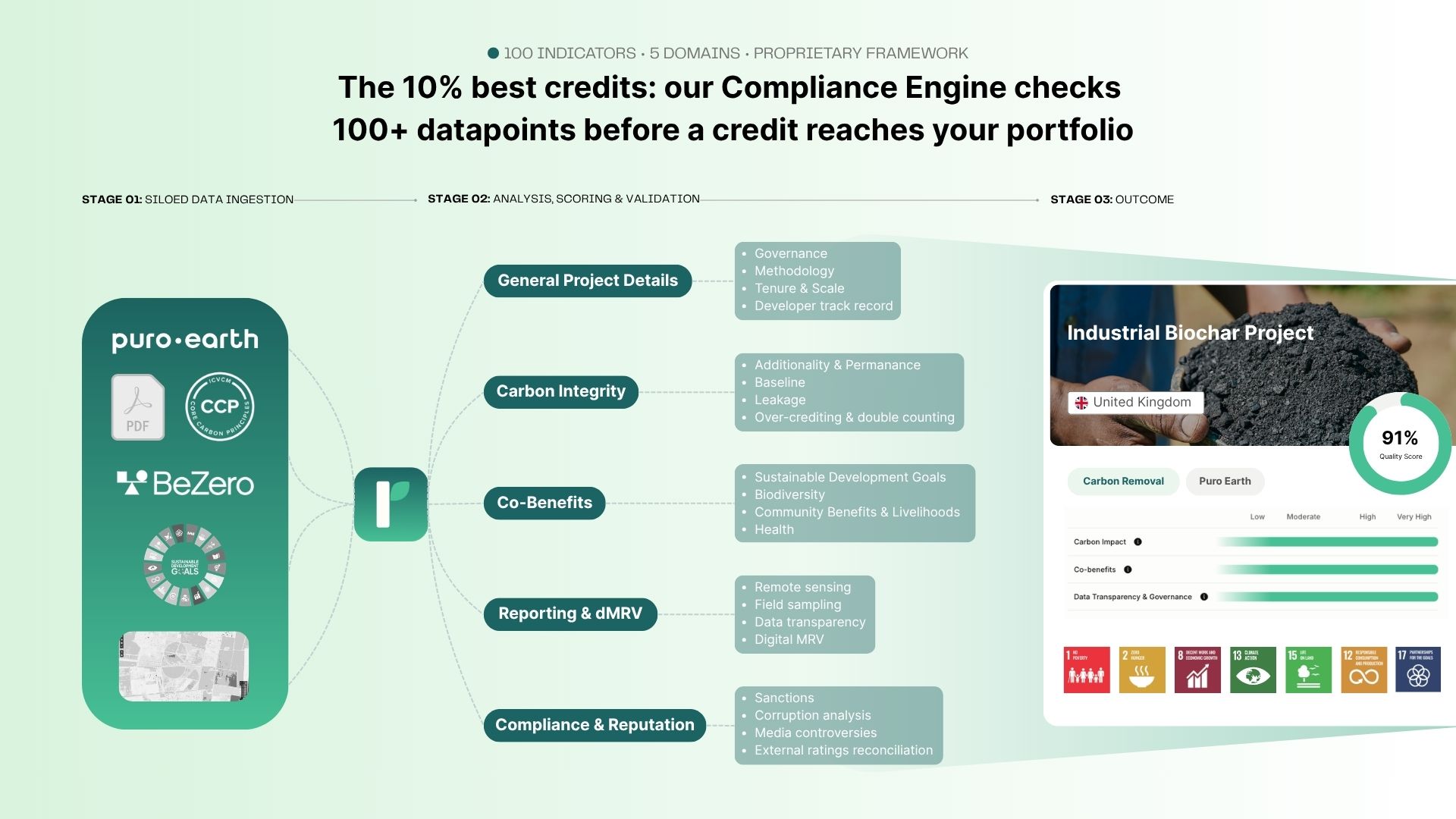
Independent ratings. Request BeZero, Sylvera, or Calyx Global ratings. These provide an independent, quantitative quality layer on top of registry certification. At Regreener, we use a proprietary quality framework covering 100+ data points across five domains (Project Details, Carbon Impact, Co-Benefits, Reporting & dMRV, Compliance & Reputation).

Co-benefits. Specify desired SDG contributions. This strengthens both your impact and your communications.

Delivery risk. Request information on buffer pools, insurance mechanisms, and guarantees against under-delivery.

Step 4: Draft Your RFP Document

An effective RFP is clear, concise, and complete. Three to eight pages is the sweet spot. Include:

  1. Company profile and objective. Who you are, why you're buying credits, and how they fit into your broader climate strategy.

  2. Volume and budget. Requested tCO₂e and a budget indication or range. Transparency about budget helps suppliers make realistic proposals.

  3. Quality criteria. All requirements from step 3, including knock-out criteria (hard requirements that a proposal must meet at minimum).

  4. Delivery terms. Desired delivery period, retirement method (by you or on your behalf), and requirements for retirement certificates.

  5. Scoring matrix. Your weighting factors, for example: quality/integrity 40%, price 25%, co-benefits 15%, delivery reliability 10%, reporting and transparency 10%.

  6. Process details. Submission deadline, Q&A round, evaluation period, expected award date, and contact details.

Step 5: Select and Approach Suppliers

Send your RFP to at least 3–5 suppliers for adequate comparison. Key supplier types:

  • Specialised carbon credit providers: Companies that source, vet, and resell credits, often with proprietary due diligence and portfolio management. Regreener is an example.

  • Project developers: Organisations that develop climate projects and generate credits themselves. You buy at source, but miss the breadth of a managed portfolio.

  • Brokers: Intermediaries that match supply and demand. Often focused on larger volumes and specific project types.

  • Marketplaces and platforms: Online platforms where you can search, compare, and buy credits. Advantage: price transparency. Disadvantage: you handle due diligence yourself.

Diversifying supplier types gives you the broadest market view.

Step 6: Evaluate the Proposals

Use a scoring matrix to compare proposals systematically. Score each supplier against your predefined criteria and document your findings. Key considerations:

  • Transparency test: Does the supplier share complete project documentation (PDDs, validation and verification reports)? Are independent ratings available? Can the supplier confirm the CCP status of every credit offered?

  • Price analysis: Compare not just the price per credit, but total cost — including transaction fees, retirement costs, and reporting charges.

  • Track record: How many credits has the supplier delivered previously? Are there known issues with past projects? Does the supplier have experience in your sector?

  • Reporting quality: What does the supplier provide for your CSRD compliance, annual report, or client communications? Think retirement certificates with company details, impact reports, and portfolio overviews.

Companies that fail to systematically document their procurement decisions face growing reputational and legal risk as EU regulation tightens and stakeholder expectations increase.

Step 7: Negotiate and Contract

After selecting your preferred supplier, negotiation begins. Key contract elements:

Pricing structure. Fixed price per credit, indexed to market prices, or tiered pricing for larger volumes? For multi-year contracts, you can negotiate price stability in exchange for volume commitments.

Delivery guarantees. What happens if the project delivers fewer credits than expected? Request buffer credits, a replacement clause, or the ability to substitute credits of comparable quality.

Retirement. Who retires the credits — you or the supplier on your behalf? Ensure you receive the retirement certificate with your company name, credit serial numbers, project ID, and retirement date.

Claims support. Does the supplier support you in framing your climate claims in line with the VCMI Claims Code and the EU EmpCo directive? This is increasingly valuable as regulation grows more complex.

Reporting and monitoring. What reports does the supplier deliver structurally? Think annual impact reports, project updates, rating changes, and portfolio reviews.

Step 8: Monitor, Evaluate, and Iterate

Carbon credit procurement is not a one-off transaction — it's a cyclical process.

Schedule an annual portfolio review. Are the projects still operational? Have new risks emerged (political, legal, methodological)? Have BeZero/Sylvera ratings remained stable? Have there been any CCP status changes?

At Regreener, we monitor projects continuously through our quality framework covering 100+ data points across five domains. Our clients receive proactive updates when ratings shift, methodologies change, or new risks surface. They always know where they stand — also after the purchase.

Use the insights from your annual evaluation to sharpen your quality criteria and supplier selection for the next round.

Common Mistakes to Avoid

Starting too late. A full tender process takes 6 to 12 weeks. Start well before your reporting deadline and avoid the Q4 rush when the entire market is buying.

Vague quality criteria. "We want quality credits" is not a usable criterion. Specify registries, project types, vintages, CCP status, and rating minimums.

Selecting on price alone. The cheapest credit is rarely the best. Low-cost credits more often carry risks around additionality, permanence, and reputation.

No scoring matrix. Without a structured evaluation, you're comparing apples to oranges — and you lack the audit trail you need.

No retirement certificate. Without a retirement certificate showing your company details, you cannot substantiate your claim. This is a hard requirement for CSRD reporting and VCMI claims.

Ignoring the contribution framing. Anyone still describing credits as "offsetting" in the sense of "climate neutral through compensation" faces legal risk under EmpCo from September 2026. Frame your credits as a contribution to climate action, alongside your own reductions.

Ready to Professionalise Your Carbon Credit Procurement?

A well-run tender saves money, protects your reputation, and delivers credits you can genuinely stand behind. But it doesn't have to be a solo effort. Regreener guides companies through the entire tender process — from drafting your quality criteria and RFP document to evaluating proposals and building a portfolio that meets ICVCM, VCMI, and CSRD requirements.

We know the market, the projects, and the pitfalls. Schedule a no-obligation call with one of our specialists and find out how we can strengthen your procurement.

One phone call to a provider, a few quotes chosen on gut feeling, and done. That's how most companies buy their first carbon credits. It works - until the CSRD auditor asks how you assessed quality. Or a journalist probes those low-quality REDD+ credits that just made headlines. Then the paper trail is missing, and so is the story.

A carbon credit tender is the answer. It's a structured procurement process that enforces transparency, comparability, and quality assurance. This guide covers the entire process: from the regulatory developments that make a tender essential, to the exact steps for running one successfully.

Quick Answer: A carbon credit tender (or Request for Proposal / RFP) is a structured procurement process in which a company invites multiple suppliers to submit proposals for the delivery of carbon credits, evaluated against quality criteria, pricing, and delivery terms.

The process typically consists of eight steps: establishing internal parameters (volume, budget, timeline), defining an offsetting philosophy (reduction versus removal, CCP requirements), setting quality criteria (registry, project type, vintage, additionality, independent ratings), drafting and distributing the RFP document, selecting suppliers, evaluating proposals using a scoring matrix, negotiating and contracting, and continuously monitoring and reviewing the portfolio.

A tender is recommended for volumes above 10,000 tCO₂e per year, annual spend exceeding €100,000, or when reporting obligations such as the CSRD or claims frameworks like the VCMI Claims Code require an auditable selection process.

When to Run a Tender - and When Not To

Not every procurement moment calls for a full tender process. Whether a formal RFP is the right approach depends on three factors: tonnage, spend, and applicable rules.

Tonnage. For purchases above 10,000 tCO₂e per year, a tender almost always pays off. You have enough scale for multiple suppliers to submit serious proposals, and quality differences between offerings become more material at higher volumes. For smaller purchases reaching out to vetted provider is usually more efficient.

Total spend. Regardless of tonnage, the total euro amount can justify a tender on its own. When your annual carbon credit budget exceeds €100,000, a structured procurement process becomes a matter of sound financial governance. At those amounts, finance and procurement teams typically expect a comparative selection process with documented justification — just as they would for any other purchase of similar scale.

Applicable rules and reporting obligations. For some companies, the trigger isn't volume or budget — it's the regulations that apply to their business. If your organisation falls under the CSRD, you need to substantiate your offsetting strategy with verifiable data and a transparent selection process. If you want to make a VCMI Carbon Integrity Claim, CCP-Approved credits are required — and documentation of your procurement process is part of the assurance framework.

If your company operates in sectors with CORSIA obligations (aviation), national compliance requirements, or strict internal ESG governance, a tender isn't a nice-to-have but an obligation. The same applies to companies planning public climate claims: under the EU Empowering Consumers Directive, you must be able to demonstrate that your procurement was conducted in a substantiated, independently verifiable manner.

The rule of thumb: as soon as any one of these three factors carries weight — high tonnage, substantial spend, or strict reporting and compliance requirements — a full tender pays for itself. If none of the three cross the threshold, an RFQ or direct procurement through a specialised provider will suffice.

Want to know which credits fit your company's climate strategy?

Book a free consultation Today

Key Terms Explained

Before we walk through the tender process, here's a reference for the most important terminology:

Carbon credit. A tradable certificate representing the reduction or removal of one tonne of CO₂ equivalent, issued by a recognised standard after independent verification.

Additionality. The principle that the emission reduction or removal would not have occurred without carbon credit financing. This is the most fundamental quality criterion in the voluntary carbon market.

Permanence. The assurance that stored or avoided CO₂ remains out of the atmosphere long-term. Forest-based projects are more vulnerable (fire, logging) than geological or mineralised storage.

Vintage. The year in which the emission reduction actually occurred. The market is shifting toward recent vintages — 3 to 5 years maximum.

Registry. The system where credits are issued, tracked, and retired. The major registries include Verra (VCS), Gold Standard, Plan Vivo, Puro.earth, ACR, Climate Action Reserve, and Isometric.

Retirement. Permanently removing a carbon credit from circulation, thereby claiming the emission reduction. A retired credit cannot be resold or transferred.

CCP label. The quality label from the ICVCM, awarded to credits that meet the ten Core Carbon Principles. Requires both a CCP-Eligible programme and a CCP-Approved methodology (the "two-tick" system).

VCMI Carbon Integrity Claim. A standardised, verifiable claim at Silver, Gold, or Platinum level, indicating that a company invests in high-quality carbon credits on top of its own emission reductions.

Contribution claim. The modern approach to carbon credits: not as "offsetting" of a company's own emissions, but as a contribution to global climate action beyond internal reductions. This framing aligns with VCMI guidance and EU regulation.

Co-benefits. Positive outcomes of a climate project beyond CO₂ reduction, such as biodiversity, clean water, local employment, or gender equality. Often linked to the UN Sustainable Development Goals (SDGs).

Emission Reduction Purchase Agreement (ERPA). A contract between a carbon credit buyer and a project developer for the delivery of credits as they are issued — a common structure for forward purchases.

Relevant Developments for Carbon Credit RFP's in 2026

The voluntary carbon market has fundamentally changed. Three developments make a professional procurement process no longer optional.

The ICVCM Core Carbon Principles (CCP)

The Integrity Council for the Voluntary Carbon Market (ICVCM) has established a global quality benchmark through its ten Core Carbon Principles — science-based standards covering additionality, permanence, quantification, and transparency. Credits meeting these principles receive a CCP label in registries like Verra and Gold Standard.

As of early 2026, approximately 105 million credits have been approved for the CCP label across 36+ methodologies. Eight carbon-crediting programmes are CCP-Eligible, including Verra (VCS), Gold Standard, ACR, Climate Action Reserve, and Isometric. The CCP uses a "two-tick" system: both the programme and the specific methodology must be approved before credits can carry the label.

Supply of CCP-labelled credits is expected to grow significantly through 2026 as major project types — including REDD+ (via VM0048), cookstoves (via VM0050), biochar, and sustainable agriculture — transition to new, CCP-approved methodologies. Verra issued its first CCP-labelled cookstove credits in February 2026.

For procurement teams, this means CCP is rapidly becoming the market's minimum quality standard. A tender allows you to hardcode CCP compliance into your requirements.

The VCMI Claims Code of Practice

The Voluntary Carbon Markets Integrity Initiative (VCMI) focuses on the demand side: how companies can credibly use carbon credits and communicate about them. Its Claims Code of Practice offers three tiers of Carbon Integrity Claims — Silver, Gold, and Platinum — recognising increasing levels of climate action beyond a company's own emission reductions.

Critically: from 1 January 2026, the VCMI requires companies making a claim to retire CCP-Approved credits. Together, ICVCM and VCMI form an "end-to-end" integrity framework — ICVCM guards supply-side quality, VCMI guards demand-side credibility.

A professional tender helps you procure credits that meet VCMI requirements, positioning your company to make a credible Carbon Integrity Claim.
a plane flying in the sky with the word go written in it

Explore our Guide: the best Carbon Credit Projects of 2026

Learn about the latest best practices, the best projects and strategic choices

The EU Empowering Consumers Directive (EmpCo)

From 27 September 2026, the EU Empowering Consumers Directive (Directive 2024/825) prohibits companies from claiming that a product has a neutral, reduced, or positive environmental impact based on carbon offsetting outside the product's own value chain. Claims like "climate neutral," "CO₂ neutral certified," or "climate net zero" are banned when based on offsetting.

Companies can still communicate about their investments in climate projects — but cannot present these as direct compensation for their emissions. Future-oriented claims ("carbon neutral by 2030") require a detailed, independently verified implementation plan.

Germany is already ahead: the Federal Court of Justice ruled in June 2024 that using "klimaneutral" in advertising without clear explanation of whether neutrality is achieved through reduction or compensation is misleading. The Deutsche Umwelthilfe has launched over 100 legal proceedings against misleading climate claims.

The combination of ICVCM, VCMI, and EmpCo means both the quality of your carbon credits and the process you use to procure them must be demonstrably sound — legally and reputationally. A tender is the instrument to achieve that.

The Tender Process in 8 Steps

Step 1: Map Your Starting Position

Don't start with suppliers — start with yourself. Map out:

  • Your offset footprint: How many tCO₂e do you want to address? Base this on your GHG Protocol-compliant footprint calculation (scope 1, 2, and where relevant, scope 3).

  • Your budget: What can you spend? Expect a wide price range — from €5–15/tCO₂e for standard emission reductions to €150–250+/tCO₂e for durable removals (DAC, biochar).

  • Your timeline: When do credits need to be delivered and retired? Avoid the Q4 rush — the entire market scrambles to meet year-end targets, and both pricing and availability suffer.

  • Your stakeholders: Involve sustainability, finance, procurement, and legal. At Regreener, we see that companies skipping this alignment phase inevitably face internal roadblocks later.

Step 2: Define Your Offsetting Philosophy

This is a strategic choice that carries through your entire tender. Ask yourself:

  • Reduction or removal? Do you accept only carbon removal credits (physical removal of CO₂ from the atmosphere), or also emission reduction credits (avoided emissions)? The Oxford Principles for Net Zero Aligned Carbon Offsetting recommend shifting toward removals over time, but a blended portfolio is realistic for most companies.

  • CCP requirement: Is CCP labelling a hard requirement or a preferred specification? Given VCMI requirements, CCP-Approved is the safest bet — but supply is still growing, so a mix of CCP-Approved and CCP-Eligible may be more pragmatic.

  • Sector alignment: Which project types align with your business and narrative? A logistics company investing in methane abatement tells a different story than a retailer choosing reforestation and cookstoves.

  • Contribution approach: Do you frame credits as "offsetting" or as "contribution to climate action"? The contribution approach aligns with VCMI and EU regulation, and protects against greenwashing risk.

Step 3: Define Your Quality Criteria

This is the core of your tender. Be as specific as possible — vague criteria lead to incomparable proposals.

Registry and standard. Which registries do you accept? Verra (VCS), Gold Standard, Plan Vivo, Puro.earth, ACR, Isometric? Do you require a specific quality label (CCP, CORSIA-eligible)?

Project type and methodology. Specify which project types you seek and which you exclude. Key categories: REDD+ (avoided deforestation), ARR (afforestation/reforestation), biochar (biomass pyrolysis), DAC (direct air capture), methane abatement (landfill gas, agriculture), cookstoves (improved efficiency), and soil carbon (agricultural soil sequestration).

Vintage. Specify maximum age. Best practice: 3–5 years maximum.

Additionality and permanence. Require suppliers to explicitly demonstrate how the project meets both criteria. This isn't a formality — it's the essence of credit quality.

Independent ratings. Request BeZero, Sylvera, or Calyx Global ratings. These provide an independent, quantitative quality layer on top of registry certification. At Regreener, we use a proprietary quality framework covering 100+ data points across five domains (Project Details, Carbon Impact, Co-Benefits, Reporting & dMRV, Compliance & Reputation).

Co-benefits. Specify desired SDG contributions. This strengthens both your impact and your communications.

Delivery risk. Request information on buffer pools, insurance mechanisms, and guarantees against under-delivery.
Step 4: Draft Your RFP Document

An effective RFP is clear, concise, and complete. Three to eight pages is the sweet spot. Include:

  1. Company profile and objective. Who you are, why you're buying credits, and how they fit into your broader climate strategy.

  2. Volume and budget. Requested tCO₂e and a budget indication or range. Transparency about budget helps suppliers make realistic proposals.

  3. Quality criteria. All requirements from step 3, including knock-out criteria (hard requirements that a proposal must meet at minimum).

  4. Delivery terms. Desired delivery period, retirement method (by you or on your behalf), and requirements for retirement certificates.

  5. Scoring matrix. Your weighting factors, for example: quality/integrity 40%, price 25%, co-benefits 15%, delivery reliability 10%, reporting and transparency 10%.

  6. Process details. Submission deadline, Q&A round, evaluation period, expected award date, and contact details.

Step 5: Select and Approach Suppliers

Send your RFP to at least 3–5 suppliers for adequate comparison. Key supplier types:

  • Specialised carbon credit providers: Companies that source, vet, and resell credits, often with proprietary due diligence and portfolio management. Regreener is an example.

  • Project developers: Organisations that develop climate projects and generate credits themselves. You buy at source, but miss the breadth of a managed portfolio.

  • Brokers: Intermediaries that match supply and demand. Often focused on larger volumes and specific project types.

  • Marketplaces and platforms: Online platforms where you can search, compare, and buy credits. Advantage: price transparency. Disadvantage: you handle due diligence yourself.

Diversifying supplier types gives you the broadest market view.

Step 6: Evaluate the Proposals

Use a scoring matrix to compare proposals systematically. Score each supplier against your predefined criteria and document your findings. Key considerations:

  • Transparency test: Does the supplier share complete project documentation (PDDs, validation and verification reports)? Are independent ratings available? Can the supplier confirm the CCP status of every credit offered?

  • Price analysis: Compare not just the price per credit, but total cost — including transaction fees, retirement costs, and reporting charges.

  • Track record: How many credits has the supplier delivered previously? Are there known issues with past projects? Does the supplier have experience in your sector?

  • Reporting quality: What does the supplier provide for your CSRD compliance, annual report, or client communications? Think retirement certificates with company details, impact reports, and portfolio overviews.

Companies that fail to systematically document their procurement decisions face growing reputational and legal risk as EU regulation tightens and stakeholder expectations increase.

Step 7: Negotiate and Contract

After selecting your preferred supplier, negotiation begins. Key contract elements:

Pricing structure. Fixed price per credit, indexed to market prices, or tiered pricing for larger volumes? For multi-year contracts, you can negotiate price stability in exchange for volume commitments.

Delivery guarantees. What happens if the project delivers fewer credits than expected? Request buffer credits, a replacement clause, or the ability to substitute credits of comparable quality.

Retirement. Who retires the credits — you or the supplier on your behalf? Ensure you receive the retirement certificate with your company name, credit serial numbers, project ID, and retirement date.

Claims support. Does the supplier support you in framing your climate claims in line with the VCMI Claims Code and the EU EmpCo directive? This is increasingly valuable as regulation grows more complex.

Reporting and monitoring. What reports does the supplier deliver structurally? Think annual impact reports, project updates, rating changes, and portfolio reviews.

Step 8: Monitor, Evaluate, and Iterate

Carbon credit procurement is not a one-off transaction — it's a cyclical process.

Schedule an annual portfolio review. Are the projects still operational? Have new risks emerged (political, legal, methodological)? Have BeZero/Sylvera ratings remained stable? Have there been any CCP status changes?

At Regreener, we monitor projects continuously through our quality framework covering 100+ data points across five domains. Our clients receive proactive updates when ratings shift, methodologies change, or new risks surface. They always know where they stand — also after the purchase.

Use the insights from your annual evaluation to sharpen your quality criteria and supplier selection for the next round.

Common Mistakes to Avoid

Starting too late. A full tender process takes 6 to 12 weeks. Start well before your reporting deadline and avoid the Q4 rush when the entire market is buying.

Vague quality criteria. "We want quality credits" is not a usable criterion. Specify registries, project types, vintages, CCP status, and rating minimums.

Selecting on price alone. The cheapest credit is rarely the best. Low-cost credits more often carry risks around additionality, permanence, and reputation.

No scoring matrix. Without a structured evaluation, you're comparing apples to oranges — and you lack the audit trail you need.

No retirement certificate. Without a retirement certificate showing your company details, you cannot substantiate your claim. This is a hard requirement for CSRD reporting and VCMI claims.

Ignoring the contribution framing. Anyone still describing credits as "offsetting" in the sense of "climate neutral through compensation" faces legal risk under EmpCo from September 2026. Frame your credits as a contribution to climate action, alongside your own reductions.

Ready to Professionalise Your Carbon Credit Procurement?

A well-run tender saves money, protects your reputation, and delivers credits you can genuinely stand behind. But it doesn't have to be a solo effort. Regreener guides companies through the entire tender process — from drafting your quality criteria and RFP document to evaluating proposals and building a portfolio that meets ICVCM, VCMI, and CSRD requirements.

We know the market, the projects, and the pitfalls. Schedule a no-obligation call with one of our specialists and find out how we can strengthen your procurement.


One phone call to a provider, a few quotes chosen on gut feeling, and done. That's how most companies buy their first carbon credits. It works - until the CSRD auditor asks how you assessed quality. Or a journalist probes those low-quality REDD+ credits that just made headlines. Then the paper trail is missing, and so is the story.

A carbon credit tender is the answer. It's a structured procurement process that enforces transparency, comparability, and quality assurance. This guide covers the entire process: from the regulatory developments that make a tender essential, to the exact steps for running one successfully.

Quick Answer: A carbon credit tender (or Request for Proposal / RFP) is a structured procurement process in which a company invites multiple suppliers to submit proposals for the delivery of carbon credits, evaluated against quality criteria, pricing, and delivery terms.

The process typically consists of eight steps: establishing internal parameters (volume, budget, timeline), defining an offsetting philosophy (reduction versus removal, CCP requirements), setting quality criteria (registry, project type, vintage, additionality, independent ratings), drafting and distributing the RFP document, selecting suppliers, evaluating proposals using a scoring matrix, negotiating and contracting, and continuously monitoring and reviewing the portfolio.

A tender is recommended for volumes above 10,000 tCO₂e per year, annual spend exceeding €100,000, or when reporting obligations such as the CSRD or claims frameworks like the VCMI Claims Code require an auditable selection process.

When to Run a Tender - and When Not To

Not every procurement moment calls for a full tender process. Whether a formal RFP is the right approach depends on three factors: tonnage, spend, and applicable rules.

Tonnage. For purchases above 10,000 tCO₂e per year, a tender almost always pays off. You have enough scale for multiple suppliers to submit serious proposals, and quality differences between offerings become more material at higher volumes. For smaller purchases reaching out to vetted provider is usually more efficient.

Total spend. Regardless of tonnage, the total euro amount can justify a tender on its own. When your annual carbon credit budget exceeds €100,000, a structured procurement process becomes a matter of sound financial governance. At those amounts, finance and procurement teams typically expect a comparative selection process with documented justification — just as they would for any other purchase of similar scale.

Applicable rules and reporting obligations. For some companies, the trigger isn't volume or budget — it's the regulations that apply to their business. If your organisation falls under the CSRD, you need to substantiate your offsetting strategy with verifiable data and a transparent selection process. If you want to make a VCMI Carbon Integrity Claim, CCP-Approved credits are required — and documentation of your procurement process is part of the assurance framework.

If your company operates in sectors with CORSIA obligations (aviation), national compliance requirements, or strict internal ESG governance, a tender isn't a nice-to-have but an obligation. The same applies to companies planning public climate claims: under the EU Empowering Consumers Directive, you must be able to demonstrate that your procurement was conducted in a substantiated, independently verifiable manner.

The rule of thumb: as soon as any one of these three factors carries weight — high tonnage, substantial spend, or strict reporting and compliance requirements — a full tender pays for itself. If none of the three cross the threshold, an RFQ or direct procurement through a specialised provider will suffice.

Want to know which credits fit your company's climate strategy?

Book a free consultation Today

Key Terms Explained

Before we walk through the tender process, here's a reference for the most important terminology:

Carbon credit. A tradable certificate representing the reduction or removal of one tonne of CO₂ equivalent, issued by a recognised standard after independent verification.

Additionality. The principle that the emission reduction or removal would not have occurred without carbon credit financing. This is the most fundamental quality criterion in the voluntary carbon market.

Permanence. The assurance that stored or avoided CO₂ remains out of the atmosphere long-term. Forest-based projects are more vulnerable (fire, logging) than geological or mineralised storage.

Vintage. The year in which the emission reduction actually occurred. The market is shifting toward recent vintages — 3 to 5 years maximum.

Registry. The system where credits are issued, tracked, and retired. The major registries include Verra (VCS), Gold Standard, Plan Vivo, Puro.earth, ACR, Climate Action Reserve, and Isometric.

Retirement. Permanently removing a carbon credit from circulation, thereby claiming the emission reduction. A retired credit cannot be resold or transferred.

CCP label. The quality label from the ICVCM, awarded to credits that meet the ten Core Carbon Principles. Requires both a CCP-Eligible programme and a CCP-Approved methodology (the "two-tick" system).

VCMI Carbon Integrity Claim. A standardised, verifiable claim at Silver, Gold, or Platinum level, indicating that a company invests in high-quality carbon credits on top of its own emission reductions.

Contribution claim. The modern approach to carbon credits: not as "offsetting" of a company's own emissions, but as a contribution to global climate action beyond internal reductions. This framing aligns with VCMI guidance and EU regulation.

Co-benefits. Positive outcomes of a climate project beyond CO₂ reduction, such as biodiversity, clean water, local employment, or gender equality. Often linked to the UN Sustainable Development Goals (SDGs).

Emission Reduction Purchase Agreement (ERPA). A contract between a carbon credit buyer and a project developer for the delivery of credits as they are issued — a common structure for forward purchases.

Relevant Developments for Carbon Credit RFP's in 2026

The voluntary carbon market has fundamentally changed. Three developments make a professional procurement process no longer optional.

The ICVCM Core Carbon Principles (CCP)

The Integrity Council for the Voluntary Carbon Market (ICVCM) has established a global quality benchmark through its ten Core Carbon Principles — science-based standards covering additionality, permanence, quantification, and transparency. Credits meeting these principles receive a CCP label in registries like Verra and Gold Standard.

As of early 2026, approximately 105 million credits have been approved for the CCP label across 36+ methodologies. Eight carbon-crediting programmes are CCP-Eligible, including Verra (VCS), Gold Standard, ACR, Climate Action Reserve, and Isometric. The CCP uses a "two-tick" system: both the programme and the specific methodology must be approved before credits can carry the label.

Supply of CCP-labelled credits is expected to grow significantly through 2026 as major project types — including REDD+ (via VM0048), cookstoves (via VM0050), biochar, and sustainable agriculture — transition to new, CCP-approved methodologies. Verra issued its first CCP-labelled cookstove credits in February 2026.

For procurement teams, this means CCP is rapidly becoming the market's minimum quality standard. A tender allows you to hardcode CCP compliance into your requirements.

The VCMI Claims Code of Practice

The Voluntary Carbon Markets Integrity Initiative (VCMI) focuses on the demand side: how companies can credibly use carbon credits and communicate about them. Its Claims Code of Practice offers three tiers of Carbon Integrity Claims — Silver, Gold, and Platinum — recognising increasing levels of climate action beyond a company's own emission reductions.

Critically: from 1 January 2026, the VCMI requires companies making a claim to retire CCP-Approved credits. Together, ICVCM and VCMI form an "end-to-end" integrity framework — ICVCM guards supply-side quality, VCMI guards demand-side credibility.

A professional tender helps you procure credits that meet VCMI requirements, positioning your company to make a credible Carbon Integrity Claim.

a plane flying in the sky with the word go written in it

Explore our Guide: the best Carbon Credit Projects of 2026

Learn about the latest best practices, the best projects and strategic choices

The EU Empowering Consumers Directive (EmpCo)

From 27 September 2026, the EU Empowering Consumers Directive (Directive 2024/825) prohibits companies from claiming that a product has a neutral, reduced, or positive environmental impact based on carbon offsetting outside the product's own value chain. Claims like "climate neutral," "CO₂ neutral certified," or "climate net zero" are banned when based on offsetting.

Companies can still communicate about their investments in climate projects — but cannot present these as direct compensation for their emissions. Future-oriented claims ("carbon neutral by 2030") require a detailed, independently verified implementation plan.

Germany is already ahead: the Federal Court of Justice ruled in June 2024 that using "klimaneutral" in advertising without clear explanation of whether neutrality is achieved through reduction or compensation is misleading. The Deutsche Umwelthilfe has launched over 100 legal proceedings against misleading climate claims.

The combination of ICVCM, VCMI, and EmpCo means both the quality of your carbon credits and the process you use to procure them must be demonstrably sound — legally and reputationally. A tender is the instrument to achieve that.

The Tender Process in 8 Steps

Step 1: Map Your Starting Position

Don't start with suppliers — start with yourself. Map out:

  • Your offset footprint: How many tCO₂e do you want to address? Base this on your GHG Protocol-compliant footprint calculation (scope 1, 2, and where relevant, scope 3).

  • Your budget: What can you spend? Expect a wide price range — from €5–15/tCO₂e for standard emission reductions to €150–250+/tCO₂e for durable removals (DAC, biochar).

  • Your timeline: When do credits need to be delivered and retired? Avoid the Q4 rush — the entire market scrambles to meet year-end targets, and both pricing and availability suffer.

  • Your stakeholders: Involve sustainability, finance, procurement, and legal. At Regreener, we see that companies skipping this alignment phase inevitably face internal roadblocks later.

Step 2: Define Your Offsetting Philosophy

This is a strategic choice that carries through your entire tender. Ask yourself:

  • Reduction or removal? Do you accept only carbon removal credits (physical removal of CO₂ from the atmosphere), or also emission reduction credits (avoided emissions)? The Oxford Principles for Net Zero Aligned Carbon Offsetting recommend shifting toward removals over time, but a blended portfolio is realistic for most companies.

  • CCP requirement: Is CCP labelling a hard requirement or a preferred specification? Given VCMI requirements, CCP-Approved is the safest bet — but supply is still growing, so a mix of CCP-Approved and CCP-Eligible may be more pragmatic.

  • Sector alignment: Which project types align with your business and narrative? A logistics company investing in methane abatement tells a different story than a retailer choosing reforestation and cookstoves.

  • Contribution approach: Do you frame credits as "offsetting" or as "contribution to climate action"? The contribution approach aligns with VCMI and EU regulation, and protects against greenwashing risk.

Step 3: Define Your Quality Criteria

This is the core of your tender. Be as specific as possible — vague criteria lead to incomparable proposals.

Registry and standard. Which registries do you accept? Verra (VCS), Gold Standard, Plan Vivo, Puro.earth, ACR, Isometric? Do you require a specific quality label (CCP, CORSIA-eligible)?

Project type and methodology. Specify which project types you seek and which you exclude. Key categories: REDD+ (avoided deforestation), ARR (afforestation/reforestation), biochar (biomass pyrolysis), DAC (direct air capture), methane abatement (landfill gas, agriculture), cookstoves (improved efficiency), and soil carbon (agricultural soil sequestration).

Vintage. Specify maximum age. Best practice: 3–5 years maximum.

Additionality and permanence. Require suppliers to explicitly demonstrate how the project meets both criteria. This isn't a formality — it's the essence of credit quality.

Independent ratings. Request BeZero, Sylvera, or Calyx Global ratings. These provide an independent, quantitative quality layer on top of registry certification. At Regreener, we use a proprietary quality framework covering 100+ data points across five domains (Project Details, Carbon Impact, Co-Benefits, Reporting & dMRV, Compliance & Reputation).

Co-benefits. Specify desired SDG contributions. This strengthens both your impact and your communications.

Delivery risk. Request information on buffer pools, insurance mechanisms, and guarantees against under-delivery.

Step 4: Draft Your RFP Document

An effective RFP is clear, concise, and complete. Three to eight pages is the sweet spot. Include:

  1. Company profile and objective. Who you are, why you're buying credits, and how they fit into your broader climate strategy.

  2. Volume and budget. Requested tCO₂e and a budget indication or range. Transparency about budget helps suppliers make realistic proposals.

  3. Quality criteria. All requirements from step 3, including knock-out criteria (hard requirements that a proposal must meet at minimum).

  4. Delivery terms. Desired delivery period, retirement method (by you or on your behalf), and requirements for retirement certificates.

  5. Scoring matrix. Your weighting factors, for example: quality/integrity 40%, price 25%, co-benefits 15%, delivery reliability 10%, reporting and transparency 10%.

  6. Process details. Submission deadline, Q&A round, evaluation period, expected award date, and contact details.

Step 5: Select and Approach Suppliers

Send your RFP to at least 3–5 suppliers for adequate comparison. Key supplier types:

  • Specialised carbon credit providers: Companies that source, vet, and resell credits, often with proprietary due diligence and portfolio management. Regreener is an example.

  • Project developers: Organisations that develop climate projects and generate credits themselves. You buy at source, but miss the breadth of a managed portfolio.

  • Brokers: Intermediaries that match supply and demand. Often focused on larger volumes and specific project types.

  • Marketplaces and platforms: Online platforms where you can search, compare, and buy credits. Advantage: price transparency. Disadvantage: you handle due diligence yourself.

Diversifying supplier types gives you the broadest market view.

Step 6: Evaluate the Proposals

Use a scoring matrix to compare proposals systematically. Score each supplier against your predefined criteria and document your findings. Key considerations:

  • Transparency test: Does the supplier share complete project documentation (PDDs, validation and verification reports)? Are independent ratings available? Can the supplier confirm the CCP status of every credit offered?

  • Price analysis: Compare not just the price per credit, but total cost — including transaction fees, retirement costs, and reporting charges.

  • Track record: How many credits has the supplier delivered previously? Are there known issues with past projects? Does the supplier have experience in your sector?

  • Reporting quality: What does the supplier provide for your CSRD compliance, annual report, or client communications? Think retirement certificates with company details, impact reports, and portfolio overviews.

Companies that fail to systematically document their procurement decisions face growing reputational and legal risk as EU regulation tightens and stakeholder expectations increase.

Step 7: Negotiate and Contract

After selecting your preferred supplier, negotiation begins. Key contract elements:

Pricing structure. Fixed price per credit, indexed to market prices, or tiered pricing for larger volumes? For multi-year contracts, you can negotiate price stability in exchange for volume commitments.

Delivery guarantees. What happens if the project delivers fewer credits than expected? Request buffer credits, a replacement clause, or the ability to substitute credits of comparable quality.

Retirement. Who retires the credits — you or the supplier on your behalf? Ensure you receive the retirement certificate with your company name, credit serial numbers, project ID, and retirement date.

Claims support. Does the supplier support you in framing your climate claims in line with the VCMI Claims Code and the EU EmpCo directive? This is increasingly valuable as regulation grows more complex.

Reporting and monitoring. What reports does the supplier deliver structurally? Think annual impact reports, project updates, rating changes, and portfolio reviews.

Step 8: Monitor, Evaluate, and Iterate

Carbon credit procurement is not a one-off transaction — it's a cyclical process.

Schedule an annual portfolio review. Are the projects still operational? Have new risks emerged (political, legal, methodological)? Have BeZero/Sylvera ratings remained stable? Have there been any CCP status changes?

At Regreener, we monitor projects continuously through our quality framework covering 100+ data points across five domains. Our clients receive proactive updates when ratings shift, methodologies change, or new risks surface. They always know where they stand — also after the purchase.

Use the insights from your annual evaluation to sharpen your quality criteria and supplier selection for the next round.

Common Mistakes to Avoid

Starting too late. A full tender process takes 6 to 12 weeks. Start well before your reporting deadline and avoid the Q4 rush when the entire market is buying.

Vague quality criteria. "We want quality credits" is not a usable criterion. Specify registries, project types, vintages, CCP status, and rating minimums.

Selecting on price alone. The cheapest credit is rarely the best. Low-cost credits more often carry risks around additionality, permanence, and reputation.

No scoring matrix. Without a structured evaluation, you're comparing apples to oranges — and you lack the audit trail you need.

No retirement certificate. Without a retirement certificate showing your company details, you cannot substantiate your claim. This is a hard requirement for CSRD reporting and VCMI claims.

Ignoring the contribution framing. Anyone still describing credits as "offsetting" in the sense of "climate neutral through compensation" faces legal risk under EmpCo from September 2026. Frame your credits as a contribution to climate action, alongside your own reductions.

Ready to Professionalise Your Carbon Credit Procurement?

A well-run tender saves money, protects your reputation, and delivers credits you can genuinely stand behind. But it doesn't have to be a solo effort. Regreener guides companies through the entire tender process — from drafting your quality criteria and RFP document to evaluating proposals and building a portfolio that meets ICVCM, VCMI, and CSRD requirements.

We know the market, the projects, and the pitfalls. Schedule a no-obligation call with one of our specialists and find out how we can strengthen your procurement.

About the Author

bernard de wit of regreener
Bernard de Wit

Bernard is the Founder of Regreener, starting in 2020 after studying Law in Leiden (the Netherlands) and Oxford (United Kingdom). Passionate about climate action, sustainability, and carbon credit markets, he helps companies take trustworthy, impactful climate action by sharing insights and best practices. When he’s not writing or advising businesses on their sustainability goals, you might find Bernard on the tennis court or catching up with friends.

TABLE OF CONTENTS

Share Article

FAQs

What is a carbon credit tender?

A carbon credit tender is a structured procurement process where you invite suppliers to submit proposals for carbon credit delivery, evaluated against predefined quality criteria, pricing, and delivery terms. It's the professional approach to purchasing credits and ensures a defensible, documented selection process.

How long does a carbon credit tender process take?

A full tender process — from internal preparation to contract signing — typically takes 6 to 12 weeks. The timeline depends on your internal decision-making, the number of suppliers, and the complexity of your quality requirements.

Should I require CCP-labelled credits?

For companies planning to make a VCMI Carbon Integrity Claim, CCP-Approved has been the standard since 1 January 2026. Even without a VCMI claim, CCP is a strong quality baseline increasingly seen as the market standard. Pragmatic advice: set CCP-Approved as a preference, accept CCP-Eligible (programme approved, methodology under assessment) as an interim step, and require written justification for any non-CCP credits.

Can I still claim "carbon neutral" based on carbon credits?

From 27 September 2026, this is prohibited in the EU under the Empowering Consumers Directive when the claim is based on offsetting outside your own value chain. You may still communicate about your investment in climate projects — but not as direct compensation for your emissions. Use the contribution approach: "We finance climate projects on top of our own emission reductions."

From what volume does a tender make sense?

A formal tender is typically worthwhile from 10,000 tCO₂e per year, or when you need a defensible selection process for CSRD reporting, stakeholders, or your board. For smaller volumes, an RFQ or direct procurement through a specialised provider may suffice.

What is the average price of a carbon credit in 2026?

Prices vary drastically based on the project type. While older renewable energy credits can still be found for under €5, high-integrity nature-based solutions typically range between €15 and €30 per ton. Engineered removals like Biochar and DAC command premiums ranging from €100 to over €400 per ton due to their high durability and scarcity.

Greenwashing-proof carbon removal

Get a free consultation with Regreener's carbon removal experts